Lines And Angles — Practice Quiz
NIOS · Class 10 · Maths
Try a 4-question quiz on Lines And Angles for NIOS Class 10 Maths: tap an answer to check it and see why. 37 questions in the full chapter test.
Interactive on Super Tutor
Studying Lines And Angles? Get the full interactive chapter.
Quizzes, flashcards, AI doubt-solver and a step-by-step study plan — built for practice quiz and more.
Free trial, no card needed.
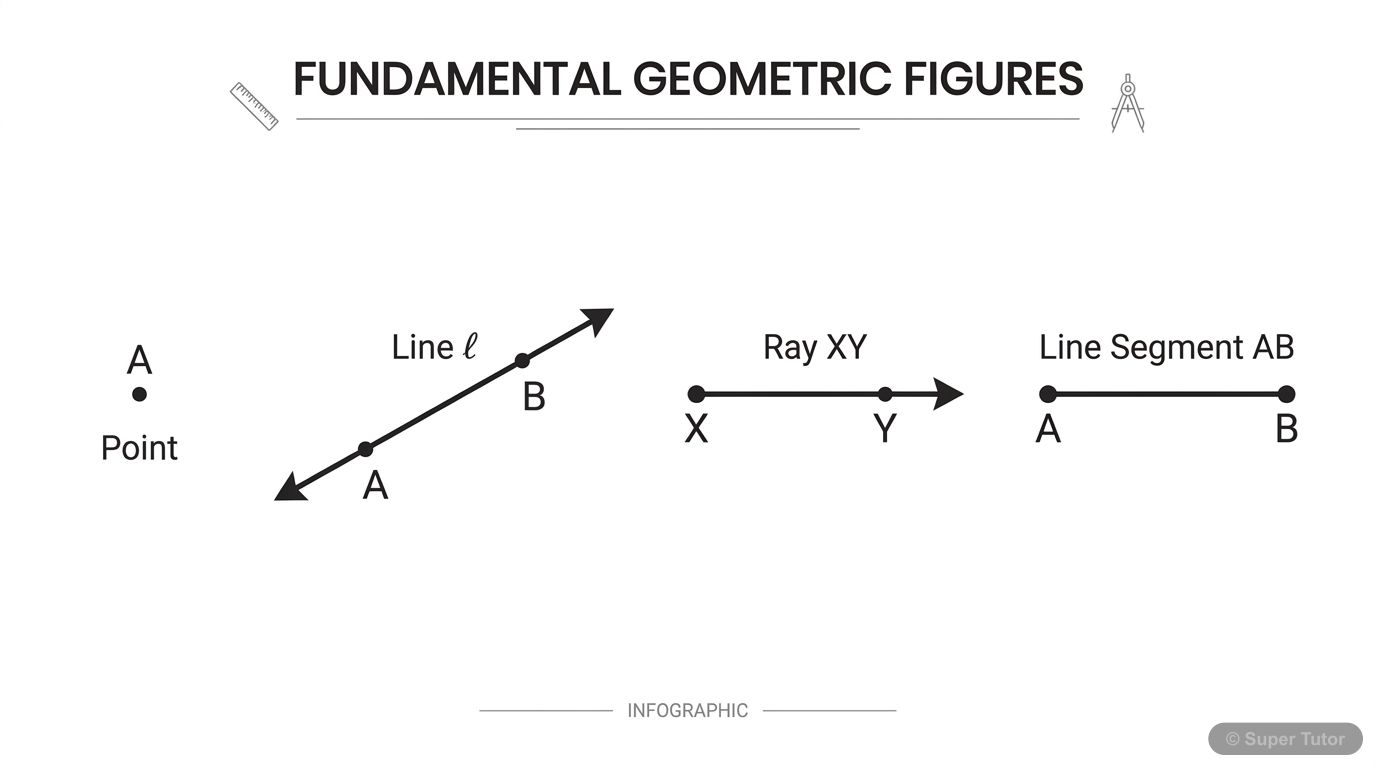
One of 17 illustrations for Lines And Angles in Super Tutor — alongside flashcards, concept maps and practice questions.
Quick Quiz: Lines And Angles
0/4Tap an answer to check it instantly. No sign-up needed for these 4.
In the figure, two parallel lines are cut by a transversal. If one of the corresponding angles measures 65°, what is the measure of its corresponding angle?
Two complementary angles are in the ratio 2:3. Find the measure of the smaller angle.
In triangle ABC, if ∠A = 60° and ∠B = 70°, what is the measure of ∠C?
When two lines intersect, they form four angles. If one angle measures 115°, what is the measure of its vertically opposite angle?
Sample Questions
Two supplementary angles are in the ratio 4:5. Find the measure of the larger angle.
Show answer
100°
Step 1: Let the angles be 4x and 5x since they are in ratio 4:5. Step 2: Since they are supplementary, their sum equals 180°: 4x + 5x = 180°. Step 3: Simplify: 9x = 180°, so x = 20°. Step 4: The larger angle = 5x = 5(20°) = 100°. Step 5: Verify: 80° + 100° = 180° ✓
In triangle PQR, the exterior angle at vertex Q measures 120°. If ∠P = 50°, find ∠R.
Show answer
70°
Step 1: Use the exterior angle theorem - an exterior angle equals the sum of the two non-adjacent interior angles. Step 2: The exterior angle at Q = ∠P + ∠R. Step 3: Substitute: 120° = 50° + ∠R. Step 4: Solve: ∠R = 120° - 50° = 70°. Step 5: Verify using angle sum: ∠P + ∠Q + ∠R = 50° + 60° + 70° = 180° ✓
Two parallel lines are cut by a transversal. If one interior angle on the same side measures 75°, what is the measure of the other interior angle on the same side?
Show answer
105°
Step 1: Identify that we have co-interior angles (interior angles on the same side of the transversal). Step 2: Recall the property that co-interior angles are supplementary when lines are parallel. Step 3: Set up equation: 75° + other angle = 180°. Step 4: Solve: other angle = 180° - 75° = 105°. Step 5: This confirms the co-interior angle property.
In an isosceles triangle ABC where AB = AC, if the vertex angle ∠A = 40°, find each base angle.
Show answer
70°
Step 1: In isosceles triangle ABC with AB = AC, the base angles ∠B and ∠C are equal. Step 2: Apply angle sum property: ∠A + ∠B + ∠C = 180°. Step 3: Since ∠B = ∠C, we have: 40° + ∠B + ∠B = 180°. Step 4: Simplify: 40° + 2∠B = 180°. Step 5: Solve: 2∠B = 140°, so ∠B = 70°. Therefore, each base angle is 70°.
+33 more questions on Lines And Angles (NIOS Class 10 Maths)
Practise AllFrequently Asked Questions
What are the important topics in Lines And Angles for NIOS Class 10 Maths?
How many practice questions are there for Lines And Angles?
Sources & Official References
Content is aligned to the official syllabus. Refer to the board website for the latest curriculum.
More resources for Lines And Angles
Important Questions
Exam-style questions with answers
Revision Notes
Key points for last-minute revision
Formula Sheet
The chapter's formulas in one place
Chapter Summary
Understand the chapter at a glance
Concept Maps
See how topics connect
Study Plan
Step-by-step plan for this chapter
Flashcards
Quick-fire cards for active recall
Syllabus
What topics to cover
For serious students
Get the full Lines And Angles chapter — start free.
Quizzes, flashcards, an AI doubt solver and a study plan for NIOS Class 10 Maths. Free to start, no card needed.