Percentage And Its Applications — Practice Quiz
NIOS · Class 10 · Maths
Try a 4-question quiz on Percentage And Its Applications for NIOS Class 10 Maths: tap an answer to check it and see why.
Interactive on Super Tutor
Studying Percentage And Its Applications? Get the full interactive chapter.
Quizzes, flashcards, AI doubt-solver and a step-by-step study plan — built for practice quiz and more.
Free trial, no card needed.
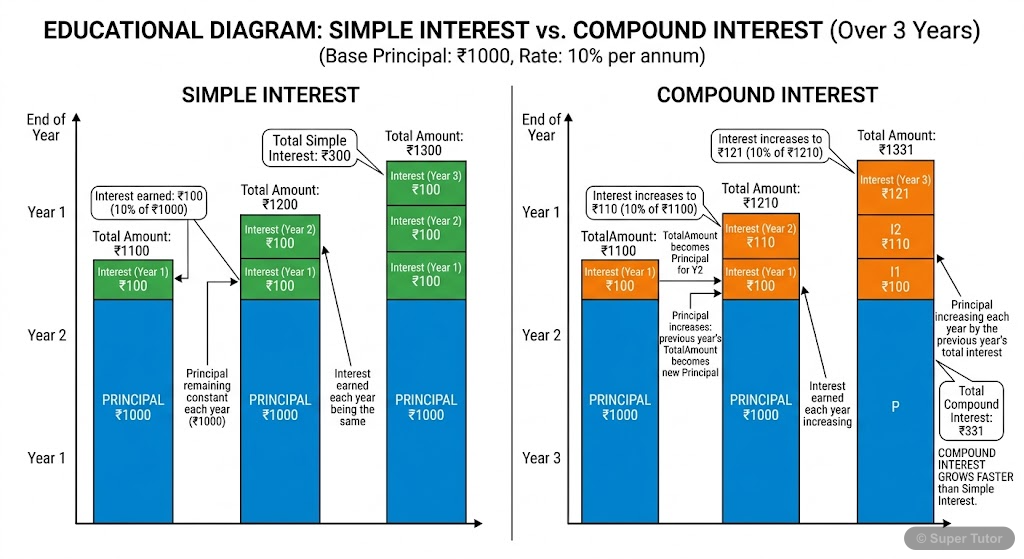
One of 8 illustrations for Percentage And Its Applications in Super Tutor — alongside flashcards, concept maps and practice questions.
Quick Quiz: Percentage And Its Applications
0/4Tap an answer to check it instantly. No sign-up needed for these 4.
What percent of 250 is 75?
A shopkeeper buys an article for ₹800 and sells it for ₹960. What is the profit percent?
A shirt marked at ₹600 is sold at a discount of 15%. Find the selling price.
Find the simple interest on ₹5000 for 3 years at 8% per annum.
Sample Questions
A sum of ₹10000 becomes ₹12100 in 2 years at compound interest. What is the rate of interest?
Show answer
10%
Step 1: Given P = ₹10000, A = ₹12100, T = 2 years. We need to find R. Step 2: Use the compound interest formula: A = P(1 + R/100)². Step 3: Substitute values: 12100 = 10000(1 + R/100)². Step 4: Simplify: (1 + R/100)² = 12100/10000 = 1.21 = (1.1)². Step 5: Therefore, 1 + R/100 = 1.1, which gives R = 10%.
The population of a town increases from 50000 to 52000. Find the percent increase.
Show answer
4%
Step 1: Initial population = 50000, Final population = 52000. Step 2: Calculate increase: Increase = 52000 - 50000 = 2000. Step 3: Use percent increase formula: Percent increase = (Increase/Original value) × 100. Step 4: Substitute values: Percent increase = (2000/50000) × 100 = 4%. Step 5: Therefore, the population increased by 4%.
A man saves 20% of his income. If his savings are ₹4000, what is his income?
Show answer
₹20000
Step 1: Let income = x. Given: 20% of income = ₹4000. Step 2: Write the equation: (20/100) × x = 4000. Step 3: Simplify: 0.20x = 4000. Step 4: Solve for x: x = 4000/0.20 = 20000. Step 5: Therefore, his income is ₹20000. Verification: 20% of 20000 = 4000 ✓
A machine worth ₹100000 depreciates at 10% per annum. What will be its value after 2 years?
Show answer
₹81000
Step 1: Initial value = ₹100000, depreciation rate = 10% per annum, time = 2 years. Step 2: Use depreciation formula: Final value = Initial value × (1 - rate/100)ⁿ. Step 3: Substitute values: Final value = 100000 × (1 - 10/100)². Step 4: Calculate: Final value = 100000 × (0.9)² = 100000 × 0.81 = ₹81000. Step 5: Therefore, the value after 2 years is ₹81000.
+39 more questions on Percentage And Its Applications (NIOS Class 10 Maths)
Practise AllFrequently Asked Questions
What are the important topics in Percentage And Its Applications for NIOS Class 10 Maths?
How many practice questions are there for Percentage And Its Applications?
Sources & Official References
Content is aligned to the official syllabus. Refer to the board website for the latest curriculum.
More resources for Percentage And Its Applications
Important Questions
Exam-style questions with answers
Revision Notes
Key points for last-minute revision
Formula Sheet
The chapter's formulas in one place
Chapter Summary
Understand the chapter at a glance
Concept Maps
See how topics connect
Study Plan
Step-by-step plan for this chapter
Flashcards
Quick-fire cards for active recall
Syllabus
What topics to cover
For serious students
Get the full Percentage And Its Applications chapter — start free.
Quizzes, flashcards, an AI doubt solver and a study plan for NIOS Class 10 Maths. Free to start, no card needed.