Tissues And Other Levels Of Organization — Important Questions
NIOS · Class 12 · Biology
45 important questions from Tissues And Other Levels Of Organization for NIOS Class 12 Biology, with answers. Includes multiple choice questions.
Interactive on Super Tutor
Studying Tissues And Other Levels Of Organization? Get the full interactive chapter.
Quizzes, flashcards, AI doubt-solver and a step-by-step study plan — built for important questions and more.
Free trial, no card needed.
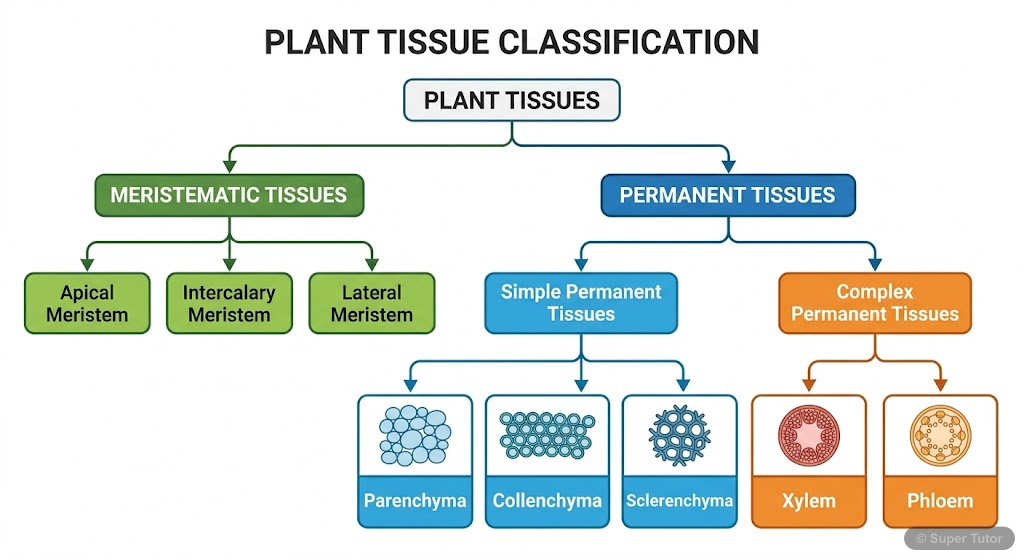
Learn better with visuals Super Tutor pairs illustrations like this with notes and quizzes for Tissues And Other Levels Of Organization.
Important Questions from Tissues And Other Levels Of Organization
Sieve tubes in phloem are described as living cells, yet they lack a nucleus at maturity. Which component of phloem compensates for this and helps in the metabolic activities of the sieve tube?
Show answer
Companion Cell
Step 1: Phloem is made of four components – Sieve tube elements, Companion cells, Phloem fibres, and Phloem parenchyma. Step 2: Sieve tubes are elongated living cells with perforated end walls (sieve plates). Importantly, they lose their nucleus at maturity, which means they cannot independently carry out metabolic activities. Step 3: Companion cells are long rectangular living cells that are closely associated with sieve tube elements. They retain their nucleus and are metabolically very active. Step 4: Companion cells are believed to control the activities of the associated enucleate sieve t
In stratified squamous epithelium, why is this tissue found specifically in areas of heavy wear and tear such as the skin and inner lining of the cheeks?
Show answer
Because being arranged in multiple layers, upper layers can be worn away while lower layers regenerate and replace them.
Step 1: Simple epithelium has cells in a single layer and is found where absorption and filtration are primary functions. Step 2: Stratified (compound) epithelium has cells arranged in multiple layers. This structural arrangement is specifically suited for protection. Step 3: In areas of heavy wear and tear like skin and the inner lining of the cheeks, the outermost cells get continuously abraded and worn away. The multiple layers allow this loss without exposing underlying tissue, as lower layers continuously divide to replace the lost cells. Step 4: Option A describes ciliated epithelium fun
In areolar connective tissue, which specific cell type secretes heparin, a substance that plays a role in blood clotting?
Show answer
Mast cells
Step 1: Areolar tissue is the most widely distributed connective tissue in the body. It has several types of cells embedded in its matrix. Step 2: Fibroblasts are cells in areolar tissue that produce the matrix fibres – yellow (elastin) fibres and white (collagen) fibres. Step 3: Macrophages (also called histiocytes) are phagocytic cells in areolar tissue that engulf bacteria and foreign micropathogens, providing defense. Step 4: Mast cells are specialised cells in areolar tissue that secrete heparin. Heparin is an anticoagulant that helps in blood clotting regulation. This is the correct answ
What is the Haversian canal in compact bone, and what is its significance?
Show answer
It is the central canal around which concentric rings (lamellae) of bone matrix are arranged, carrying blood vessels and nerves to nourish the bone cells.
Step 1: Compact bone has a highly organised structure. The matrix is arranged in concentric rings called lamellae, and these rings surround a central canal. Step 2: This central canal in compact bone is called the Haversian canal. Osteocytes (bone cells) are located on the lamellae and send out branched processes that connect adjacent cells. Step 3: The Haversian canal runs longitudinally through compact bone and carries blood vessels and nerves, thus providing nourishment to the deeply embedded osteocytes. Step 4: Option A describes the medullary cavity of long bones which contains bone marro
+41 more questions on Tissues And Other Levels Of Organization (NIOS Class 12 Biology)
Practise AllFrequently Asked Questions
What are the important topics in Tissues And Other Levels Of Organization for NIOS Class 12 Biology?
How many important questions are there in Tissues And Other Levels Of Organization?
Sources & Official References
Content is aligned to the official syllabus. Refer to the board website for the latest curriculum.
More resources for Tissues And Other Levels Of Organization
For serious students
Get the full Tissues And Other Levels Of Organization chapter — start free.
Quizzes, flashcards, an AI doubt solver and a study plan for NIOS Class 12 Biology. Free to start, no card needed.