The Kingdoms Monera, Protoctista And Fungi — Important Questions
NIOS · Class 12 · Biology
45 important questions from The Kingdoms Monera, Protoctista And Fungi for NIOS Class 12 Biology, with answers. Includes multiple choice questions.
Interactive on Super Tutor
Studying The Kingdoms Monera, Protoctista And Fungi? Get the full interactive chapter.
Quizzes, flashcards, AI doubt-solver and a step-by-step study plan — built for important questions and more.
Free trial, no card needed.
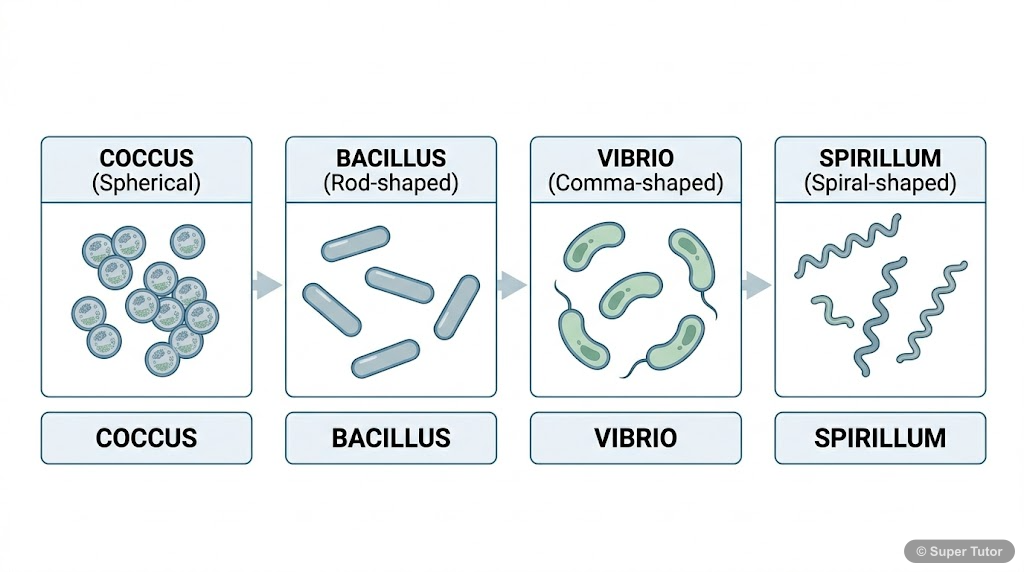
One of 5 illustrations for The Kingdoms Monera, Protoctista And Fungi in Super Tutor — alongside flashcards, concept maps and practice questions.
Important Questions from The Kingdoms Monera, Protoctista And Fungi
A student observes that certain bacteria thrive in hot springs with highly acidic conditions and low oxygen levels. These bacteria most likely belong to which group of Archaebacteria?
Show answer
Thermoacidophilic bacteria, which live in hot springs with acidic and low-oxygen conditions
Step 1: Archaebacteria are a group within Kingdom Monera that live in unusual environments with very low oxygen levels. They are classified into three main types based on their habitat. Step 2: Thermoacidophilic bacteria (thermo = heat; acidophilic = acid-loving) live specifically in hot springs — environments that are both hot and acidic. This perfectly matches the description in the question. Step 3: Methanogenic bacteria live in sewage and intestinal tracts of animals (anaerobic environments) and produce methane — not relevant here. Step 4: Halophilic bacteria (halo = salt) live in extremel
Euglena is described as a 'connecting link' between plants and animals. Which combination of features BEST justifies this description?
Show answer
It contains chloroplasts for autotrophic nutrition in light (plant-like) but can also absorb organic matter heterotrophically in dark (animal-like), and moves with a flagellum
Step 1: A 'connecting link' is an organism that shows characteristics of two different groups, bridging the gap between them. Step 2: Euglena has chloroplasts containing chlorophyll — in sunlight, it photosynthesizes its own food just like a plant (autotrophic). This is the plant-like feature. Step 3: When kept in the dark for extended periods, Euglena loses its chlorophyll and begins feeding on dissolved organic matter heterotrophically — an animal-like behavior. Step 4: Euglena also has a flagellum for active movement and a stigma (eyespot) sensitive to light — these are animal-like features
In the life cycle of Plasmodium, malaria is caused when the parasite undergoes its asexual phase in the human body. Which specific event in the human body directly causes the characteristic fever and chills of malaria?
Show answer
The rupture of red blood cells (RBCs) releasing merozoites and toxic substances into the bloodstream
Step 1: Plasmodium has two hosts — the female Anopheles mosquito (sexual phase) and the human body (asexual phase). Step 2: When infected mosquito bites, sporozoites enter the human bloodstream, travel to the liver, multiply, and then enter RBCs (red blood cells). Step 3: Inside RBCs, Plasmodium multiplies asexually forming many merozoites. At regular intervals (every 48 or 72 hours), the RBCs rupture and release merozoites along with toxic waste products (haemozoin pigment) into the blood. Step 4: This synchronized rupture of thousands of RBCs simultaneously releases toxins, which trigger the
Diatoms are described as unique among protoctists due to the composition of their cell walls. Why are diatom deposits (diatomaceous earth) commercially and industrially important?
Show answer
Their siliceous (silica-containing) shells are preserved as fossils, and diatomaceous earth is used as filters and for lining furnaces
Step 1: Diatoms are unique protoctists because their cell walls (shells) are made of silica — a glassy mineral substance. This makes their shells extremely durable and resistant to decay. Step 2: When diatoms die, their silica shells sink and accumulate at the bottom of water bodies over millions of years, forming thick deposits called diatomaceous earth. Step 3: These silica-rich deposits have several industrial uses: (a) As filters — in water purification and filtration of beverages, (b) As lining material for furnaces — because silica is heat-resistant. Step 4: Option A is wrong — diatom ce
+41 more questions on The Kingdoms Monera, Protoctista And Fungi (NIOS Class 12 Biology)
Practise AllFrequently Asked Questions
What are the important topics in The Kingdoms Monera, Protoctista And Fungi for NIOS Class 12 Biology?
How many important questions are there in The Kingdoms Monera, Protoctista And Fungi?
Sources & Official References
Content is aligned to the official syllabus. Refer to the board website for the latest curriculum.
More resources for The Kingdoms Monera, Protoctista And Fungi
For serious students
Get the full The Kingdoms Monera, Protoctista And Fungi chapter — start free.
Quizzes, flashcards, an AI doubt solver and a study plan for NIOS Class 12 Biology. Free to start, no card needed.