Tissues And Other Levels Of Organization — Flashcards
NIOS · Class 12 · Biology
25 flashcards for Tissues And Other Levels Of Organization (NIOS Class 12 Biology) to test yourself on key terms and facts.
Interactive on Super Tutor
Studying Tissues And Other Levels Of Organization? Get the full interactive chapter.
Quizzes, flashcards, AI doubt-solver and a step-by-step study plan — built for flashcards and more.
Free trial, no card needed.
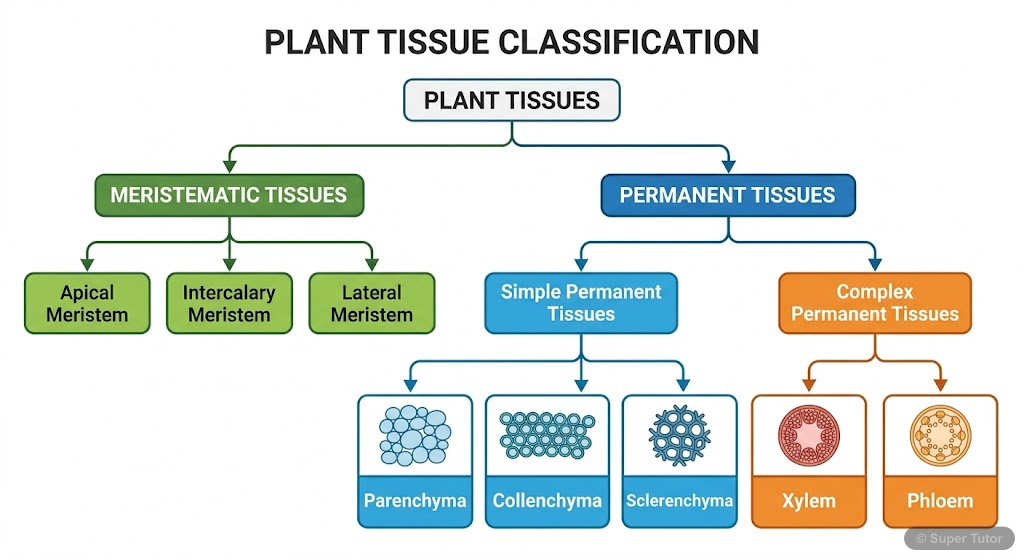
Learn better with visuals Super Tutor pairs illustrations like this with notes and quizzes for Tissues And Other Levels Of Organization.
What is a tissue? Define it with reference to cellular organization.
Answer
A tissue is a group of cells that share a common origin, similar structure, and a common function. Tissues represent the second level of biological organization, where similar cells aggregate together…
Classify plant tissues into two main categories and explain the basic differences between them.
Answer
Plant tissues are classified into two main categories: (1) Meristematic tissues - composed of immature, undifferentiated cells that actively divide to produce new cells. They have no intercellular spa…
Name and locate the three types of meristematic tissue in a plant, and state the function of each.
Answer
The three types of meristematic tissue are: (1) Apical Meristem - located at the root tip and shoot tip; responsible for growth in length of the plant and its branches. (2) Intercalary Meristem - loca…
What are the three types of simple plant tissues, and what is the key distinguishing feature between them in terms of cell wall composition?
Answer
The three simple plant tissues are: (1) Parenchyma - thin-walled, living cells with cellulose walls; storage and photosynthetic functions. (2) Collenchyma - thick primary walls made of cellulose and p…
Describe parenchyma tissue, including its characteristics, functions, and two specialized types.
Answer
Parenchyma is a simple plant tissue composed of living, thin-walled cells with prominent nuclei and abundant cytoplasm. Characteristics: cells are rounded or oval with intercellular spaces; walls are …
Compare collenchyma and sclerenchyma tissue. What are their structural differences and functional implications?
Answer
Structural differences: Collenchyma has elongated living cells with thick primary walls made of cellulose and pectin, with thickening concentrated at cell corners; walls are flexible. Sclerenchyma has…
What is a complex tissue? Name the two main complex tissues in plants and explain why they are called 'vascular tissues'.
Answer
A complex tissue is composed of more than one type of cell working together as a functional unit. The two main complex tissues are: (1) Xylem - conducts water and mineral salts upward from roots to le…
Describe the four components of xylem tissue, their characteristics, and their collective function.
Answer
The four components of xylem are: (1) Tracheids - dead cells with pointed ends, thick lignified walls with pores; function in water conduction. (2) Vessels - dead cells, shorter and broader than trach…
+17 more flashcards
Practise AllFrequently Asked Questions
What are the important topics in Tissues And Other Levels Of Organization for NIOS Class 12 Biology?
How many flashcards are available for Tissues And Other Levels Of Organization?
How should I revise Tissues And Other Levels Of Organization for the NIOS Class 12 board exam?
Sources & Official References
Content is aligned to the official syllabus. Refer to the board website for the latest curriculum.
More resources for Tissues And Other Levels Of Organization
For serious students
Get the full Tissues And Other Levels Of Organization chapter — start free.
Quizzes, flashcards, an AI doubt solver and a study plan for NIOS Class 12 Biology. Free to start, no card needed.