Tissues And Other Levels Of Organization — Chapter Summary
NIOS · Class 12 · Biology
Summary of Tissues And Other Levels Of Organization for NIOS Class 12 Biology. Part of the NIOS Class 12 Biology syllabus.
Interactive on Super Tutor
Studying Tissues And Other Levels Of Organization? Get the full interactive chapter.
Quizzes, flashcards, AI doubt-solver and a step-by-step study plan — built for chapter summary and more.
Free trial, no card needed.
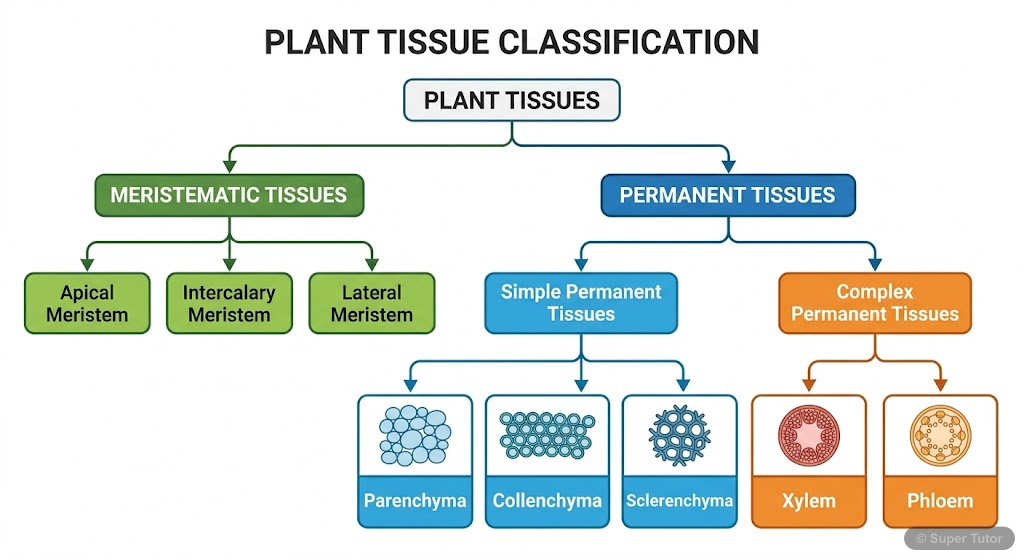
Learn better with visuals Super Tutor pairs illustrations like this with notes and quizzes for Tissues And Other Levels Of Organization.
Overview
Tissues are groups of similar cells that work together to perform specific functions in living organisms. Just as a cell is the basic unit of life, tissues form the building blocks of organs and organ systems. Understanding tissues helps us comprehend how complex multicellular organisms like humans
Key Concepts
A tissue is a group
A tissue is a group of cells with common origin, similar structure, and the same function. Cells in a tissue are derived from the same embryonic layer
Meristematic tissues consist of immature
Meristematic tissues consist of immature, undifferentiated cells that actively divide to produce new cells. Key features include: composed of living,
Simple permanent tissues are composed
Simple permanent tissues are composed of only one type of cell. Three types exist: (1) Parenchyma - living, thin-walled cells for storage, photosynthe
Complex tissues contain multiple cell types
Complex tissues contain multiple cell types working together as a unit. Two main types are: (1) Xylem - conducts water and minerals upward from roots,
This theory explains vegetative shoot apex
This theory explains vegetative shoot apex organization with two distinct zones: (1) Tunica - peripheral layers showing anticlinal (perpendicular) cel
Learning Objectives
- Define what a tissue is and understand its key characteristics
- Classify plant tissues into meristematic and permanent tissues
- Identify and describe various types of plant tissues including simple and complex tissues
- Explain the Tunica Corpus theory and Histogen theory of plant growth
- Classify animal tissues into epithelial, connective, muscular, and nervous tissues
Frequently Asked Questions
What are the important topics in Tissues And Other Levels Of Organization for NIOS Class 12 Biology?
How should I revise Tissues And Other Levels Of Organization for the NIOS Class 12 board exam?
Sources & Official References
Content is aligned to the official syllabus. Refer to the board website for the latest curriculum.
More resources for Tissues And Other Levels Of Organization
For serious students
Get the full Tissues And Other Levels Of Organization chapter — start free.
Quizzes, flashcards, an AI doubt solver and a study plan for NIOS Class 12 Biology. Free to start, no card needed.