The Solid State — Chapter Summary
NIOS · Class 12 · Chemistry
Summary of The Solid State for NIOS Class 12 Chemistry. Key concepts: Solids consist of particles, Crystalline solids have long and Four types exist.
Interactive on Super Tutor
Studying The Solid State? Get the full interactive chapter.
Quizzes, flashcards, AI doubt-solver and a step-by-step study plan — built for chapter summary and more.
Free trial, no card needed.
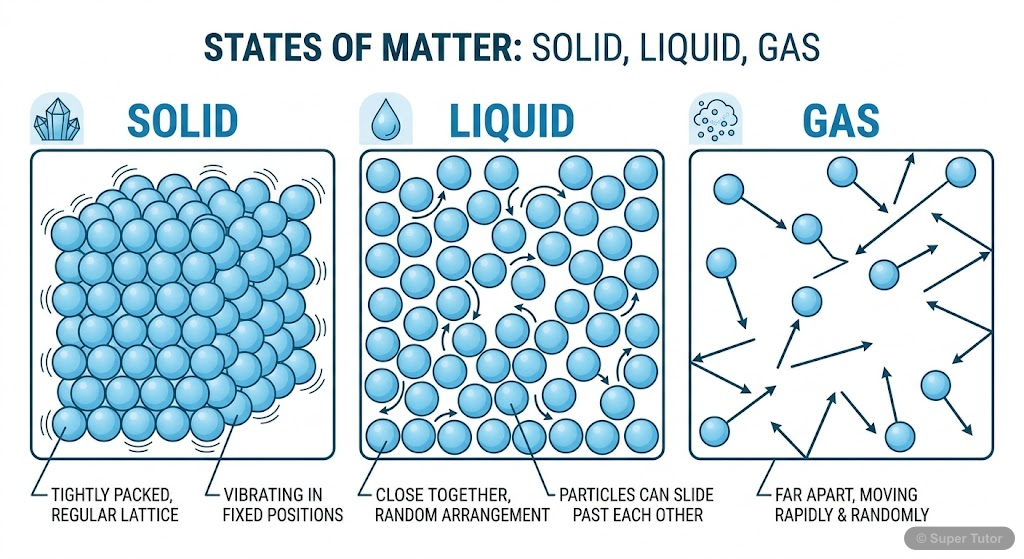
One of 2 illustrations for The Solid State in Super Tutor — alongside flashcards, concept maps and practice questions.
Overview
The solid state represents one of the three fundamental states of matter, characterized by its rigidity, definite shape, and definite volume. In solids, constituent particles (atoms, molecules, or ions) are closely packed with strong intermolecular forces holding them together. Unlike gases and liqu
Key Concepts
Solids consist of particles arranged
Solids consist of particles arranged in closely packed, ordered arrangements with strong intermolecular forces. Particles vibrate about fixed position
Crystalline solids have long
Crystalline solids have long-range order with particles arranged in regular, repeating three-dimensional patterns throughout the entire structure. Exa
Four types exist
Four types exist: (1) Ionic solids - held by electrostatic coulombic forces between ions; hard and brittle with high melting points (NaCl, ZnS); (2) M
A crystal lattice is a three
A crystal lattice is a three-dimensional arrangement of lattice points representing positions of constituent particles. A unit cell is the smallest re
Simple cubic (SC)
Simple cubic (SC): 8 corner atoms × 1/8 contribution = 1 atom per unit cell. Body-centered cubic (BCC): 8 corner atoms × 1/8 + 1 body-center atom = 2
Learning Objectives
- Explain the nature of solid state and distinguish it from liquid and gaseous states
- Differentiate between crystalline and amorphous solids based on particle arrangement
- Classify crystalline solids into ionic, molecular, covalent, and metallic types
- Understand crystal lattice, unit cells, and their significance in solid structure
- Calculate the number of atoms in cubic unit cells and density of solids
Frequently Asked Questions
What are the important topics in The Solid State for NIOS Class 12 Chemistry?
How should I revise The Solid State for the NIOS Class 12 board exam?
Sources & Official References
Content is aligned to the official syllabus. Refer to the board website for the latest curriculum.
More resources for The Solid State
For serious students
Get the full The Solid State chapter — start free.
Quizzes, flashcards, an AI doubt solver and a study plan for NIOS Class 12 Chemistry. Free to start, no card needed.