Chapter 5 of 8
Concept Maps
The Solid State — Concept Maps
NIOS · Class 12 · Chemistry
3 concept maps of The Solid State for NIOS Class 12 Chemistry, each also written out as a text outline. Part of the NIOS Class 12 Chemistry syllabus.
44 questions33 flashcards5 concepts
Interactive on Super Tutor
Studying The Solid State? Get the full interactive chapter.
Quizzes, flashcards, AI doubt-solver and a step-by-step study plan — built for concept maps and more.
Free trial, no card needed.
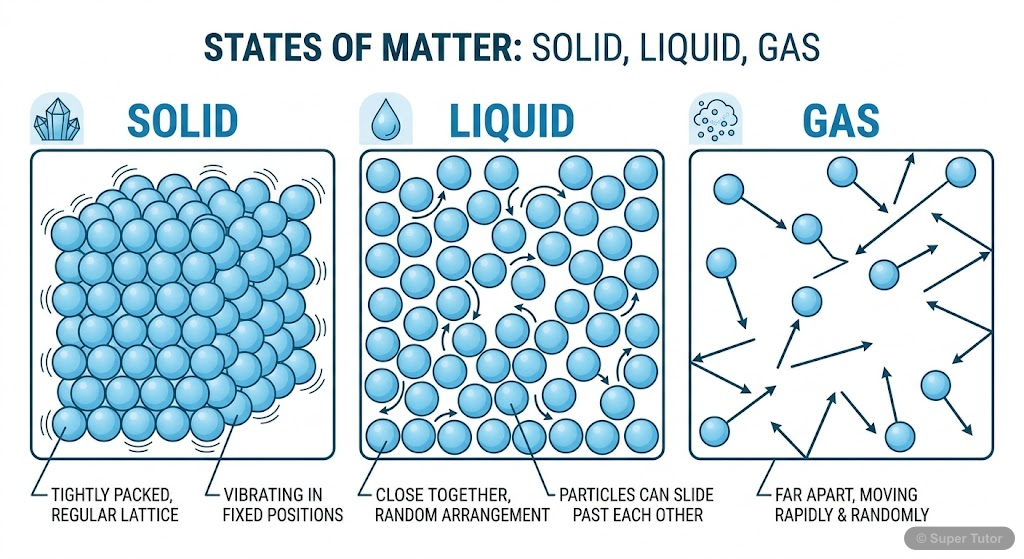
Super Tutor
One of 2 illustrations for The Solid State in Super Tutor — alongside flashcards, concept maps and practice questions.
3 Concept Maps
Mind map showing the classification of solids into crystalline and amorphous types with their characteristic features
The map in words
- Solid Classification
- Crystalline Solids
- Long-range order
- Sharp melting point
- Anisotropic
- Regular geometry
- Examples: NaCl, Diamond
- Amorphous Solids
- Short-range order
- Range of melting points
- Isotropic
- Irregular shape
- Examples: Glass, Rubber
- Crystalline Solids
Flowchart showing classification of crystalline solids based on intermolecular forces and their properties
The map in words
- Crystalline Solids
- Type of Force
- Electrostatic: Ionic Solids
- High melting point Hard and brittle
- van der Waals/Dipole: Molecular Solids
- Low melting point Soft
- Covalent Bonds: Covalent Solids
- Very high melting point Hard
- Metallic Bonding: Metallic Solids
- Variable melting point Malleable
- Electrostatic: Ionic Solids
- Type of Force
State diagram showing phase transitions of solids, with melting highlighted as the conversion from solid to liquid
The map in words
- Solid → Liquid (Melting (at m.p.))
- Liquid → Solid (Freezing)
- Liquid → Gas (Vaporization)
- Gas → Liquid (Condensation)
Explore these maps interactively
Explore DiagramsFrequently Asked Questions
What are the important topics in The Solid State for NIOS Class 12 Chemistry?
Key topics in The Solid State include Nature of Solid State, Classification of Solids: Amorphous vs Crystalline, Classification of Crystalline Solids by Bonding Type, Crystal Lattice and Unit Cells. Study these first, then practise questions on each for the NIOS Class 12 board exam.
What do the concept maps for The Solid State show?
The 3 maps show how the ideas in The Solid State connect: Mind map showing the classification of solids into crystalline and amorphous types with their characteristic features; Flowchart showing classification of crystalline solids based on intermolecular forces and their properties. Each map is also written out as an outline on this page.
How should I revise The Solid State for the NIOS Class 12 board exam?
Learn the core ideas first, then work through the 44 practice questions on The Solid State. Revise definitions regularly and use flashcards for quick recall before the exam.
Sources & Official References
Content is aligned to the official syllabus. Refer to the board website for the latest curriculum.
More resources for The Solid State
For serious students
Get the full The Solid State chapter — start free.
Quizzes, flashcards, an AI doubt solver and a study plan for NIOS Class 12 Chemistry. Free to start, no card needed.