Chapter 5 of 8
Revision Notes
The Solid State — Revision Notes
NIOS · Class 12 · Chemistry
The Solid State revision notes for NIOS Class 12 Chemistry: 4 topics in quick points. Part of the NIOS Class 12 Chemistry syllabus.
44 questions33 flashcards5 concepts
Interactive on Super Tutor
Studying The Solid State? Get the full interactive chapter.
Quizzes, flashcards, AI doubt-solver and a step-by-step study plan — built for revision notes and more.
Free trial, no card needed.
Super Tutor
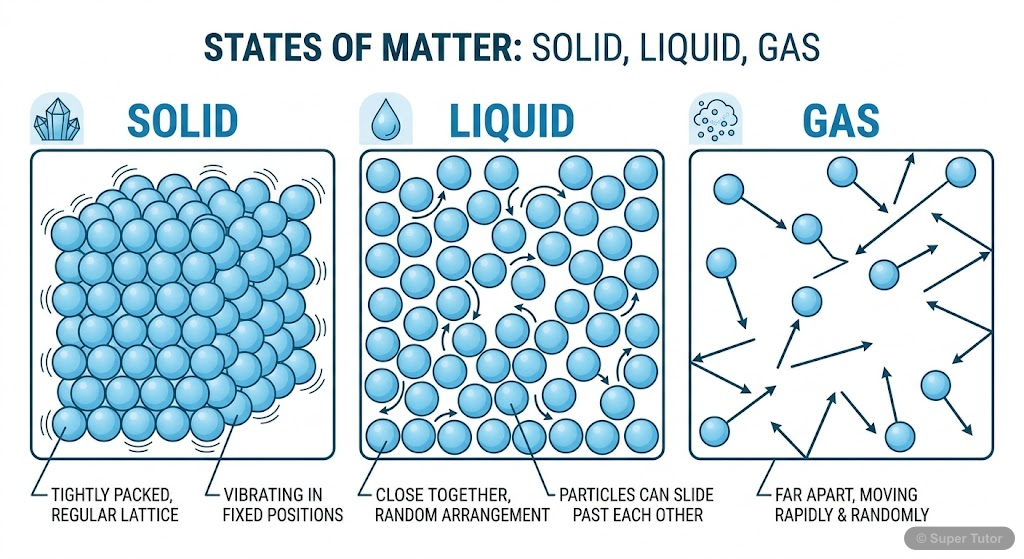
One of 2 illustrations for The Solid State in Super Tutor — alongside flashcards, concept maps and practice questions.
Key Topics to Revise
1
1. Nature of Solid State
- Solids have definite shape and volume due to closely packed particles in ordered arrangement
- Constituent particles (atoms, molecules, ions) experience strong intermolecular forces of attraction
- Particles can only vibrate about fixed positions - no translational motion like gases or liquids
2
2. Classification of Solids: Amorphous vs Crystalline
- Solids classified based on arrangement of constituent particles: CRYSTALLINE and AMORPHOUS
- Crystalline solids: Regular, periodic, long-range order throughout structure
- Amorphous solids: Irregular arrangement, short-range order only, appear random
3
3. Classification of Crystalline Solids by Bonding Type
- Four types based on forces between constituent particles: IONIC, MOLECULAR, COVALENT, METALLIC
- IONIC SOLIDS: Held by electrostatic (coulombic) attractions between cations and anions
- - Examples: NaCl, CsCl, ZnS, MgO, CaF₂
4
4. Crystal Lattice and Unit Cells
- Crystal lattice: 3D array of points representing positions of constituent particles
- Each point is called a lattice point - represents center of a particle
- Unit cell: Smallest repeating unit that generates entire lattice when repeated in 3D
Get complete notes with diagrams and examples
Full NotesKey Concepts
Solids consist of particles arrangedCrystalline solids have longFour types existA crystal lattice is a threeSimple cubic (SC)
Frequently Asked Questions
What are the important topics in The Solid State for NIOS Class 12 Chemistry?
Key topics in The Solid State include Nature of Solid State, Classification of Solids: Amorphous vs Crystalline, Classification of Crystalline Solids by Bonding Type, Crystal Lattice and Unit Cells. Study these first, then practise questions on each for the NIOS Class 12 board exam.
How should I revise The Solid State for the NIOS Class 12 board exam?
Learn the core ideas first, then work through the 44 practice questions on The Solid State. Revise definitions regularly and use flashcards for quick recall before the exam.
Sources & Official References
Content is aligned to the official syllabus. Refer to the board website for the latest curriculum.
More resources for The Solid State
For serious students
Get the full The Solid State chapter — start free.
Quizzes, flashcards, an AI doubt solver and a study plan for NIOS Class 12 Chemistry. Free to start, no card needed.