Chemical Thermodynamics — Practice Quiz
NIOS · Class 12 · Chemistry
Try a 4-question quiz on Chemical Thermodynamics for NIOS Class 12 Chemistry: tap an answer to check it and see why. 45 questions in the full chapter test.
Interactive on Super Tutor
Studying Chemical Thermodynamics? Get the full interactive chapter.
Quizzes, flashcards, AI doubt-solver and a step-by-step study plan — built for practice quiz and more.
Free trial, no card needed.
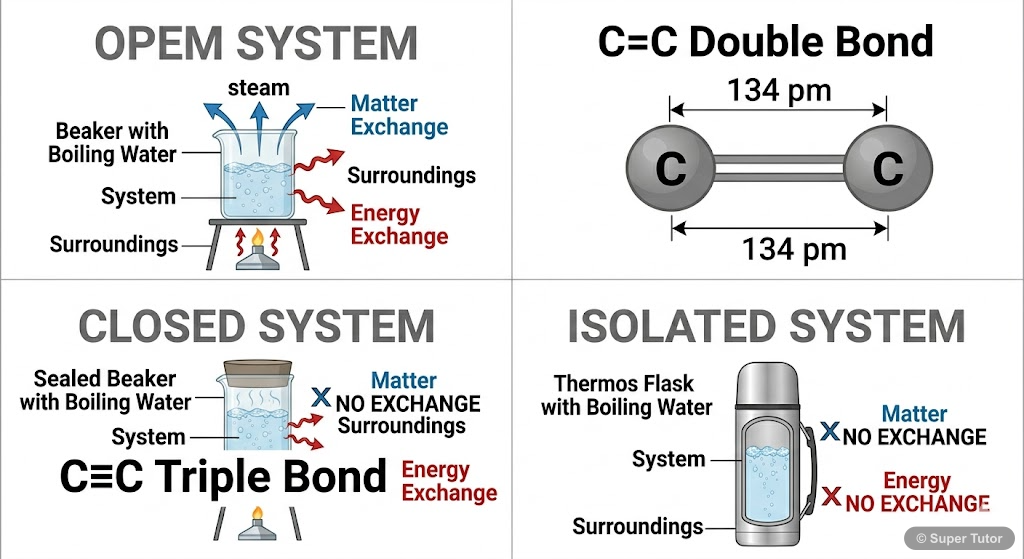
One of 4 illustrations for Chemical Thermodynamics in Super Tutor — alongside flashcards, concept maps and practice questions.
Quick Quiz: Chemical Thermodynamics
0/4Tap an answer to check it instantly. No sign-up needed for these 4.
A system absorbs 500 kJ of heat and 200 kJ of work is done ON the system. What is the change in internal energy (ΔU) of the system?
For the reaction: N₂(g) + 3H₂(g) → 2NH₃(g); ΔH = -92 kJ. What is the value of Δnᵍ and how does ΔH compare to ΔU?
Which of the following correctly describes an ISOLATED system?
The standard enthalpy of neutralization of a strong acid with a strong base is always −57 kJ/mol. Which reaction correctly represents this process?
Sample Questions
For the combustion of ethanol: C₂H₅OH(l) + 3O₂(g) → 2CO₂(g) + 3H₂O(l); ΔH = −1366 kJ/mol. How much heat is released on combustion of 23 g of ethanol? (Molar mass of C₂H₅OH = 46 g/mol)
Show answer
683 kJ
Step 1: Find moles of ethanol = mass/molar mass = 23/46 = 0.5 mol. Step 2: The given ΔH = −1366 kJ refers to combustion of 1 mole of ethanol. Step 3: Heat released for 0.5 mol = 0.5 × 1366 = 683 kJ. Step 4: The sign is negative (exothermic), so heat RELEASED = 683 kJ. Option 1366 kJ is for 1 mole; 2732 kJ would be for 2 moles; 341.5 kJ would be the answer if 23 g were taken as 1/4 mol, which is incorrect.
Which of the following processes is an example of an ENDOTHERMIC reaction?
Show answer
Dissolving NH₄Cl in water (test tube feels cold)
Step 1: Endothermic reactions ABSORB heat from surroundings, making the surroundings (or the test tube) feel cold. Step 2: Dissolving NH₄Cl in water absorbs heat → test tube feels cold → endothermic. Step 3: Combustion of coal releases heat and light → exothermic. Step 4: Zinc + HCl produces H₂ gas and the test tube becomes warm → exothermic. Adding water to CaO releases a lot of heat → highly exothermic. The key observation for endothermic reaction is cooling of surroundings.
According to Hess's Law, if C(graphite) + O₂(g) → CO₂(g); ΔH₁ = −394 kJ and CO(g) + ½O₂(g) → CO₂(g); ΔH₂ = −283 kJ, then ΔH for C(graphite) + ½O₂(g) → CO(g) is:
Show answer
−111 kJ/mol
Step 1: Write the target reaction: C(graphite) + ½O₂(g) → CO(g); ΔH = ? Step 2: According to Hess's Law, ΔH = ΔH₁ − ΔH₂ (subtract reaction 2 from reaction 1). Step 3: ΔH = (−394) − (−283) = −394 + 283 = −111 kJ/mol. Step 4: This works because CO₂ appears on the right in both equations; subtracting equation 2 reverses it and cancels CO₂ and ½O₂. The positive value +111 kJ arises from a sign error. −677 kJ comes from incorrectly adding both values. Hess's Law is valid because enthalpy is a state function.
The standard enthalpy of formation (ΔfH°) of an element in its most stable state is:
Show answer
Zero
Step 1: Standard enthalpy of formation is defined as the enthalpy change when ONE mole of a compound is formed from its elements in their most stable states. Step 2: By convention, since elements in their most stable form are the reference state, no energy change occurs in 'forming' them from themselves. Step 3: For example, ΔfH°(O₂, g) = 0, ΔfH°(C, graphite) = 0, ΔfH°(Fe, s) = 0. Step 4: This is a universally accepted convention used as the reference for all thermochemical calculations. It does NOT mean elements have no energy; it simply means we set their enthalpy as the baseline (zero refer
+41 more questions on Chemical Thermodynamics (NIOS Class 12 Chemistry)
Practise AllFrequently Asked Questions
What are the important topics in Chemical Thermodynamics for NIOS Class 12 Chemistry?
How many practice questions are there for Chemical Thermodynamics?
Sources & Official References
Content is aligned to the official syllabus. Refer to the board website for the latest curriculum.
More resources for Chemical Thermodynamics
Important Questions
Exam-style questions with answers
Revision Notes
Key points for last-minute revision
Formula Sheet
The chapter's formulas in one place
Chapter Summary
Understand the chapter at a glance
Concept Maps
See how topics connect
Flashcards
Quick-fire cards for active recall
Syllabus
What topics to cover
For serious students
Get the full Chemical Thermodynamics chapter — start free.
Quizzes, flashcards, an AI doubt solver and a study plan for NIOS Class 12 Chemistry. Free to start, no card needed.