Chemical Thermodynamics — Concept Maps
NIOS · Class 12 · Chemistry
3 concept maps of Chemical Thermodynamics for NIOS Class 12 Chemistry, each also written out as a text outline.
Interactive on Super Tutor
Studying Chemical Thermodynamics? Get the full interactive chapter.
Quizzes, flashcards, AI doubt-solver and a step-by-step study plan — built for concept maps and more.
Free trial, no card needed.
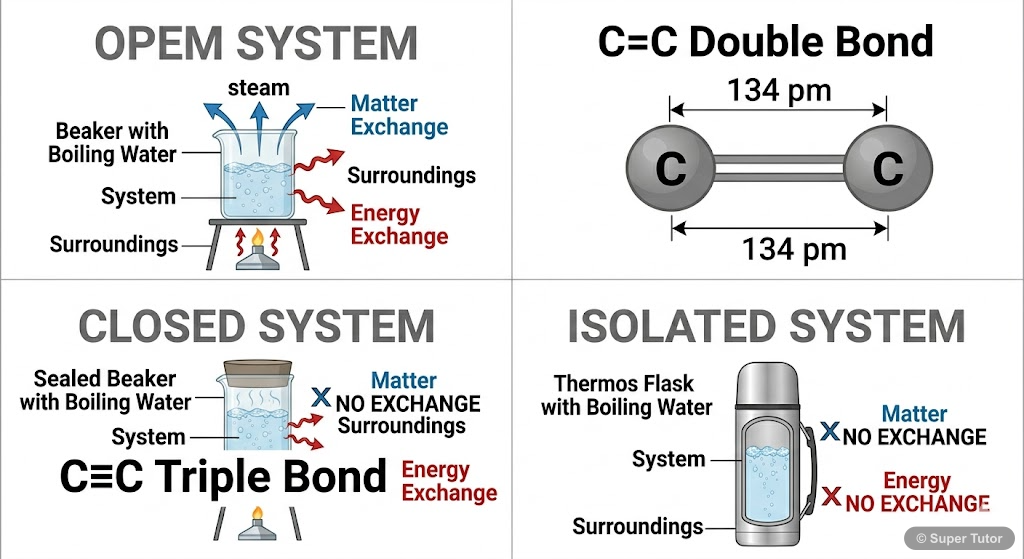
One of 4 illustrations for Chemical Thermodynamics in Super Tutor — alongside flashcards, concept maps and practice questions.
Chemical Thermodynamics - Complete Chapter Overview
The map in words
- Chemical Thermodynamics
- Basic Concepts
- System
- Isolated
- Closed
- Open
- Surroundings
- State Functions
- P T V U H
- Path Functions
- Heat q
- Work w
- Processes
- Isothermal
- Adiabatic
- Reversible
- Irreversible
- System
- Energy and Reactions
- Exothermic
- Delta H negative
- Heat released
- Endothermic
- Delta H positive
- Heat absorbed
- Thermochemical Equations
- States of matter
- Delta H value
- Molar quantities
- Exothermic
- First Law
- Delta U = q plus w
- Internal Energy U
- Work w = negative p delta V
- At constant V
- Delta U = qv
- At constant P
- Delta H = qp
- Delta H and Delta U
- Delta H = Delta U plus Δng RT
- Delta ng gaseous moles only
- Solids and Liquids
- Delta H equals Delta U
- Standard Enthalpies
- Formation Delta fH zero
- Elements = 0
- Combustion Delta combH zero
- Always negative
- Neutralization
- Strong acid base = 57 kJ
- Atomisation
- Phase Transition
- Solution
- Ionization
- Formation Delta fH zero
- Laws of Thermochemistry
- Lavoisier Laplace Law
- Reverse reaction
- Sign changes
- Hess's Law
- Path independent
- Algebraic combination
- Delta rH = sum Delta fH products minus reactants
- Lavoisier Laplace Law
- Bond Enthalpies
- Bond Breaking
- Endothermic
- Bond Formation
- Exothermic
- Bond Dissociation Enthalpy
- Specific molecule
- Bond Enthalpy
- Average value
- Delta rH = sum BE reactants minus sum BE products
- Bond Breaking
- Basic Concepts
Chemical Thermodynamics Concept Overview
The map in words
- Chemical Thermodynamics
- System and Surroundings
- Isolated System
- Closed System
- Open System
- Types of Reactions
- Exothermic
- ΔH negative
- Heat released
- Endothermic
- ΔH positive
- Heat absorbed
- Exothermic
- Thermodynamic Laws
- First Law
- ΔU = q + w
- Energy conservation
- Lavoisier-Laplace
- Equation reversal
- Hess's Law
- Independent of path
- First Law
- Enthalpy Concepts
- Definition
- H = U + pV
- ΔH = ΔU + pΔV
- Standard Enthalpies
- Formation ΔfH°
- Combustion ΔcombH°
- Neutralization ΔneuthH°
- Atomization ΔaH°
- Definition
- Bond Energy
- Bond Enthalpy
- Average bond energy
- Bond Dissociation
- Specific bond energy
- Calculations
- Energy of breaking
- Energy of forming
- Bond Enthalpy
- Calculation Methods
- Enthalpy of Formation
- Tabulated values
- Most accurate
- Bond Enthalpy
- Average values
- Gaseous reactions
- Hess's Law
- Path independent
- Multi-step reactions
- Enthalpy of Formation
- System and Surroundings
Diagram showing the relationship between system, surroundings, and universe
The map in words
- Universe
- System
- Reaction Mixture
- Surroundings
- Beaker, Air, Room
- System
Explore these maps interactively
Explore DiagramsFrequently Asked Questions
What are the important topics in Chemical Thermodynamics for NIOS Class 12 Chemistry?
What do the concept maps for Chemical Thermodynamics show?
How should I revise Chemical Thermodynamics for the NIOS Class 12 board exam?
Sources & Official References
Content is aligned to the official syllabus. Refer to the board website for the latest curriculum.
More resources for Chemical Thermodynamics
Practice Quiz
Test yourself with a quick quiz
Important Questions
Exam-style questions with answers
Revision Notes
Key points for last-minute revision
Formula Sheet
The chapter's formulas in one place
Chapter Summary
Understand the chapter at a glance
Flashcards
Quick-fire cards for active recall
Syllabus
What topics to cover
For serious students
Get the full Chemical Thermodynamics chapter — start free.
Quizzes, flashcards, an AI doubt solver and a study plan for NIOS Class 12 Chemistry. Free to start, no card needed.