Chemical Thermodynamics — Flashcards
NIOS · Class 12 · Chemistry
30 flashcards for Chemical Thermodynamics (NIOS Class 12 Chemistry) to test yourself on key terms and facts. Part of the NIOS Class 12 Chemistry syllabus.
Interactive on Super Tutor
Studying Chemical Thermodynamics? Get the full interactive chapter.
Quizzes, flashcards, AI doubt-solver and a step-by-step study plan — built for flashcards and more.
Free trial, no card needed.
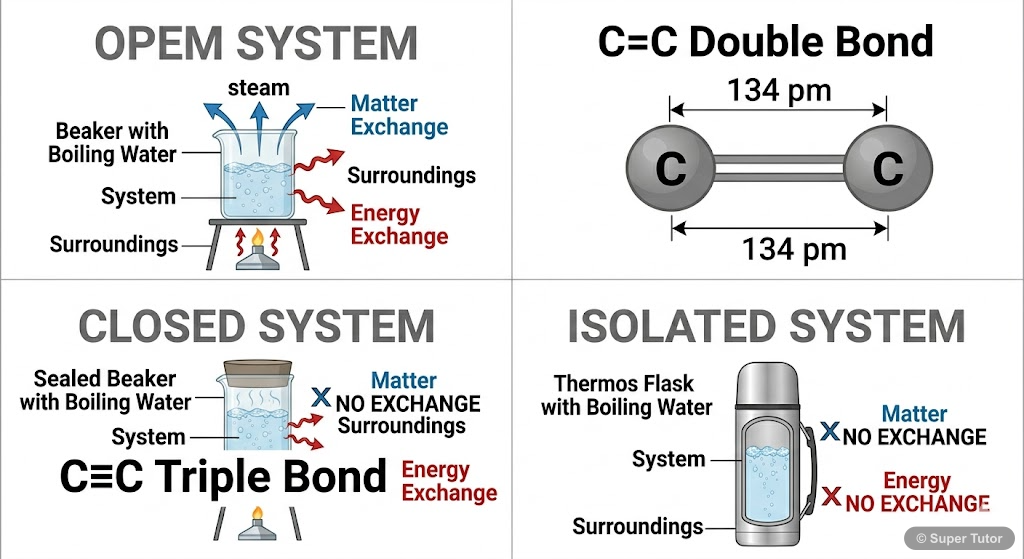
One of 4 illustrations for Chemical Thermodynamics in Super Tutor — alongside flashcards, concept maps and practice questions.
What is the difference between a system and surroundings in thermodynamics?
Answer
System: The part of the physical universe under study (e.g., reaction mixture in a beaker). Surroundings: Everything else outside the system (e.g., beaker, room, air). Together they make up the univer…
Define the three types of systems: isolated, closed, and open.
Answer
Isolated system: Exchanges neither matter nor energy with surroundings (example: perfect thermos flask). Closed system: Exchanges energy but not matter (example: stoppered steel flask). Open system: E…
What is the difference between extensive and intensive properties?
Answer
Extensive property: Value depends on the size of the system (mass, volume, heat capacity). Examples: 100g of iron vs 50g of iron have different masses. Intensive property: Value is independent of syst…
Classify the reaction: Zn(s) + 2HCl(aq) → ZnCl₂(aq) + H₂(g). The test tube becomes hot. Is it exothermic or endothermic?
Answer
This is an EXOTHERMIC reaction. The test tube becomes hot because heat energy is released to the surroundings. Definition: Exothermic reactions proceed with evolution of heat (ΔH is negative). The zin…
Classify the reaction: When solid ammonium chloride (NH₄Cl) is dissolved in water, the test tube becomes cold. Is it exothermic or endothermic?
Answer
This is an ENDOTHERMIC reaction. The test tube becomes cold because heat energy is absorbed from the surroundings. Definition: Endothermic reactions proceed with absorption of heat (ΔH is positive). N…
Write the thermochemical equation for the combustion of methane, ensuring you include state symbols and ΔH value.
Answer
CH₄(g) + 2O₂(g) → CO₂(g) + 2H₂O(l); ΔH = -891 kJ/mol. This is an exothermic reaction (ΔH negative). State symbols: (g) = gas, (l) = liquid. The negative ΔH value indicates that 891 kJ of heat is relea…
State the First Law of Thermodynamics mathematically and explain each term.
Answer
ΔU = q + w. Where: ΔU = change in internal energy (J or kJ), q = heat absorbed by the system (positive if absorbed, negative if released), w = work done on the system (positive if done on system, nega…
Define internal energy (U) and explain whether it is a state function or path function.
Answer
Internal energy (U): Sum of all energies of atoms, molecules, and ions in a system, including translational, vibrational, rotational energies, and electronic energy. It is a STATE FUNCTION—depends onl…
+22 more flashcards
Practise AllFrequently Asked Questions
What are the important topics in Chemical Thermodynamics for NIOS Class 12 Chemistry?
How many flashcards are available for Chemical Thermodynamics?
How should I revise Chemical Thermodynamics for the NIOS Class 12 board exam?
Sources & Official References
Content is aligned to the official syllabus. Refer to the board website for the latest curriculum.
More resources for Chemical Thermodynamics
Practice Quiz
Test yourself with a quick quiz
Important Questions
Exam-style questions with answers
Revision Notes
Key points for last-minute revision
Formula Sheet
The chapter's formulas in one place
Chapter Summary
Understand the chapter at a glance
Concept Maps
See how topics connect
Syllabus
What topics to cover
For serious students
Get the full Chemical Thermodynamics chapter — start free.
Quizzes, flashcards, an AI doubt solver and a study plan for NIOS Class 12 Chemistry. Free to start, no card needed.