Chemical Thermodynamics — Chapter Summary
NIOS · Class 12 · Chemistry
Summary of Chemical Thermodynamics for NIOS Class 12 Chemistry. Part of the NIOS Class 12 Chemistry syllabus. Chemical Thermodynamics is the branch.
Interactive on Super Tutor
Studying Chemical Thermodynamics? Get the full interactive chapter.
Quizzes, flashcards, AI doubt-solver and a step-by-step study plan — built for chapter summary and more.
Free trial, no card needed.
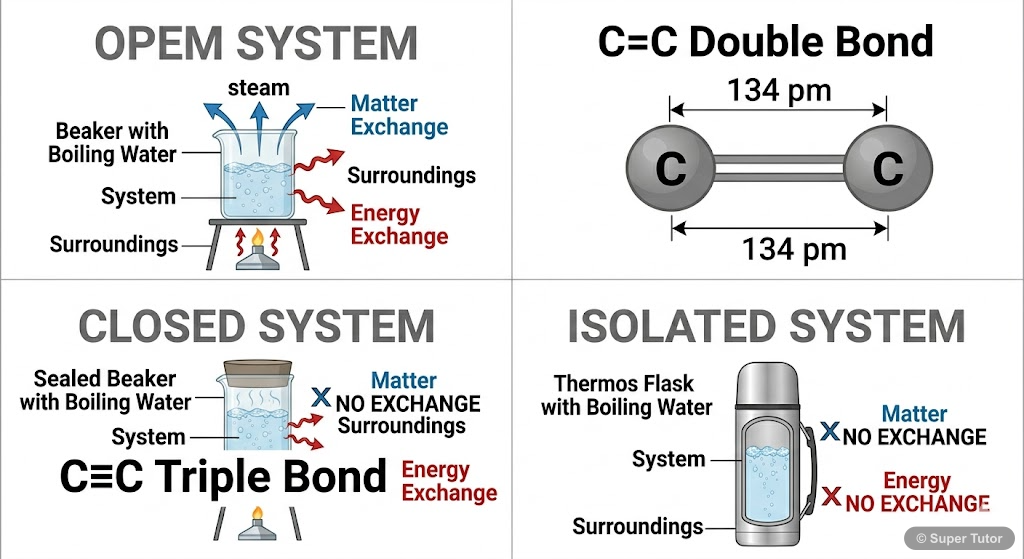
One of 4 illustrations for Chemical Thermodynamics in Super Tutor — alongside flashcards, concept maps and practice questions.
Overview
Chemical Thermodynamics is the branch of chemistry that studies the energy changes accompanying chemical reactions and physical processes. It helps us understand why some reactions occur spontaneously while others require external energy input. This chapter explores how energy is transferred between
Key Concepts
A system is the part
A system is the part of the universe being studied (e.g., reaction mixture in a beaker), while surroundings comprise everything else. Three types exis
State functions depend only on initial
State functions depend only on initial and final states, not on the path taken. Examples include pressure, temperature, volume, internal energy, and e
Extensive properties depend on system size
Extensive properties depend on system size (mass, volume, heat capacity, internal energy). Intensive properties are independent of size (temperature,
Exothermic reactions release heat to surroundings
Exothermic reactions release heat to surroundings (ΔH < 0): combustion of fuel, neutralization of acids with bases, rusting of iron. The system become
Energy cannot be created or destroyed
Energy cannot be created or destroyed; it only transforms from one form to another. Mathematically: ΔU = q + w, where ΔU is internal energy change, q
Learning Objectives
- Define and differentiate between system, surroundings, and isolated/closed/open systems
- Understand state functions and their importance in thermodynamics
- Distinguish between exothermic and endothermic reactions with real-world examples
- Apply the First Law of Thermodynamics (ΔU = q + w) to solve problems
- Calculate internal energy changes and relate them to enthalpy changes
Frequently Asked Questions
What are the important topics in Chemical Thermodynamics for NIOS Class 12 Chemistry?
How should I revise Chemical Thermodynamics for the NIOS Class 12 board exam?
Sources & Official References
Content is aligned to the official syllabus. Refer to the board website for the latest curriculum.
More resources for Chemical Thermodynamics
For serious students
Get the full Chemical Thermodynamics chapter — start free.
Quizzes, flashcards, an AI doubt solver and a study plan for NIOS Class 12 Chemistry. Free to start, no card needed.