Chapter 4 of 8
Revision Notes
The Gaseous And Liquid State — Revision Notes
NIOS · Class 12 · Chemistry
The Gaseous And Liquid State revision notes for NIOS Class 12 Chemistry: 4 topics in quick points. Part of the NIOS Class 12 Chemistry syllabus.
45 questions40 flashcards8 formulas & key relations5 concepts
Interactive on Super Tutor
Studying The Gaseous And Liquid State? Get the full interactive chapter.
Quizzes, flashcards, AI doubt-solver and a step-by-step study plan — built for revision notes and more.
Free trial, no card needed.
Super Tutor
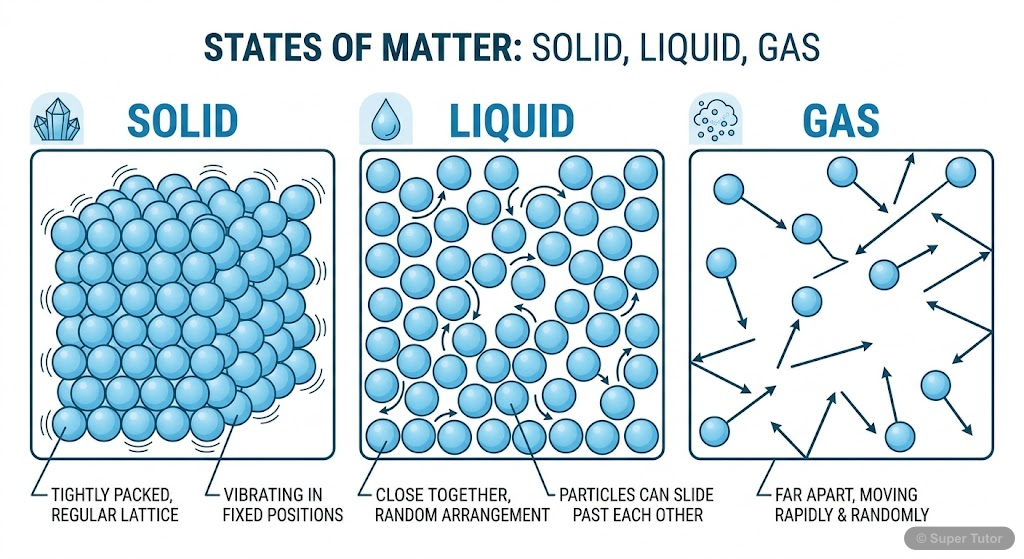
An illustration from Super Tutor's The Gaseous And Liquid State chapter — alongside flashcards, concept maps and practice questions.
Key Topics to Revise
1
1. States of Matter and Intermolecular Forces
- Matter exists in three main states: solid, liquid, and gas (plasma is the fourth state at very high temperatures)
- Gaseous state: molecules are far apart with negligible intermolecular forces, highly compressible, no definite shape or volume
- Liquid state: molecules closer than gases but no ordered arrangement, definite volume but no definite shape, largely incompressible
2
2. Boyle's Law - Pressure and Volume
- Boyle's Law: at constant temperature and amount of gas, volume is inversely proportional to pressure (V ∝ 1/p)
- Mathematical expression: p₁V₁ = p₂V₂ or pV = constant
- Valid for ideal gases at constant T and n
3
3. Charles' Law - Temperature and Volume
- Charles' Law: at constant pressure and amount of gas, volume is directly proportional to absolute temperature (V ∝ T)
- Mathematical expression: V/T = constant or V₁/T₁ = V₂/T₂
- Valid only at constant pressure and amount of gas
4
4. Gay-Lussac's Law - Temperature and Pressure
- Gay-Lussac's Law: at constant volume, pressure of a fixed amount of gas is directly proportional to absolute temperature
- Mathematical expression: p/T = constant or p₁/T₁ = p₂/T₂
- Valid only at constant volume and amount of gas
Get complete notes with diagrams and examples
Full NotesKey Concepts
Matter exists in solidFour types of intermolecular interactions existAt constant temperature and amountAt constant pressure and amountAt constant volume and amount
Frequently Asked Questions
What are the important topics in The Gaseous And Liquid State for NIOS Class 12 Chemistry?
Key topics in The Gaseous And Liquid State include States of Matter and Intermolecular Forces, Boyle's Law - Pressure and Volume, Charles' Law - Temperature and Volume, Gay-Lussac's Law - Temperature and Pressure. Study these first, then practise questions on each for the NIOS Class 12 board exam.
How should I revise The Gaseous And Liquid State for the NIOS Class 12 board exam?
Learn the core ideas first, then work through the 45 practice questions on The Gaseous And Liquid State. Revise definitions regularly and use flashcards for quick recall before the exam.
Sources & Official References
Content is aligned to the official syllabus. Refer to the board website for the latest curriculum.
More resources for The Gaseous And Liquid State
For serious students
Get the full The Gaseous And Liquid State chapter — start free.
Quizzes, flashcards, an AI doubt solver and a study plan for NIOS Class 12 Chemistry. Free to start, no card needed.