The Gaseous And Liquid State — Flashcards
NIOS · Class 12 · Chemistry
40 flashcards for The Gaseous And Liquid State (NIOS Class 12 Chemistry) to test yourself on key terms and facts.
Interactive on Super Tutor
Studying The Gaseous And Liquid State? Get the full interactive chapter.
Quizzes, flashcards, AI doubt-solver and a step-by-step study plan — built for flashcards and more.
Free trial, no card needed.
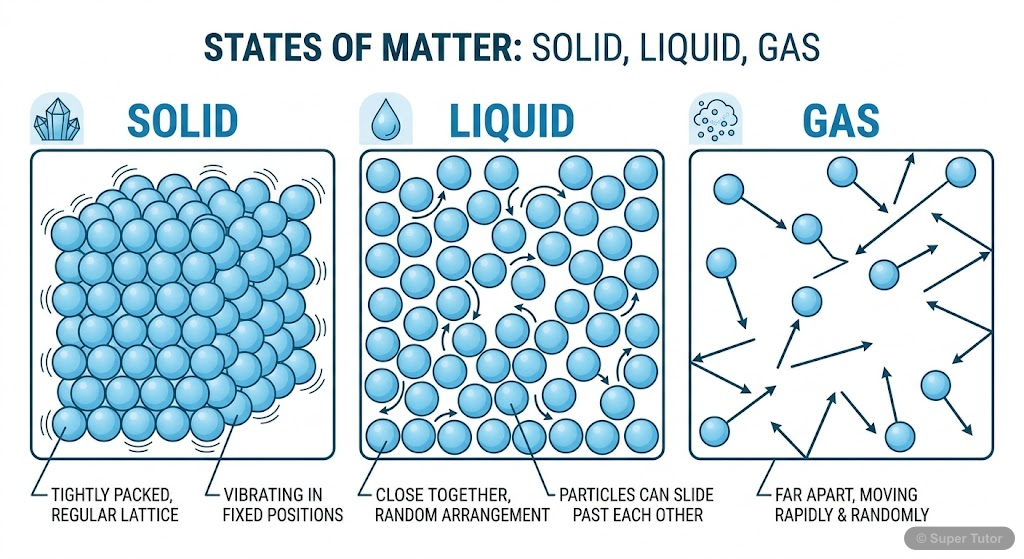
An illustration from Super Tutor's The Gaseous And Liquid State chapter — alongside flashcards, concept maps and practice questions.
What are the three states of matter and their main characteristics?
Answer
Solid: Definite shape, definite volume, particles tightly packed in regular arrangement, strong intermolecular forces, incompressible. Liquid: Indefinite shape (takes shape of container), definite vo…
What are London forces (Dispersion forces) and why are they important?
Answer
London forces are weak intermolecular forces that arise due to instantaneous dipoles in atoms or non-polar molecules. When electrons move, they create temporary uneven distribution creating a temporar…
Explain dipole-dipole forces with an example.
Answer
Dipole-dipole forces occur between polar molecules. The positive end (δ+) of one molecule's dipole attracts the negative end (δ-) of another molecule's dipole. Example: In propanone (CH₃)₂C=O, molecu…
What is hydrogen bonding and why does water have a higher boiling point than H₂S?
Answer
Hydrogen bonding is an exceptionally strong dipole-dipole interaction that occurs when hydrogen is bonded to highly electronegative atoms (N, O, F). The hydrogen atom becomes highly polar and attracts…
State Boyle's Law mathematically and explain what happens to gas volume when pressure doubles at constant temperature.
Answer
Boyle's Law: At constant temperature, volume is inversely proportional to pressure. Mathematical expression: V ∝ 1/p (at constant T and n) Or: p₁V₁ = p₂V₂ When pressure doubles: If p₂ = 2p₁, then V₂…
Calculate the final volume: A gas occupies 25 mL at 1 atm pressure. What volume will it occupy at 1.25 atm at constant temperature?
Answer
Using Boyle's Law: p₁V₁ = p₂V₂ Given: p₁ = 1 atm V₁ = 25 mL p₂ = 1.25 atm V₂ = ? Solution: V₂ = (p₁ × V₁)/p₂ V₂ = (1 atm × 25 mL)/(1.25 atm) V₂ = 25/1.25 V₂ = 20 mL Answer: The gas will occupy 20 m…
State Charles' Law and explain what absolute zero means in the context of this law.
Answer
Charles' Law: At constant pressure, volume is directly proportional to absolute temperature. Mathematical expression: V ∝ T (at constant p and n) Or: V₁/T₁ = V₂/T₂ Or: V = kT (where k is a constant) …
Calculate final volume: A gas occupies 2 L at 1000°C. What volume will it occupy at 0°C at constant pressure?
Answer
Using Charles' Law: V₁/T₁ = V₂/T₂ Given: V₁ = 2 L T₁ = 1000 + 273 = 1273 K T₂ = 0 + 273 = 273 K V₂ = ? Solution: V₂ = (V₁ × T₂)/T₁ V₂ = (2 L × 273 K)/(1273 K) V₂ = 546/1273 V₂ = 0.429 L Answer: The…
+32 more flashcards
Practise AllFrequently Asked Questions
What are the important topics in The Gaseous And Liquid State for NIOS Class 12 Chemistry?
How many flashcards are available for The Gaseous And Liquid State?
How should I revise The Gaseous And Liquid State for the NIOS Class 12 board exam?
Sources & Official References
Content is aligned to the official syllabus. Refer to the board website for the latest curriculum.
More resources for The Gaseous And Liquid State
Practice Quiz
Test yourself with a quick quiz
Important Questions
Exam-style questions with answers
Revision Notes
Key points for last-minute revision
Formula Sheet
The chapter's formulas in one place
Chapter Summary
Understand the chapter at a glance
Concept Maps
See how topics connect
Syllabus
What topics to cover
For serious students
Get the full The Gaseous And Liquid State chapter — start free.
Quizzes, flashcards, an AI doubt solver and a study plan for NIOS Class 12 Chemistry. Free to start, no card needed.