The Gaseous And Liquid State — Chapter Summary
NIOS · Class 12 · Chemistry
Summary of The Gaseous And Liquid State for NIOS Class 12 Chemistry. Part of the NIOS Class 12 Chemistry syllabus.
Interactive on Super Tutor
Studying The Gaseous And Liquid State? Get the full interactive chapter.
Quizzes, flashcards, AI doubt-solver and a step-by-step study plan — built for chapter summary and more.
Free trial, no card needed.
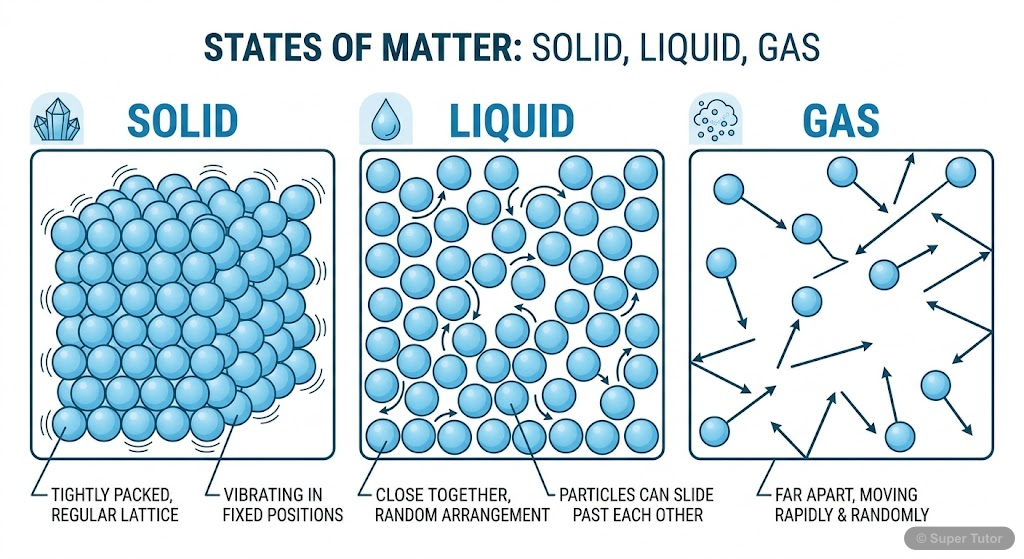
An illustration from Super Tutor's The Gaseous And Liquid State chapter — alongside flashcards, concept maps and practice questions.
Overview
Matter exists in three fundamental states: solid, liquid, and gas. These states differ primarily in the arrangement of molecules and the strength of intermolecular forces between them. The gaseous state is characterized by molecules that are far apart with negligible intermolecular forces, allowing
Key Concepts
Matter exists in solid
Matter exists in solid, liquid, and gaseous states. In solids, molecules are tightly packed in an ordered arrangement with strong intermolecular force
Four types of intermolecular interactions exist
Four types of intermolecular interactions exist: (1) London forces or dispersion forces - weak attractions between all molecules, result from instanta
At constant temperature and amount
At constant temperature and amount of gas, the volume is inversely proportional to pressure: V ∝ 1/p or p₁V₁ = p₂V₂. When pressure increases, volume d
At constant pressure and amount
At constant pressure and amount of gas, volume is directly proportional to absolute temperature: V ∝ T or V₁/T₁ = V₂/T₂. This law applies only when te
At constant volume and amount
At constant volume and amount of gas, pressure is directly proportional to absolute temperature: p ∝ T or p₁/T₁ = p₂/T₂. This law shows that increasin
Learning Objectives
- Differentiate between the three states of matter based on molecular arrangement and intermolecular forces
- Describe and explain four types of intermolecular interactions: London forces, dipole-dipole forces, dipole-induced dipole forces, and hydrogen bonding
- State and apply Boyle's law, Charles' law, Gay-Lussac's law, and Avogadro's law mathematically
- Derive and apply the ideal gas equation (pV = nRT) to solve problems involving pressure, volume, temperature, and number of moles
- Understand and apply Dalton's law of partial pressures to gas mixtures
Frequently Asked Questions
What are the important topics in The Gaseous And Liquid State for NIOS Class 12 Chemistry?
How should I revise The Gaseous And Liquid State for the NIOS Class 12 board exam?
Sources & Official References
Content is aligned to the official syllabus. Refer to the board website for the latest curriculum.
More resources for The Gaseous And Liquid State
For serious students
Get the full The Gaseous And Liquid State chapter — start free.
Quizzes, flashcards, an AI doubt solver and a study plan for NIOS Class 12 Chemistry. Free to start, no card needed.