The Gaseous And Liquid State — Concept Maps
NIOS · Class 12 · Chemistry
3 concept maps of The Gaseous And Liquid State for NIOS Class 12 Chemistry, each also written out as a text outline.
Interactive on Super Tutor
Studying The Gaseous And Liquid State? Get the full interactive chapter.
Quizzes, flashcards, AI doubt-solver and a step-by-step study plan — built for concept maps and more.
Free trial, no card needed.
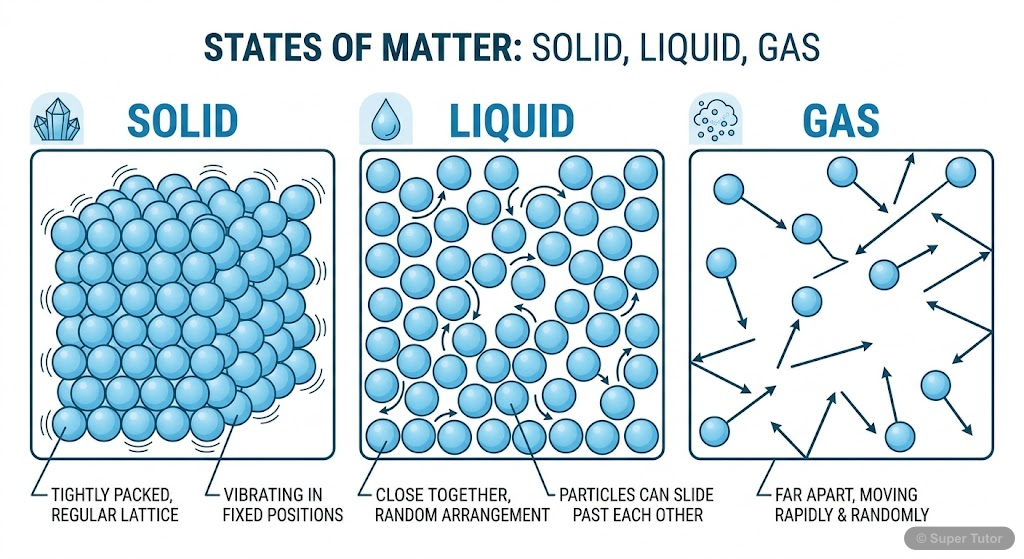
An illustration from Super Tutor's The Gaseous And Liquid State chapter — alongside flashcards, concept maps and practice questions.
Mind map showing the three states of matter and their characteristic properties
The map in words
- States of Matter
- Solid
- Definite shape
- Definite volume
- High density
- Incompressible
- Tightly packed molecules
- Liquid
- Indefinite shape
- Definite volume
- Medium density
- Largely incompressible
- Close molecules, can move
- Gas
- Indefinite shape
- Indefinite volume
- Low density
- Highly compressible
- Far apart molecules
- Solid
Classification of intermolecular forces from weakest to strongest
The map in words
- Intermolecular Forces
- Van der Waals Forces
- London Forces
- Weakest
- Dipole-Dipole Forces
- Medium
- Dipole-Induced Dipole
- Medium
- London Forces
- Hydrogen Bonding
- Strongest
- Van der Waals Forces
Sequential process showing how London forces form through instantaneous and induced dipoles
The map in words
- A → A: Electrons distribute unevenly
- A → B: Creates instantaneous dipole
- B → B: Develops induced dipole
- A → B: Dipoles attract each other
- A → A: Dipole disappears
- B → B: Induced dipole vanishes
- A → A: New instantaneous dipole appears
Explore these maps interactively
Explore DiagramsFrequently Asked Questions
What are the important topics in The Gaseous And Liquid State for NIOS Class 12 Chemistry?
What do the concept maps for The Gaseous And Liquid State show?
How should I revise The Gaseous And Liquid State for the NIOS Class 12 board exam?
Sources & Official References
Content is aligned to the official syllabus. Refer to the board website for the latest curriculum.
More resources for The Gaseous And Liquid State
Practice Quiz
Test yourself with a quick quiz
Important Questions
Exam-style questions with answers
Revision Notes
Key points for last-minute revision
Formula Sheet
The chapter's formulas in one place
Chapter Summary
Understand the chapter at a glance
Flashcards
Quick-fire cards for active recall
Syllabus
What topics to cover
For serious students
Get the full The Gaseous And Liquid State chapter — start free.
Quizzes, flashcards, an AI doubt solver and a study plan for NIOS Class 12 Chemistry. Free to start, no card needed.