Morphology of Flowering Plants — Flashcards
Punjab Board · Class 11 · Biology
25 flashcards for Morphology of Flowering Plants (Punjab Board Class 11 Biology) to test yourself on key terms and facts.
Interactive on Super Tutor
Studying Morphology of Flowering Plants? Get the full interactive chapter.
Quizzes, flashcards, AI doubt-solver and a step-by-step study plan — built for flashcards and more.
Free trial, no card needed.
One of 16 illustrations for Morphology of Flowering Plants in Super Tutor — alongside flashcards, concept maps and practice questions.
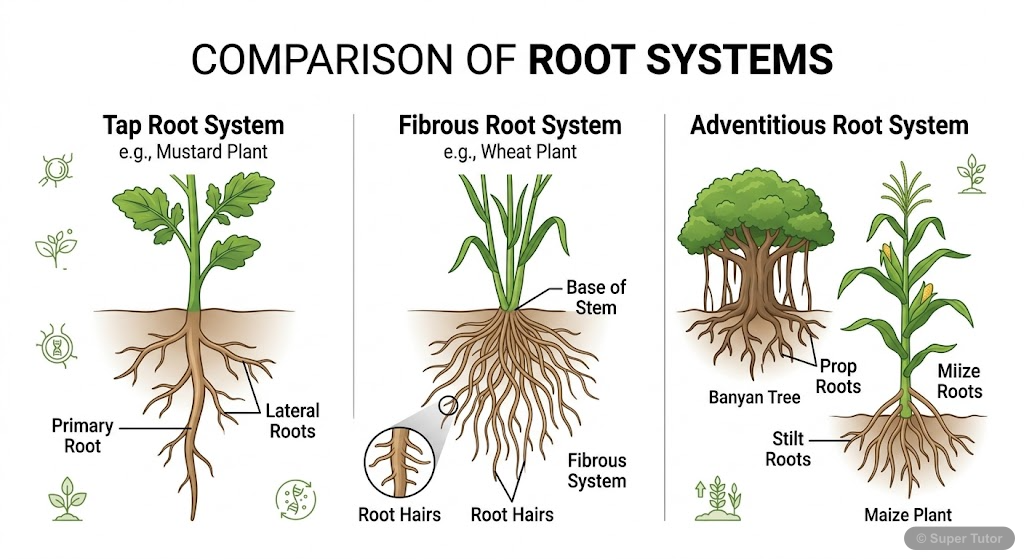
What is the main structural difference between a tap root system and a fibrous root system?
Answer
A tap root system has a main primary root that grows vertically downward with lateral branches (secondary, tertiary roots), as seen in dicots like mustard. A fibrous root system consists of many thin …
Define adventitious roots and provide two examples of plants that have them.
Answer
Adventitious roots are roots that arise from parts of the plant other than the radicle (primary root). They develop from stem, leaf, or other non-root tissues. Examples include: (1) Grass and Monstera…
Describe the four distinct regions of a root tip and their functions.
Answer
From apex to base: (1) Root cap - protects the tender apex as it pushes through soil; (2) Meristematic region - cells are small, thin-walled with dense cytoplasm, divide repeatedly to provide new cell…
What are root hairs and why are they crucial for plant survival?
Answer
Root hairs are fine, delicate, thread-like extensions of epidermal cells in the maturation region of roots. They are crucial because: (1) They dramatically increase the root's surface area for absorpt…
What are the main functions of a plant stem?
Answer
The stem has multiple important functions: (1) Spreading out and supporting branches, leaves, flowers, and fruits in space for maximum light exposure; (2) Transporting water and minerals absorbed by r…
Distinguish between nodes and internodes on a plant stem.
Answer
Nodes are the regions on the stem where leaves and buds originate and attach. They are typically slightly swollen and represent the attachment points. Internodes are the regions between two consecutiv…
What is the difference between a simple leaf and a compound leaf? How can you tell them apart?
Answer
A simple leaf has an entire lamina (blade) or if it has incisions, they do NOT reach the midrib. A compound leaf has incisions that DO reach the midrib, dividing it into separate leaflets. Key distinc…
Compare reticulate venation and parallel venation. Which plant group typically has each?
Answer
Reticulate venation: Veins form an irregular network pattern with smaller veinlets branching and rejoining. The venation resembles a network of roads. Typically found in dicotyledonous plants (dicots)…
+17 more flashcards
Practise AllFrequently Asked Questions
What are the important topics in Morphology of Flowering Plants for Punjab Board Class 11 Biology?
How many flashcards are available for Morphology of Flowering Plants?
How should I revise Morphology of Flowering Plants for Class 11 exams?
Sources & Official References
Content is aligned to the official syllabus. Refer to the board website for the latest curriculum.
More resources for Morphology of Flowering Plants
For serious students
Get the full Morphology of Flowering Plants chapter — start free.
Quizzes, flashcards, an AI doubt solver and a study plan for Punjab Board Class 11 Biology. Free to start, no card needed.