Chapter 5 of 5
Concept Maps
Morphology of Flowering Plants — Concept Maps
Punjab Board · Class 11 · Biology
3 concept maps of Morphology of Flowering Plants for Punjab Board Class 11 Biology, each also written out as a text outline.
45 questions25 flashcards5 concepts
Interactive on Super Tutor
Studying Morphology of Flowering Plants? Get the full interactive chapter.
Quizzes, flashcards, AI doubt-solver and a step-by-step study plan — built for concept maps and more.
Free trial, no card needed.
Super Tutor
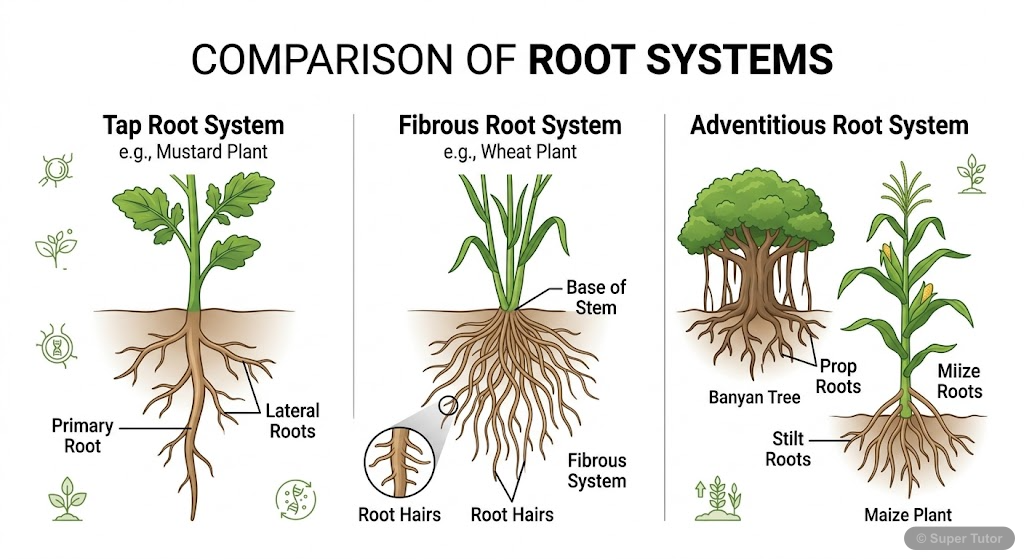
One of 16 illustrations for Morphology of Flowering Plants in Super Tutor — alongside flashcards, concept maps and practice questions.
3 Concept Maps
Classification of leaves into simple and compound types based on lamina division
The map in words
- Leaf Types
- Simple Leaf
- Entire lamina
- Incisions don#39;t touch midrib
- One lamina per petiole
- Compound Leaf
- Multiple leaflets
- Incisions reach midrib
- Two types
- Pinnately Compound
- Leaflets on rachis
- Example: Neem
- Palmately Compound
- Leaflets from center
- Example: Silk cotton
- Pinnately Compound
- Simple Leaf
Three types of phyllotaxy showing different leaf arrangement patterns
The map in words
- Phyllotaxy Patterns
- Alternate
- Single leaf per node
- Leaves alternate
- Examples: China rose, Mustard
- Opposite
- Pair of leaves per node
- Directly opposite
- Examples: Calotropis, Guava
- Whorled
- Multiple leaves per node
- Form a whorl
- Examples: Alstonia
- Alternate
Two major types of inflorescence based on axis growth and flower arrangement
The map in words
- Inflorescence Types
- Racemose
- Main axis continues
- Acropetal succession
- Flowers lateral
- Examples: Mustard, Pea
- Cymose
- Main axis terminates
- Basipetal succession
- Limited growth
- Examples: Celosia
- Racemose
Explore these maps interactively
Explore DiagramsFrequently Asked Questions
What are the important topics in Morphology of Flowering Plants for Punjab Board Class 11 Biology?
Key topics in Morphology of Flowering Plants include The Root System, The Stem, The Leaf, The Inflorescence. Study these first, then practise questions on each for Class 11 exams.
What do the concept maps for Morphology of Flowering Plants show?
The 3 maps show how the ideas in Morphology of Flowering Plants connect: Classification of leaves into simple and compound types based on lamina division; Three types of phyllotaxy showing different leaf arrangement patterns. Each map is also written out as an outline on this page.
How should I revise Morphology of Flowering Plants for Class 11 exams?
Learn the core ideas first, then work through the 45 practice questions on Morphology of Flowering Plants. Revise definitions regularly and use flashcards for quick recall before the exam.
Sources & Official References
Content is aligned to the official syllabus. Refer to the board website for the latest curriculum.
More resources for Morphology of Flowering Plants
For serious students
Get the full Morphology of Flowering Plants chapter — start free.
Quizzes, flashcards, an AI doubt solver and a study plan for Punjab Board Class 11 Biology. Free to start, no card needed.