Animal Kingdom — Flashcards
Punjab Board · Class 11 · Biology
30 flashcards for Animal Kingdom (Punjab Board Class 11 Biology) to test yourself on key terms and facts. Sample: "What are the main criteria used.
Interactive on Super Tutor
Studying Animal Kingdom? Get the full interactive chapter.
Quizzes, flashcards, AI doubt-solver and a step-by-step study plan — built for flashcards and more.
Free trial, no card needed.
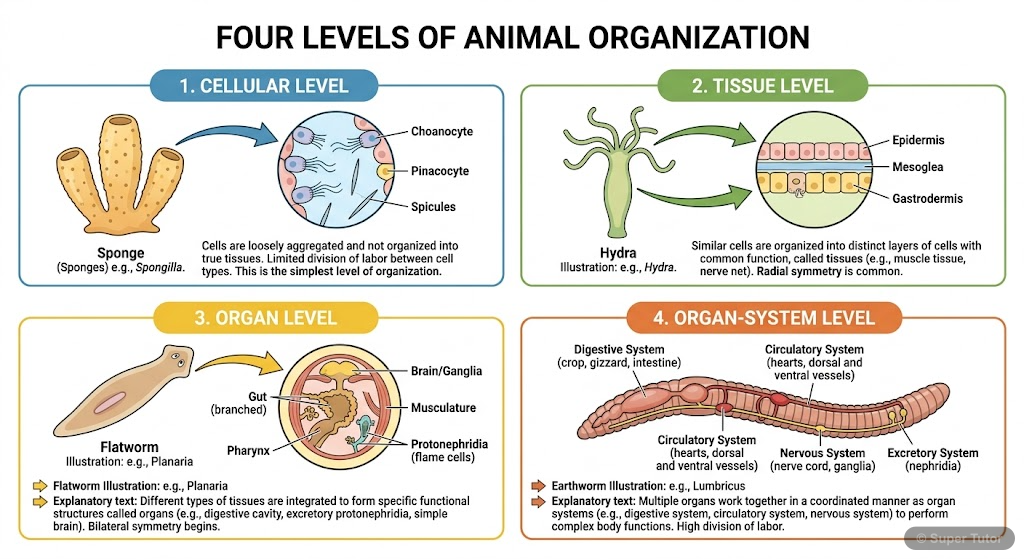
Learn better with visuals Super Tutor pairs illustrations like this with notes and quizzes for Animal Kingdom.
What are the main criteria used to classify animals in the Kingdom Animalia?
Answer
Animals are classified based on fundamental features including: (1) Level of organization (cellular, tissue, organ, organ-system), (2) Body symmetry (asymmetrical, radial, bilateral), (3) Presence of …
Define 'cellular level of organization' and give an example of an animal displaying this level.
Answer
Cellular level of organization occurs when cells are arranged as loose cell aggregates without forming distinct tissues. There is minimal division of labor among cells. The best example is Porifera (s…
What is the difference between tissue level and organ level of organization?
Answer
Tissue level organization occurs when cells performing similar functions are grouped together to form tissues, as seen in Coelenterata (Cnidaria). At this level, tissues work together but do not yet f…
Explain radial symmetry and bilateral symmetry with one example of each.
Answer
Radial symmetry exists when any plane passing through the central axis of the body divides the organism into two identical halves. Examples include Coelenterata, Ctenophora, and adult Echinoderms. Thi…
What are diploblastic and triploblastic animals? Name the germinal layers in each.
Answer
Diploblastic animals have two embryonic germinal layers: (1) External ectoderm and (2) Internal endoderm, with an undifferentiated mesoglea between them. Examples: Coelenterata (Cnidaria). Triploblast…
What is a coelom and how do coelomate, pseudocoelomate, and acoelomate animals differ?
Answer
A coelom is a body cavity lined entirely by mesoderm that separates the gut from the body wall. Coelomates possess a true coelom lined by mesoderm (Examples: Annelida, Mollusca, Arthropoda, Echinoderm…
What is metameric segmentation? In which phylum is it first observed?
Answer
Metameric segmentation (metamerism) is a condition where the body is externally and internally divided into segments with serial repetition of at least some organs. Each segment is called a metamere.
What is a notochord and why is it important in animal classification?
Answer
A notochord is a mesodermally derived, rod-like structure formed on the dorsal side during embryonic development. It provides skeletal support and is the defining characteristic of Phylum Chordata. An…
+22 more flashcards
Practise AllFrequently Asked Questions
What are the important topics in Animal Kingdom for Punjab Board Class 11 Biology?
How many flashcards are available for Animal Kingdom?
How should I revise Animal Kingdom for Class 11 exams?
Sources & Official References
Content is aligned to the official syllabus. Refer to the board website for the latest curriculum.
More resources for Animal Kingdom
For serious students
Get the full Animal Kingdom chapter — start free.
Quizzes, flashcards, an AI doubt solver and a study plan for Punjab Board Class 11 Biology. Free to start, no card needed.