Chapter 4 of 5
Concept Maps
Animal Kingdom — Concept Maps
Punjab Board · Class 11 · Biology
3 concept maps of Animal Kingdom for Punjab Board Class 11 Biology, each also written out as a text outline. Maps: Mind map showing the major.
45 questions30 flashcards5 concepts
Interactive on Super Tutor
Studying Animal Kingdom? Get the full interactive chapter.
Quizzes, flashcards, AI doubt-solver and a step-by-step study plan — built for concept maps and more.
Free trial, no card needed.
Super Tutor
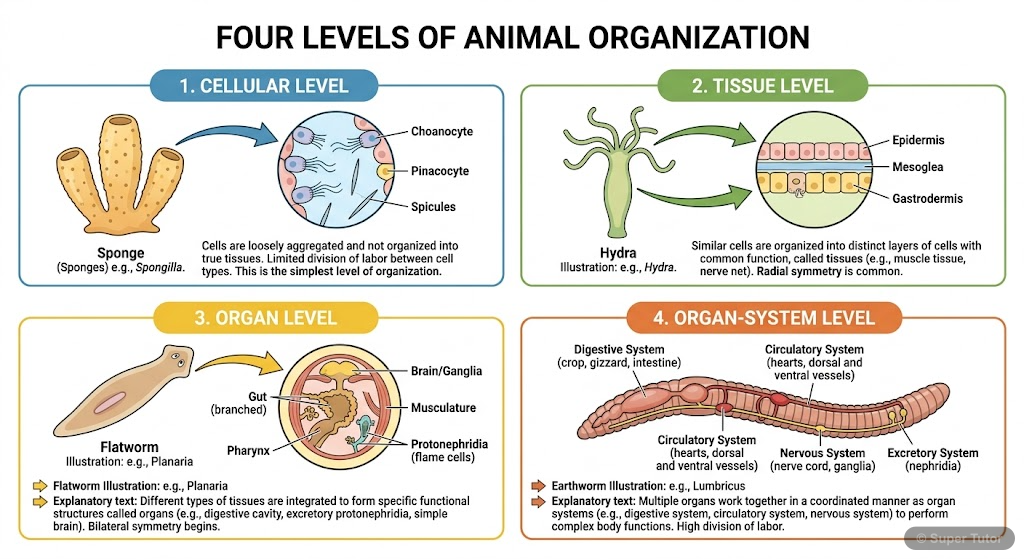
Learn better with visuals Super Tutor pairs illustrations like this with notes and quizzes for Animal Kingdom.
3 Concept Maps
Mind map showing the major classification features used to organize animals in the kingdom
The map in words
- Classification Features
- Level of Organisation
- Cellular
- Tissue
- Organ
- Organ-system
- Body Symmetry
- Radial
- Bilateral
- Asymmetrical
- Coelom Type
- Coelomate
- Pseudocoelomate
- Acoelomate
- Other Features
- Segmentation
- Notochord
- Digestive System
- Level of Organisation
Flowchart showing the progression from simple cellular organization to complex organ systems
The map in words
- Cellular Level
- least complex: Tissue Level
- more complex: Organ Level
- more complex: Organ-System Level
- most complex: Higher Vertebrates
- Example: Mammals/Birds
- Example: Annelida to Chordata
- most complex: Higher Vertebrates
- Example: Platyhelminthes/Flatworms
- more complex: Organ-System Level
- Example: Coelenterata/Jellyfish
- more complex: Organ Level
- Example: Porifera/Sponges
- least complex: Tissue Level
Flowchart illustrating the three types of body symmetry found in animals
The map in words
- Body Symmetry
- Asymmetrical
- No dividing plane
- Example: Sponges
- Radial Symmetry
- Central axis divides equally
- Example: Sea anemone, Starfish
- Bilateral Symmetry
- Left and right halves identical
- Example: Worms, Insects, Vertebrates
- Asymmetrical
Explore these maps interactively
Explore DiagramsFrequently Asked Questions
What are the important topics in Animal Kingdom for Punjab Board Class 11 Biology?
Key topics in Animal Kingdom include Basis of Classification - The Six Key Criteria, Non-Chordate Phyla - Porifera to Hemichordata, Phylum Chordata - Subphyla and Vertebrate Classes, Comparative Summary of All Phyla. Study these first, then practise questions on each for Class 11 exams.
What do the concept maps for Animal Kingdom show?
The 3 maps show how the ideas in Animal Kingdom connect: Mind map showing the major classification features used to organize animals in the kingdom; Flowchart showing the progression from simple cellular organization to complex organ systems. Each map is also written out as an outline on this page.
How should I revise Animal Kingdom for Class 11 exams?
Learn the core ideas first, then work through the 45 practice questions on Animal Kingdom. Revise definitions regularly and use flashcards for quick recall before the exam.
Sources & Official References
Content is aligned to the official syllabus. Refer to the board website for the latest curriculum.
More resources for Animal Kingdom
For serious students
Get the full Animal Kingdom chapter — start free.
Quizzes, flashcards, an AI doubt solver and a study plan for Punjab Board Class 11 Biology. Free to start, no card needed.