Thermodynamics — Concept Maps
Punjab Board · Class 11 · Chemistry
3 concept maps of Thermodynamics for Punjab Board Class 11 Chemistry, each also written out as a text outline.
Interactive on Super Tutor
Studying Thermodynamics? Get the full interactive chapter.
Quizzes, flashcards, AI doubt-solver and a step-by-step study plan — built for concept maps and more.
Free trial, no card needed.
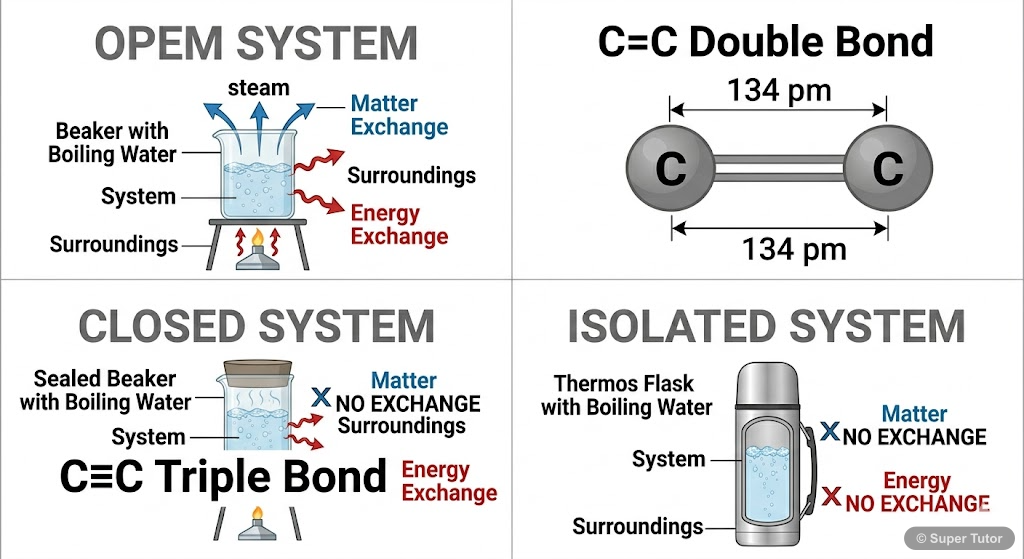
One of 2 illustrations for Thermodynamics in Super Tutor — alongside flashcards, concept maps and practice questions.
Thermodynamics - Complete Chapter Overview
The map in words
- Thermodynamics
- Basic Terms
- System
- Open System
- Closed System
- Isolated System
- Surroundings
- State Functions
- U Internal Energy
- H Enthalpy
- S Entropy
- G Gibbs Energy
- Path Functions
- Heat q
- Work w
- System
- First Law
- Delta U = q + w
- Work
- w = minus pex DeltaV
- Reversible Work
- Free Expansion
- Heat Capacity
- Cv at constant volume
- Cp at constant pressure
- Cp minus Cv = R
- Enthalpy
- H = U + pV
- Delta H = Delta U + Dng RT
- Types of Enthalpy
- Enthalpy of Formation
- Enthalpy of Combustion
- Enthalpy of Fusion
- Enthalpy of Vaporization
- Bond Enthalpy
- Lattice Enthalpy
- Hess Law
- Path Independence
- Born Haber Cycle
- Spontaneity
- Entropy S
- Disorder Measure
- Delta S = qrev div T
- Second Law
- Gibbs Energy G
- G = H minus TS
- Delta G = Delta H minus T Delta S
- Delta G less than 0 Spontaneous
- Delta G = 0 Equilibrium
- Equilibrium Connection
- Delta G = minus RT ln K
- K greater than 1 Spontaneous
- Entropy S
- Basic Terms
Thermodynamics — Complete Chapter Overview
The map in words
- Thermodynamics
- Basic Concepts
- System
- Open System
- Closed System
- Isolated System
- Surroundings
- State Functions
- Internal Energy U
- Enthalpy H
- Entropy S
- Gibbs Energy G
- Path Functions
- Heat q
- Work w
- System
- First Law
- Delta U = q + w
- Adiabatic Process
- Isothermal Process
- Free Expansion
- Reversible Work
- Enthalpy
- H = U + pV
- Delta H = q at constant p
- Delta H = Delta U + DeltaNg RT
- Exothermic Delta H negative
- Endothermic Delta H positive
- Calorimetry
- Bomb Calorimeter
- Constant Volume
- Measures Delta U
- Pressure Calorimeter
- Constant Pressure
- Measures Delta H
- Bomb Calorimeter
- Enthalpy Types
- Formation
- Combustion
- Atomization
- Bond Enthalpy
- Lattice Enthalpy
- Phase Changes
- Hess Law
- Path Independence
- Born Haber Cycle
- Algebraic Addition
- Spontaneity
- Entropy S
- Disorder Randomness
- Delta S = qrev / T
- Second Law
- Delta S universe > 0
- Third Law
- S = 0 at 0K
- Entropy S
- Gibbs Energy
- G = H - TS
- Delta G = Delta H - T Delta S
- Spontaneous Delta G < 0
- Equilibrium Delta G = 0
- Delta G = -RT ln K
- Basic Concepts
Thermodynamics Concepts Overview
The map in words
- Thermodynamics
- System and Surroundings
- Open System
- Closed System
- Isolated System
- First Law ΔU = q + w
- Internal Energy U
- Heat q
- Work w
- Enthalpy H = U + pV
- Formation ΔfH°
- Combustion ΔcH°
- Phase Changes
- Bond Enthalpy
- Entropy S
- Disorder Measure
- ΔS = qrev/T
- Second Law
- Gibbs Energy G = H - TS
- ΔG = ΔH - TΔS
- Spontaneity Criterion
- Equilibrium Constant
- Measurement
- Calorimetry
- Hess's Law
- Tables of Values
- System and Surroundings
Explore these maps interactively
Explore DiagramsFrequently Asked Questions
What are the important topics in Thermodynamics for Punjab Board Class 11 Chemistry?
What do the concept maps for Thermodynamics show?
How should I revise Thermodynamics for Class 11 exams?
Sources & Official References
Content is aligned to the official syllabus. Refer to the board website for the latest curriculum.
More resources for Thermodynamics
Practice Quiz
Test yourself with a quick quiz
Important Questions
Exam-style questions with answers
Revision Notes
Key points for last-minute revision
Formula Sheet
The chapter's formulas in one place
Chapter Summary
Understand the chapter at a glance
Flashcards
Quick-fire cards for active recall
Syllabus
What topics to cover
For serious students
Get the full Thermodynamics chapter — start free.
Quizzes, flashcards, an AI doubt solver and a study plan for Punjab Board Class 11 Chemistry. Free to start, no card needed.