Thermodynamics — Flashcards
Punjab Board · Class 11 · Chemistry
25 flashcards for Thermodynamics (Punjab Board Class 11 Chemistry) to test yourself on key terms and facts. Sample: "Define a thermodynamic system.
Interactive on Super Tutor
Studying Thermodynamics? Get the full interactive chapter.
Quizzes, flashcards, AI doubt-solver and a step-by-step study plan — built for flashcards and more.
Free trial, no card needed.
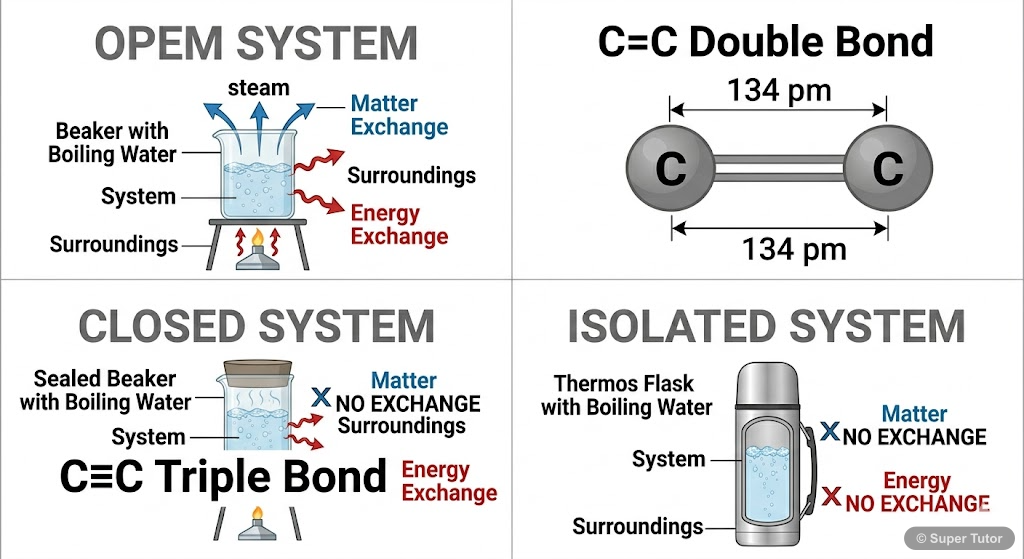
One of 2 illustrations for Thermodynamics in Super Tutor — alongside flashcards, concept maps and practice questions.
Define a thermodynamic system and distinguish between open, closed, and isolated systems with one example each.
Answer
System: The part of universe where observations are made. Surroundings: Everything else. Open System: Exchange of both matter and energy. Example: Reactants in an open beaker. Closed System: Exchang…
What is internal energy (U)? Why is it a state function?
Answer
Internal Energy (U): Sum of all forms of energy in a system (chemical, mechanical, electrical, etc.). State Function Property: The change in internal energy (ΔU) depends ONLY on initial and final sta…
Calculate work done when 2 liters of ideal gas at 10 atm pressure expands to 10 liters against external pressure of 1 atm.
Answer
Given: V_initial = 2 L, V_final = 10 L, p_external = 1 atm Formula: w = -p_ext × ΔV Step 1: ΔV = V_final - V_initial = 10 - 2 = 8 L Step 2: w = -1 atm × 8 L = -8 L·atm Step 3: Convert to joules: w…
State the First Law of Thermodynamics and explain its significance.
Answer
First Law Statement: 'Energy of an isolated system is constant' or 'Energy cannot be created or destroyed, only converted.' Mathematical Form: ΔU = q + w Where: - ΔU = change in internal energy - q …
What is enthalpy (H)? How does it relate to internal energy?
Answer
Enthalpy (H): Defined as H = U + pV Where: U = internal energy, p = pressure, V = volume Change in Enthalpy: ΔH = ΔU + Δ(pV) At constant pressure: ΔH = ΔU + pΔV Key Relationship: ΔH = ΔU + Δn_g RT…
Calculate internal energy change (ΔU) for vaporization of 1 mole of water at 100°C and 1 bar, given ΔH_vap = 41.00 kJ/mol.
Answer
Given: ΔH_vap = 41.00 kJ/mol, T = 373 K, 1 mole water Formula: ΔU = ΔH - Δn_g RT Step 1: Identify Δn_g H₂O(l) → H₂O(g) Δn_g = 1 (product) - 0 (reactant) = 1 mole Step 2: Calculate Δn_g RT Δn_g RT =…
What is the difference between extensive and intensive properties? Give three examples of each.
Answer
Extensive Properties: Depend on the quantity or size of matter present Examples: 1. Mass - increases when amount of substance increases 2. Volume - larger sample has larger volume 3. Internal energy (…
Define heat capacity and molar heat capacity. Calculate heat required to raise temperature of 50g water by 10°C (specific heat of water = 4.18 J/g°C).
Answer
Heat Capacity (C): Amount of heat required to raise temperature of substance by 1°C (or 1 K) Formula: q = C × ΔT Molar Heat Capacity (C_m): Heat capacity per mole of substance Formula: C_m = C/n Spe…
+17 more flashcards
Practise AllFrequently Asked Questions
What are the important topics in Thermodynamics for Punjab Board Class 11 Chemistry?
How many flashcards are available for Thermodynamics?
How should I revise Thermodynamics for Class 11 exams?
Sources & Official References
Content is aligned to the official syllabus. Refer to the board website for the latest curriculum.
More resources for Thermodynamics
Practice Quiz
Test yourself with a quick quiz
Important Questions
Exam-style questions with answers
Revision Notes
Key points for last-minute revision
Formula Sheet
The chapter's formulas in one place
Chapter Summary
Understand the chapter at a glance
Concept Maps
See how topics connect
Syllabus
What topics to cover
For serious students
Get the full Thermodynamics chapter — start free.
Quizzes, flashcards, an AI doubt solver and a study plan for Punjab Board Class 11 Chemistry. Free to start, no card needed.