Thermodynamics — Syllabus
Punjab Board · Class 11 · Chemistry
What Thermodynamics covers in Punjab Board Class 11 Chemistry: 4 topics, for the 2026-27 session. Part of the Punjab Board Class 11 Chemistry syllabus.
Interactive on Super Tutor
Studying Thermodynamics? Get the full interactive chapter.
Quizzes, flashcards, AI doubt-solver and a step-by-step study plan — built for syllabus and more.
Free trial, no card needed.
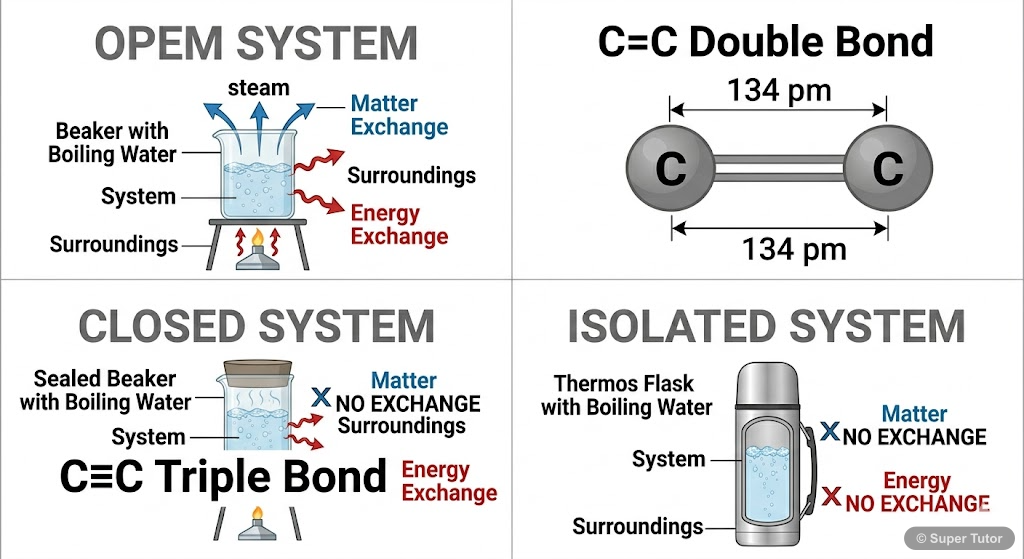
One of 2 illustrations for Thermodynamics in Super Tutor — alongside flashcards, concept maps and practice questions.
Topics in Thermodynamics
1. Basic Thermodynamic Terms: System, Surroundings, and Types of Systems
- The SYSTEM is the part of the universe under study. The SURROUNDINGS is everything else. Together, System + Surroundings = Universe.
- OPEN SYSTEM: Both matter AND energy can be exchanged with surroundings. Example: Reactants in an open beaker.
- CLOSED SYSTEM: Only ENERGY can be exchanged, NOT matter. Example: Reactants in a sealed copper vessel.
2. Internal Energy, Work, Heat, and the First Law of Thermodynamics
- INTERNAL ENERGY (U) is the total energy of the system — sum of all kinetic and potential energies of all particles.
- Internal energy is a STATE FUNCTION. We can only measure CHANGE in internal energy (ΔU), not absolute U.
- WORK (w): When external pressure pex compresses a gas from Vi to Vf, work done on system = w = −pex × ΔV.
3. Enthalpy (H), Heat Capacity, and Relationship Between ΔH and ΔU
- ENTHALPY (H) = U + pV. It is a state function defined to handle constant pressure processes.
- At constant pressure: ΔH = qp. Heat absorbed at constant pressure equals change in enthalpy.
- Relationship: ΔH = ΔU + ΔngRT, where Δng = moles of gaseous products − moles of gaseous reactants.
4. Enthalpy Changes: Standard Enthalpy, Formation, Combustion, Hess's Law
- STANDARD STATE: Pure form of a substance at 1 bar pressure and specified temperature (usually 298 K). Denoted by superscript ⊖.
- STANDARD ENTHALPY OF REACTION (Δr H⊖): Enthalpy change when reaction occurs with all substances in standard states.
- STANDARD ENTHALPY OF FORMATION (Δf H⊖): Enthalpy change when 1 mole of a compound is formed from its elements in their most stable reference states.
Key Concepts
Work through every topic in Thermodynamics with notes and quizzes
Start This ChapterFrequently Asked Questions
What are the important topics in Thermodynamics for Punjab Board Class 11 Chemistry?
How should I revise Thermodynamics for Class 11 exams?
Sources & Official References
Content is aligned to the official syllabus. Refer to the board website for the latest curriculum.
More resources for Thermodynamics
Practice Quiz
Test yourself with a quick quiz
Important Questions
Exam-style questions with answers
Revision Notes
Key points for last-minute revision
Formula Sheet
The chapter's formulas in one place
Chapter Summary
Understand the chapter at a glance
Concept Maps
See how topics connect
Flashcards
Quick-fire cards for active recall
For serious students
Get the full Thermodynamics chapter — start free.
Quizzes, flashcards, an AI doubt solver and a study plan for Punjab Board Class 11 Chemistry. Free to start, no card needed.