Thermodynamics — Chapter Summary
Punjab Board · Class 11 · Chemistry
Summary of Thermodynamics for Punjab Board Class 11 Chemistry. Key concepts: In thermodynamics, Internal energy is the sum and Work (w) in chemistry.
Interactive on Super Tutor
Studying Thermodynamics? Get the full interactive chapter.
Quizzes, flashcards, AI doubt-solver and a step-by-step study plan — built for chapter summary and more.
Free trial, no card needed.
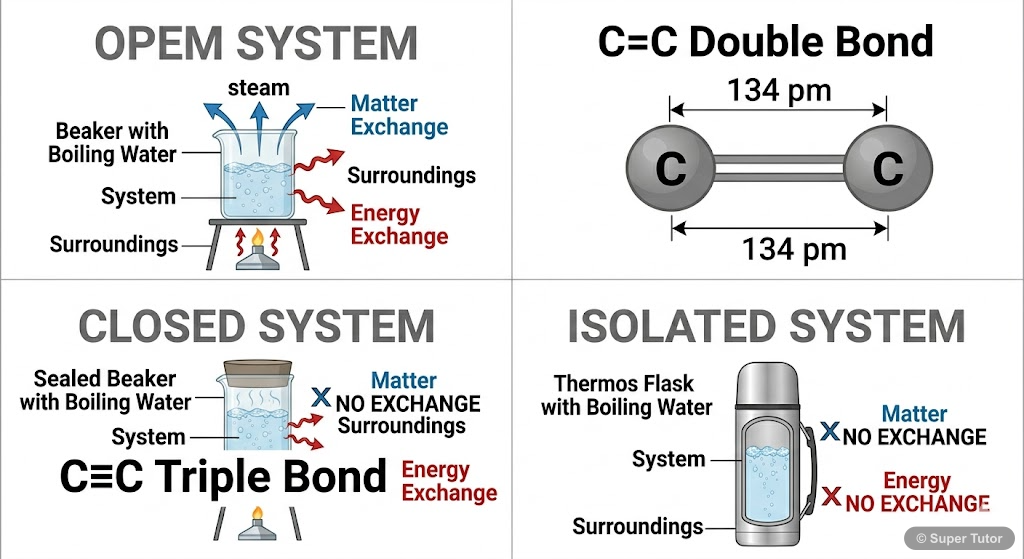
One of 2 illustrations for Thermodynamics in Super Tutor — alongside flashcards, concept maps and practice questions.
Overview
Thermodynamics is the study of energy transformations in chemical and physical processes. It deals with macroscopic systems involving large numbers of molecules and focuses on initial and final states rather than the path taken. Understanding thermodynamics helps us answer fundamental questions: How
Key Concepts
In thermodynamics
In thermodynamics, the system is the part of the universe we observe (e.g., reactants in a beaker), while surroundings include everything else that in
Internal energy is the sum
Internal energy is the sum of all energy in a system (chemical, electrical, mechanical). It's a state function, meaning its value depends only on the
Work (w) in chemistry primarily refers
Work (w) in chemistry primarily refers to pressure-volume work: w = -pΔV. For reversible isothermal processes with ideal gases: w_rev = -nRT ln(V_f/V_
Enthalpy H = U + pV
Enthalpy H = U + pV is a state function particularly useful at constant pressure. At constant pressure, ΔH = q_p (heat absorbed equals enthalpy change
Calorimetry measures heat changes
Calorimetry measures heat changes: q = CΔT, where C is heat capacity. Bomb calorimeters measure ΔU at constant volume (sealed vessel). Coffee-cup calo
Learning Objectives
- Understand and distinguish between different types of thermodynamic systems (open, closed, isolated)
- Apply the First Law of Thermodynamics to calculate internal energy changes
- Calculate and interpret enthalpy changes in chemical reactions
- Measure energy changes experimentally using calorimetry
- Apply Hess's Law to determine enthalpy changes for unmeasurable reactions
Frequently Asked Questions
What are the important topics in Thermodynamics for Punjab Board Class 11 Chemistry?
How should I revise Thermodynamics for Class 11 exams?
Sources & Official References
Content is aligned to the official syllabus. Refer to the board website for the latest curriculum.
More resources for Thermodynamics
For serious students
Get the full Thermodynamics chapter — start free.
Quizzes, flashcards, an AI doubt solver and a study plan for Punjab Board Class 11 Chemistry. Free to start, no card needed.