Chemical Bonding and Molecular Structure — Practice Quiz
Punjab Board · Class 11 · Chemistry
Try a 4-question quiz on Chemical Bonding and Molecular Structure for Punjab Board Class 11 Chemistry: tap an answer to check it and see why.
Interactive on Super Tutor
Studying Chemical Bonding and Molecular Structure? Get the full interactive chapter.
Quizzes, flashcards, AI doubt-solver and a step-by-step study plan — built for practice quiz and more.
Free trial, no card needed.
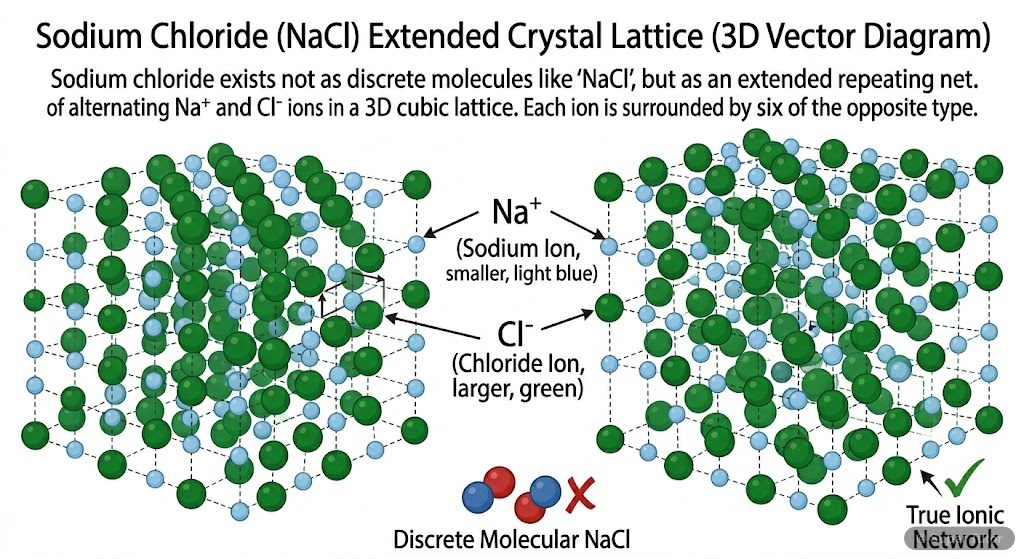
One of 17 illustrations for Chemical Bonding and Molecular Structure in Super Tutor — alongside flashcards, concept maps and practice questions.
Quick Quiz: Chemical Bonding and Molecular Structure
0/4Tap an answer to check it instantly. No sign-up needed for these 4.
The formal charge on the central oxygen atom in ozone (O₃) is:
Which of the following molecules has the HIGHEST bond angle among the given options?
In Molecular Orbital Theory, the bond order of O₂⁻ (superoxide ion) is:
Which of the following statements correctly explains why NH₃ has a higher dipole moment than NF₃, even though F is more electronegative than H?
Sample Questions
In PCl₅, the axial P–Cl bonds are slightly longer and weaker than the equatorial P–Cl bonds. What is the correct reason?
Show answer
Axial bond pairs face more repulsion from equatorial bond pairs (at 90°) than equatorial bonds face from each other (at 120°)
Step 1: In PCl₅ (sp³d hybridisation), three Cl atoms occupy equatorial positions (120° apart) and two Cl atoms occupy axial positions (90° from equatorial plane). Step 2: Each axial bond pair is at 90° from all three equatorial bond pairs — this is a strong, close-range repulsion. Step 3: Each equatorial bond pair is at 120° from the other two equatorial pairs — a weaker, wider-angle repulsion. Step 4: Because axial bonds suffer greater repulsion, they are pushed outward slightly, making them longer (and weaker). Step 5: This makes PCl₅ more reactive because the axial Cl atoms are easier to di
Which of the following species is INCORRECT when matched with its hybridisation?
Show answer
ClF₃ → sp³
Step 1: ClF₃ has Cl as the central atom. Cl has 7 valence electrons and forms 3 bonds with F, leaving 2 lone pairs. Step 2: Total electron pairs = 3 (bond pairs) + 2 (lone pairs) = 5. Step 3: With 5 electron pairs, the hybridisation is sp³d (not sp³ which only accounts for 4 pairs). Step 4: sp³d gives a trigonal bipyramidal electron geometry; with 2 lone pairs in equatorial positions, the molecular shape is T-shaped. Step 5: sp³ would only be correct for 4 electron pairs. So ClF₃ → sp³d is correct, making ClF₃ → sp³ the wrong match.
The bond order of N₂ according to Molecular Orbital Theory is 3, and it is diamagnetic. Which MO configuration correctly represents N₂?
Show answer
KK(σ2s)²(σ*2s)²(σ2pz)²(π2px)²(π2py)²
Step 1: N has 7 electrons; N₂ has 14 electrons total. KK accounts for 4 electrons (σ1s² and σ*1s²). Step 2: For N₂ (lighter molecule), the correct MO order puts (π2p) BELOW (σ2pz): KK(σ2s)²(σ*2s)²(π2px)²(π2py)²(σ2pz)². Step 3: Both orderings give the same electron population here; Nb = 10, Na = 4. Step 4: Bond order = ½(10 – 4) = 3. The configuration KK(σ2s)²(σ*2s)²(σ2pz)²(π2px)²(π2py)² also gives the same count: Nb=10, Na=4. Step 5: All electrons are paired, confirming diamagnetic nature. Option A correctly lists all bonding MOs fully filled with no antibonding electrons beyond σ*2s.
Which of the following correctly explains why CO₂ has zero dipole moment despite having polar C=O bonds?
Show answer
CO₂ is a linear molecule; the two equal and opposite C=O bond dipoles cancel each other vectorially
Step 1: Each C=O bond is polar because oxygen is more electronegative than carbon, so each bond has a dipole moment pointing from C toward O. Step 2: In CO₂, the carbon is sp hybridised, making the molecule perfectly linear (bond angle = 180°). Step 3: The two C=O dipoles point in exactly opposite directions along the same axis. Step 4: Since dipole moment is a vector quantity, these two equal but opposite vectors cancel completely: μ(net) = μ₁ – μ₂ = 0. Step 5: This is why CO₂ is nonpolar overall despite having polar bonds — symmetry of the molecule is the key factor. Compare this with H₂O (b
+40 more questions on Chemical Bonding and Molecular Structure (Punjab Board Class 11 Chemistry)
Practise AllFrequently Asked Questions
What are the important topics in Chemical Bonding and Molecular Structure for Punjab Board Class 11 Chemistry?
How many practice questions are there for Chemical Bonding and Molecular Structure?
Sources & Official References
Content is aligned to the official syllabus. Refer to the board website for the latest curriculum.
More resources for Chemical Bonding and Molecular Structure
For serious students
Get the full Chemical Bonding and Molecular Structure chapter — start free.
Quizzes, flashcards, an AI doubt solver and a study plan for Punjab Board Class 11 Chemistry. Free to start, no card needed.