Structure of Atom — Practice Quiz
Punjab Board · Class 11 · Chemistry
Try a 4-question quiz on Structure of Atom for Punjab Board Class 11 Chemistry: tap an answer to check it and see why.
Interactive on Super Tutor
Studying Structure of Atom? Get the full interactive chapter.
Quizzes, flashcards, AI doubt-solver and a step-by-step study plan — built for practice quiz and more.
Free trial, no card needed.
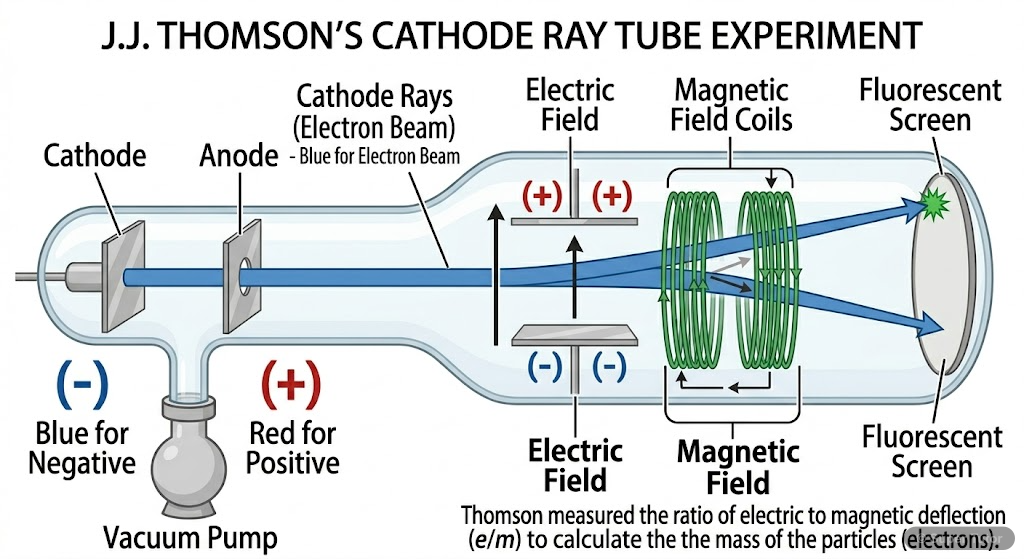
Learn better with visuals Super Tutor pairs illustrations like this with notes and quizzes for Structure of Atom.
Quick Quiz: Structure of Atom
0/4Tap an answer to check it instantly. No sign-up needed for these 4.
Which sub-atomic particle was discovered using the cathode ray discharge tube experiment?
J.J. Thomson measured the charge-to-mass ratio (e/mₑ) of an electron. What is the accepted value of this ratio?
Millikan's oil drop experiment determined which property of the electron?
Which scientist discovered the neutron by bombarding beryllium with alpha particles?
Sample Questions
In Thomson's model of the atom, how are electrons arranged?
Show answer
Electrons are embedded in a uniform sphere of positive charge
Step 1: J.J. Thomson proposed his atomic model in 1898. Step 2: He described the atom as a positively charged sphere (radius ~10⁻¹⁰ m) in which positive charge is uniformly distributed. Step 3: Electrons are embedded in this sphere like plums in a pudding, which is why it is called the 'plum pudding model'. Step 4: This model explained overall electrical neutrality of the atom. Step 5: However, it was disproved by Rutherford's alpha-particle scattering experiment. The other options describe Rutherford's model, a misconception, and the quantum mechanical model respectively.
In Rutherford's alpha-particle scattering experiment, what was the observation that led him to propose the existence of a nucleus?
Show answer
A very few alpha particles (~1 in 20,000) bounced back at nearly 180°
Step 1: Rutherford directed a beam of alpha particles at a thin gold foil. Step 2: Most alpha particles passed straight through, showing the atom is mostly empty space. Step 3: A small fraction was deflected by small angles due to repulsion from positive charges. Step 4: A very few (~1 in 20,000) bounced back at nearly 180° – this was the key surprise. Step 5: This 'head-on' collision was only possible if a very small, dense, positively charged region (the nucleus) existed at the centre of the atom. If positive charge were spread out (as in Thomson's model), no such large-angle deflection woul
For the atom ⁸⁰₃₅Br, what is the number of neutrons present in the nucleus?
Show answer
45
Step 1: The notation ⁸⁰₃₅Br tells us: mass number A = 80, atomic number Z = 35. Step 2: Atomic number Z = number of protons = 35. Step 3: Using the formula: Number of neutrons = A − Z. Step 4: Number of neutrons = 80 − 35 = 45. Step 5: The option '35' is the number of protons (= electrons for a neutral atom), '80' is the mass number, and '115' is the incorrect sum instead of difference.
Atoms that have the same mass number but different atomic numbers are called:
Show answer
Isobars
Step 1: The prefix 'iso' means same, 'bar' relates to mass (like barometer measures pressure/weight). Step 2: Isobars: same mass number (A), different atomic number (Z). Example: ¹⁴₆C and ¹⁴₇N both have A = 14. Step 3: Isotopes: same atomic number (Z), different mass number (A). Example: ¹H, ²H (deuterium), ³H (tritium) all have Z = 1. Step 4: Isotones: same number of neutrons but different atomic numbers. Step 5: Allotropes are different physical forms of the same element (like diamond and graphite for carbon) – not related to nuclear composition.
+41 more questions on Structure of Atom (Punjab Board Class 11 Chemistry)
Practise AllFrequently Asked Questions
What are the important topics in Structure of Atom for Punjab Board Class 11 Chemistry?
How many practice questions are there for Structure of Atom?
Sources & Official References
Content is aligned to the official syllabus. Refer to the board website for the latest curriculum.
More resources for Structure of Atom
Important Questions
Exam-style questions with answers
Revision Notes
Key points for last-minute revision
Formula Sheet
The chapter's formulas in one place
Chapter Summary
Understand the chapter at a glance
Concept Maps
See how topics connect
Flashcards
Quick-fire cards for active recall
Syllabus
What topics to cover
For serious students
Get the full Structure of Atom chapter — start free.
Quizzes, flashcards, an AI doubt solver and a study plan for Punjab Board Class 11 Chemistry. Free to start, no card needed.