Classification of Elements and Periodicity in Properties — Practice Quiz
Punjab Board · Class 11 · Chemistry
Try a 4-question quiz on Classification of Elements and Periodicity in Properties for Punjab Board Class 11 Chemistry: tap an answer to check it and see.
Interactive on Super Tutor
Studying Classification of Elements and Periodicity in Properties? Get the full interactive chapter.
Quizzes, flashcards, AI doubt-solver and a step-by-step study plan — built for practice quiz and more.
Free trial, no card needed.
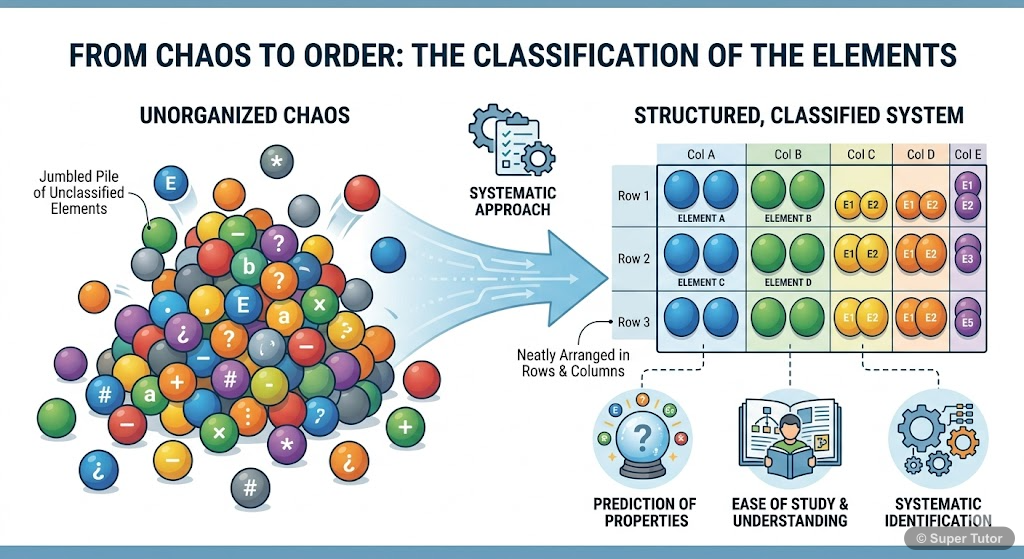
Learn better with visuals Super Tutor pairs illustrations like this with notes and quizzes for Classification of Elements and Periodicity in Properties.
Quick Quiz: Classification of Elements and Periodicity in Properties
0/4Tap an answer to check it instantly. No sign-up needed for these 4.
The first ionization enthalpy of oxygen (1314 kJ/mol) is LESS than that of nitrogen (1402 kJ/mol) despite oxygen having a higher atomic number. What is the correct reason for this anomaly?
Which of the following arrangements correctly represents the isoelectronic species O²⁻, F⁻, Na⁺, and Mg²⁺ in order of INCREASING ionic radius?
The IUPAC systematic name for the element with atomic number 119 would be:
Element X has the electronic configuration [Xe] 4f¹⁴ 5d¹⁰ 6s² 6p⁵. Which of the following statements about element X is CORRECT?
Sample Questions
Na₂O reacts with water to form NaOH (basic oxide), while Cl₂O₇ reacts with water to form HClO₄ (acidic oxide). Which of the following oxides would be expected to be AMPHOTERIC?
Show answer
Al₂O₃
Step 1: Oxides are classified based on the position of the element in the periodic table. Elements on the far left (metals) form basic oxides; elements on the far right (non-metals) form acidic oxides. Step 2: Elements near the border between metals and non-metals (metalloids or elements with intermediate character) form amphoteric oxides — they can react with both acids and bases. Step 3: Aluminium (Al) is a metal that lies near the boundary. Al₂O₃ reacts with acids: Al₂O₃ + 6HCl → 2AlCl₃ + 3H₂O AND with bases: Al₂O₃ + 2NaOH → 2NaAlO₂ + H₂O. Step 4: MgO is a basic oxide (Group 2 metal). SO₃ i
The first ionization enthalpy of Al (577 kJ/mol) is LOWER than that of Mg (738 kJ/mol), even though Al has a higher atomic number. The BEST explanation is:
Show answer
The 3p electron in Al is more shielded and at higher energy than the 3s electron in Mg, making it easier to remove.
Step 1: Mg has the configuration [Ne] 3s². The electron removed is a 3s electron. Step 2: Al has the configuration [Ne] 3s² 3p¹. The electron removed is the 3p electron. Step 3: 3p orbitals are higher in energy than 3s orbitals. The 3p electron also has poorer penetration to the nucleus and is more effectively shielded by the 3s² electrons of Al itself. Step 4: Therefore, less energy is needed to remove the 3p electron from Al compared to the 3s electron from Mg — making Al's first ionization enthalpy lower. Step 5: Option A is wrong — Mg is actually larger than Al, but that alone doesn't expl
Mendeleev left gaps in his Periodic Table for undiscovered elements and named one 'Eka-Silicon'. He predicted its density as 5.5 g/cm³. The element discovered later (Germanium) had a density of 5.36 g/cm³. This achievement demonstrates which key strength of Mendeleev's Periodic Table?
Show answer
Mendeleev's table could predict the existence and properties of undiscovered elements.
Step 1: One of the greatest achievements of Mendeleev's Periodic Table was its PREDICTIVE POWER. Step 2: He identified gaps in the table based on patterns in properties and boldly predicted the existence, atomic mass, density, and oxide/chloride formulas of missing elements. Step 3: He named them Eka-Boron (Scandium), Eka-Aluminium (Gallium), and Eka-Silicon (Germanium). The predicted and observed properties matched remarkably well. Step 4: Option A is wrong — Mendeleev himself had to make exceptions, like placing tellurium before iodine ignoring atomic mass order. Step 5: Option C is wrong —
Which of the following correctly explains WHY atomic radius DECREASES across a period from left to right?
Show answer
The effective nuclear charge increases across a period as electrons are added to the same shell without significantly increasing shielding.
Step 1: As we move across a period, atomic number (and hence nuclear charge) increases by 1 each step. Step 2: Each new electron is added to the SAME principal energy level (e.g., n=2 for Period 2). Step 3: Electrons in the same shell do not shield each other very effectively from the nucleus — so the shielding does not increase proportionally. Step 4: Result: The effective nuclear charge (= actual nuclear charge − shielding) increases steadily across the period. Step 5: This increased attraction pulls all electrons, including valence electrons, closer to the nucleus → atomic radius decreases.
+41 more questions on Classification of Elements and Periodicity in Properties (Punjab Board Class 11 Chemistry)
Practise AllFrequently Asked Questions
What are the important topics in Classification of Elements and Periodicity in Properties for Punjab Board Class 11 Chemistry?
How many practice questions are there for Classification of Elements and Periodicity in Properties?
Sources & Official References
Content is aligned to the official syllabus. Refer to the board website for the latest curriculum.
More resources for Classification of Elements and Periodicity in Properties
For serious students
Get the full Classification of Elements and Periodicity in Properties chapter — start free.
Quizzes, flashcards, an AI doubt solver and a study plan for Punjab Board Class 11 Chemistry. Free to start, no card needed.