Electric Charges and Fields — Concept Maps
Punjab Board · Class 12 · Physics
3 concept maps of Electric Charges and Fields for Punjab Board Class 12 Physics, each also written out as a text outline.
Interactive on Super Tutor
Studying Electric Charges and Fields? Get the full interactive chapter.
Quizzes, flashcards, AI doubt-solver and a step-by-step study plan — built for concept maps and more.
Free trial, no card needed.
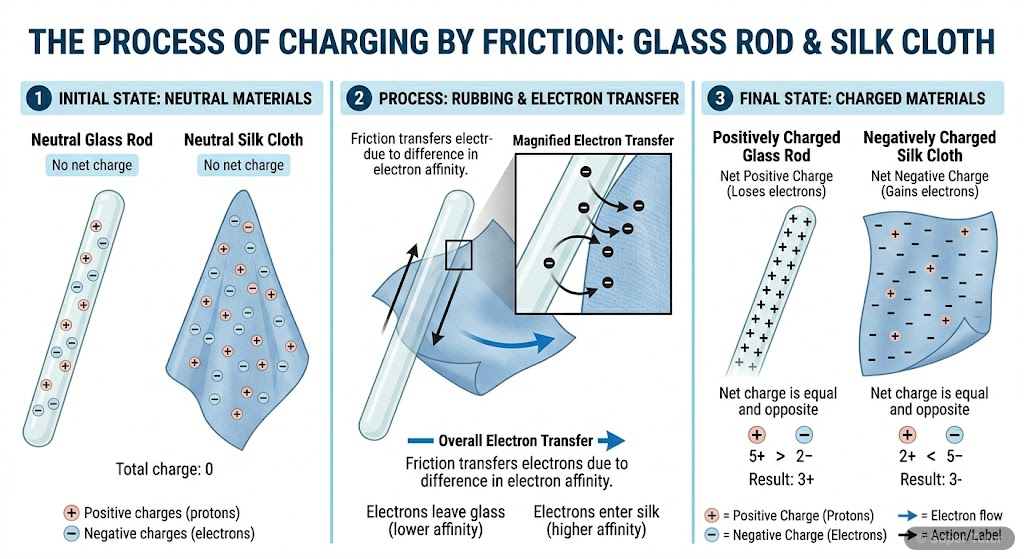
Learn better with visuals Super Tutor pairs illustrations like this with notes and quizzes for Electric Charges and Fields.
Chapter 1: Electric Charges and Fields – Complete Concept Map
The map in words
- Electric Charges and Fields
- Electric Charge
- Two Types
- Positive Charge
- Negative Charge
- Like charges repel
- Unlike charges attract
- Unit is Coulomb C
- Three Properties
- Quantisation q = ne
- Additivity algebraic sum
- Conservation isolated system
- Two Types
- Materials
- Conductors
- Metals
- Human body
- Earth
- Insulators
- Glass
- Plastic
- Rubber
- Conductors
- Coulombs Law
- F = kq1q2 divided by r squared
- k = 9 times 10 to 9 Nm2 per C2
- Inverse square law
- Obeys Newton Third Law
- Vector form with unit vectors
- Superposition Principle
- Total force = vector sum
- Each pair unaffected by others
- Pairwise interactions only
- Electric Field
- E = F per q
- Unit N per C
- Point charge E = kQ per r squared
- Radially outward for positive Q
- Radially inward for negative Q
- Superposition applies
- Electric Field Lines
- Start at positive charges
- End at negative charges
- Never cross each other
- No closed loops
- Density shows field strength
- Electric Dipole
- Two equal opposite charges
- Separation 2a
- Dipole moment p = q times 2a
- Axial field 2p over 4 pi eps0 r3
- Equatorial field p over 4 pi eps0 r3
- Torque tau = p cross E
- Net force zero in uniform field
- Electric Flux
- Phi = E dot S = ES cos theta
- Unit Nm2 per C
- Max when E perpendicular to surface
- Zero when E parallel to surface
- Gauss Law
- Phi = q enclosed per eps0
- Valid for any closed surface
- Three Applications
- Long wire E = lambda over 2 pi eps0 r
- Infinite sheet E = sigma over 2 eps0
- Spherical shell
- Outside E = q over 4 pi eps0 r2
- Inside E = zero
- Electric Charge
Electric Charges and Fields – Complete Chapter Overview
The map in words
- Electric Charges and Fields
- Electric Charge
- Two Types
- Positive
- Negative
- Properties
- Additivity
- Conservation
- Quantisation q equals ne
- Units
- Coulomb C
- Microcoulomb uC
- e equals 1.6 x 10⁻¹⁹ C
- Two Types
- Conductors and Insulators
- Conductors
- Free electrons
- Metals, human body
- Insulators
- Bound electrons
- Glass, rubber, plastic
- Conductors
- Coulombs Law
- F equals kq1q2 divided by r squared
- k equals 9 x 10 power 9 Nm2 per C2
- Vector Form
- Newton Third Law satisfied
- In medium F reduces by factor K
- Superposition Principle
- Vector sum of all forces
- Individual forces unaffected
- Components method
- Electric Field
- E equals F divided by q
- Unit N per C or V per m
- Point charge E equals kQ divided by r squared
- Superposition applies
- Field Lines
- Start at positive end at negative
- Never cross
- Density shows strength
- No closed loops
- Electric Dipole
- p equals q times 2a
- Direction minus q to plus q
- Axial E equals 2kp divided by r cubed
- Equatorial E equals kp divided by r cubed
- In Uniform Field
- Net Force zero
- Torque tau equals p cross E
- Electric Flux
- phi equals E dot S equals ES cos theta
- Unit N m squared per C
- Scalar quantity
- Gausss Law
- Closed surface flux equals q divided by epsilon0
- Applications
- Infinite line charge E equals lambda divided by 2pi epsilon0 r
- Infinite plane E equals sigma divided by 2epsilon0
- Spherical shell
- Outside E equals kq divided by r squared
- Inside E equals zero
- Charge Distribution
- Linear lambda C per m
- Surface sigma C per m squared
- Volume rho C per m cubed
- Electric Charge
Electric Charges and Fields - Concept Hierarchy
The map in words
- Electric Charges and Fields
- Charge Fundamentals
- Types of Charge
- Positive
- Negative
- Properties
- Quantisation
- Additivity
- Conservation
- Charge Transfer
- Conduction
- Induction
- Types of Charge
- Coulomb's Law
- Force Calculation
- Point Charges
- Multiple Charges
- Vector Form
- Direction
- Magnitude
- Force Calculation
- Electric Field
- Single Charge
- Multiple Charges
- Field Lines
- Density
- Direction
- Field Strength
- Gauss's Law
- Flux Concept
- Applications
- Infinite Wire
- Infinite Plane
- Spherical Shell
- Symmetry
- Electric Dipole
- Dipole Moment
- Field Pattern
- On Axis
- Equatorial
- Torque in Field
- Charge Distribution
- Conductors
- Surface Charge
- Field Inside
- Insulators
- Localized Charge
- Continuous
- Linear Density
- Surface Density
- Volume Density
- Conductors
- Charge Fundamentals
Explore these maps interactively
Explore DiagramsFrequently Asked Questions
What are the important topics in Electric Charges and Fields for Punjab Board Class 12 Physics?
What do the concept maps for Electric Charges and Fields show?
How should I revise Electric Charges and Fields for the Punjab Board Class 12 board exam?
Sources & Official References
Content is aligned to the official syllabus. Refer to the board website for the latest curriculum.
More resources for Electric Charges and Fields
Practice Quiz
Test yourself with a quick quiz
Important Questions
Exam-style questions with answers
Revision Notes
Key points for last-minute revision
Formula Sheet
The chapter's formulas in one place
Chapter Summary
Understand the chapter at a glance
Flashcards
Quick-fire cards for active recall
Syllabus
What topics to cover
For serious students
Get the full Electric Charges and Fields chapter — start free.
Quizzes, flashcards, an AI doubt solver and a study plan for Punjab Board Class 12 Physics. Free to start, no card needed.