Electric Charges and Fields — Chapter Summary
Punjab Board · Class 12 · Physics
Summary of Electric Charges and Fields for Punjab Board Class 12 Physics. Part of the Punjab Board Class 12 Physics syllabus.
Interactive on Super Tutor
Studying Electric Charges and Fields? Get the full interactive chapter.
Quizzes, flashcards, AI doubt-solver and a step-by-step study plan — built for chapter summary and more.
Free trial, no card needed.
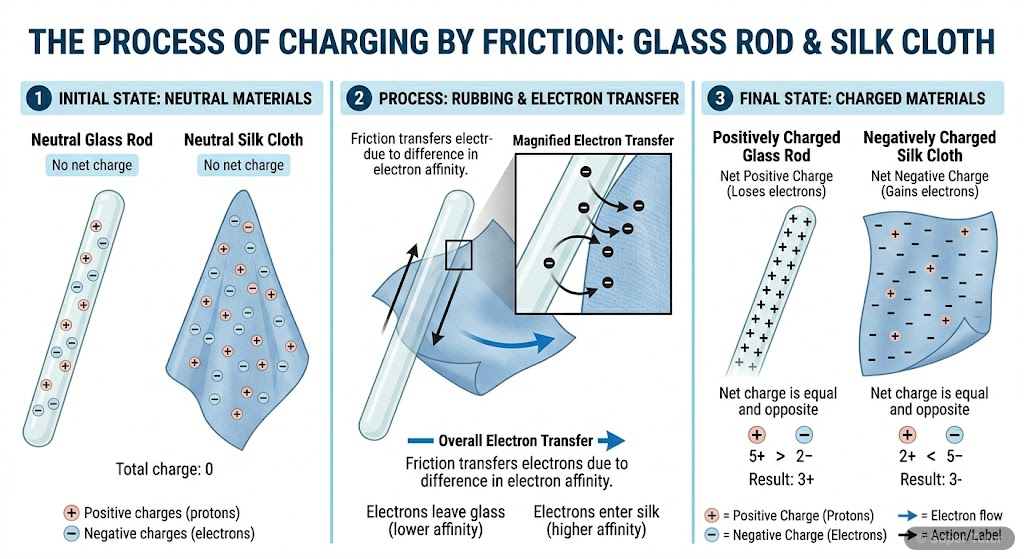
Learn better with visuals Super Tutor pairs illustrations like this with notes and quizzes for Electric Charges and Fields.
Overview
Electric charges and fields form the foundation of electrostatics, a branch of physics that studies stationary electric charges and the forces they exert on each other. This chapter explores how charges interact through invisible electric fields, explaining phenomena from lightning to the behavior o
Key Concepts
Electric charge is a fundamental property
Electric charge is a fundamental property of matter that causes objects to experience forces in electromagnetic fields. There are two types: positive
Electric charge is quantized
Electric charge is quantized, meaning all charges are integral multiples of the elementary charge e = 1.602 × 10⁻¹⁹ C (the charge of one proton or ele
The total electric charge in
The total electric charge in an isolated system remains constant over time. Charge cannot be created or destroyed; it can only be transferred from one
Conductors (metals
Conductors (metals, human body, earth) allow free movement of charge through them because they have many loosely bound electrons that can move easily.
The electrostatic force between two point
The electrostatic force between two point charges q₁ and q₂ separated by distance r is given by: F = k|q₁q₂|/r² = |q₁q₂|/(4πε₀r²), where k ≈ 9 × 10⁹ N
Learning Objectives
- Understand the nature of electric charge, its properties (additivity, conservation, and quantization), and its role in matter
- Master Coulomb's Law and apply it to calculate forces between point charges
- Grasp the concept of electric field and calculate fields due to various charge configurations
- Visualize electric fields using field lines and understand their properties
- Apply the principle of superposition to complex charge systems
Frequently Asked Questions
What are the important topics in Electric Charges and Fields for Punjab Board Class 12 Physics?
How should I revise Electric Charges and Fields for the Punjab Board Class 12 board exam?
Sources & Official References
Content is aligned to the official syllabus. Refer to the board website for the latest curriculum.
More resources for Electric Charges and Fields
For serious students
Get the full Electric Charges and Fields chapter — start free.
Quizzes, flashcards, an AI doubt solver and a study plan for Punjab Board Class 12 Physics. Free to start, no card needed.