Electric Charges and Fields — Revision Notes
Punjab Board · Class 12 · Physics
Electric Charges and Fields revision notes for Punjab Board Class 12 Physics: 4 topics in quick points. Part of the Punjab Board Class 12 Physics syllabus.
Interactive on Super Tutor
Studying Electric Charges and Fields? Get the full interactive chapter.
Quizzes, flashcards, AI doubt-solver and a step-by-step study plan — built for revision notes and more.
Free trial, no card needed.
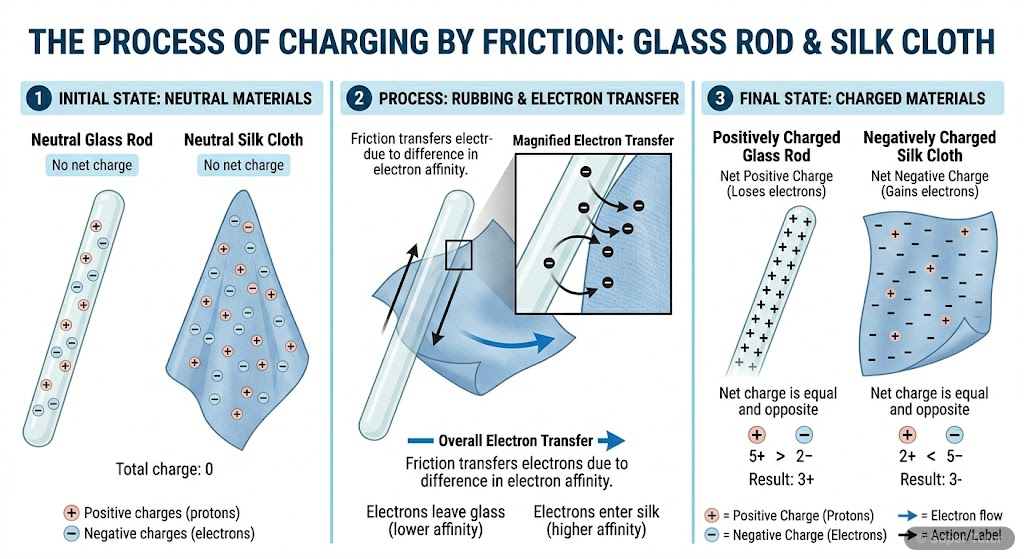
Learn better with visuals Super Tutor pairs illustrations like this with notes and quizzes for Electric Charges and Fields.
Key Topics to Revise
1. Electric Charge – Nature and Basic Properties
- Electric charge is a fundamental property of matter. There are exactly two types: positive charge and negative charge.
- Like charges repel each other; unlike charges attract each other. This is confirmed by simple experiments with glass and plastic rods.
- The SI unit of charge is coulomb (C). It is a derived unit: 1 C = 1 A·s.
2. Three Fundamental Properties of Electric Charge
- QUANTISATION: Electric charge always comes in integer multiples of the basic unit e = 1.6 × 10⁻¹⁹ C. You cannot have half an electron's charge.
- ADDITIVITY: The total charge of a system is simply the algebraic sum of all individual charges. Charges add like real numbers (with proper signs).
- CONSERVATION: The total charge of an isolated system always remains constant. Charge can be transferred but neither created nor destroyed.
3. Coulomb's Law
- Coulomb's Law gives the force between two stationary point charges in vacuum.
- The force is directly proportional to the product of the magnitudes of the charges and inversely proportional to the square of the distance between them.
- The force acts along the line joining the two charges.
4. Superposition Principle and Forces Between Multiple Charges
- The principle of superposition states that the force on a charge due to multiple other charges is the vector sum of all individual forces, calculated one pair at a time.
- The presence of other charges does NOT affect the force between any given pair of charges.
- There are no additional three-body or four-body interaction forces — only pairwise interactions.
Get complete notes with diagrams and examples
Full NotesKey Concepts
Frequently Asked Questions
What are the important topics in Electric Charges and Fields for Punjab Board Class 12 Physics?
How should I revise Electric Charges and Fields for the Punjab Board Class 12 board exam?
Sources & Official References
Content is aligned to the official syllabus. Refer to the board website for the latest curriculum.
More resources for Electric Charges and Fields
For serious students
Get the full Electric Charges and Fields chapter — start free.
Quizzes, flashcards, an AI doubt solver and a study plan for Punjab Board Class 12 Physics. Free to start, no card needed.