Electric Charges and Fields — Flashcards
Punjab Board · Class 12 · Physics
25 flashcards for Electric Charges and Fields (Punjab Board Class 12 Physics) to test yourself on key terms and facts.
Interactive on Super Tutor
Studying Electric Charges and Fields? Get the full interactive chapter.
Quizzes, flashcards, AI doubt-solver and a step-by-step study plan — built for flashcards and more.
Free trial, no card needed.
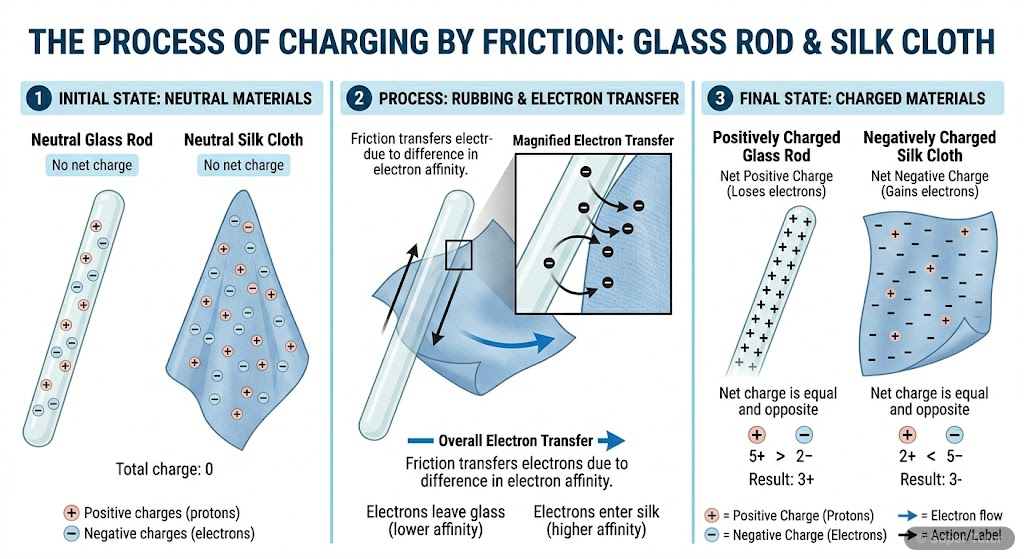
Learn better with visuals Super Tutor pairs illustrations like this with notes and quizzes for Electric Charges and Fields.
Two identical metallic spheres A and B carry charges of +10 μC and +20 μC respectively. They are made to touch and then separated by 5 cm. Calculate the force between them after separation.
Answer
Step 1: When spheres touch, charge distributes equally. Total charge = +10 + 20 = +30 μC Each sphere gets = 30/2 = +15 μC Step 2: After separation, both have +15 μC r = 5 cm = 0.05 m Step 3: Apply C…
Why do you observe a spark when you take off your woolen sweater on a dry day?
Answer
When you pull off a woolen sweater, friction occurs between the wool and synthetic cloth. This friction causes electrons to transfer from one material to another, creating a charge separation. The ch…
State Coulomb's Law in vector form with all symbols explained.
Answer
Coulomb's Law (Vector Form): 𝐅₂₁ = (1/4πε₀) × (q₁q₂/r₂₁²) × 𝐫̂₂₁ Where: - 𝐅₂₁ = Force on charge q₂ due to charge q₁ (in Newtons) - q₁, q₂ = Point charges (in Coulombs) - r₂₁ = Distance between charg…
Three charges of +2 μC, +3 μC, and -2 μC are placed at the vertices of an equilateral triangle of side 10 cm. Calculate the net force on the +3 μC charge.
Answer
Step 1: Setup - Place charges: - q₁ = +2 μC at vertex A - q₂ = +3 μC at vertex B (test charge) - q₃ = -2 μC at vertex C - Side length = 10 cm = 0.1 m Step 2: Force on q₂ due to q₁ (repulsive, along A…
What is the significance of introducing the concept of electric field instead of using only Coulomb's Law?
Answer
The electric field concept is significant for several reasons: 1. **Independence from Test Charge**: The electric field E = F/q is independent of the test charge placed at a point. It represents a pr…
A uniform electric field of magnitude 2000 N/C points in the +x direction. An electron is released from rest at the origin. Calculate its acceleration and the distance it travels in 10 μs.
Answer
Step 1: Find the force on electron Charge on electron: q = -e = -1.6 × 10⁻¹⁹ C Electric field: E = 2000 N/C (in +x direction) Force: F = qE = (-1.6 × 10⁻¹⁹) × (2000) F = -3.2 × 10⁻¹⁶ N (in -x directi…
Why is the electric field zero inside a uniformly charged thin spherical shell? Explain using both Coulomb's Law and Gauss's Law.
Answer
Explanation using Coulomb's Law: Consider a point P inside the shell. Divide the shell into small area elements. Each element dA produces a field at P. Consider two elements on opposite sides of a lin…
Calculate the electric field at a distance of 2 cm from an infinitely long uniformly charged wire carrying a linear charge density of 5 μC/m.
Answer
Given: Linear charge density: λ = 5 μC/m = 5 × 10⁻⁶ C/m Perpendicular distance: r = 2 cm = 0.02 m k = 9 × 10⁹ N·m²/C² For an infinitely long charged wire, using Gauss's Law: Step 1: Apply Gauss's La…
+17 more flashcards
Practise AllFrequently Asked Questions
What are the important topics in Electric Charges and Fields for Punjab Board Class 12 Physics?
How many flashcards are available for Electric Charges and Fields?
How should I revise Electric Charges and Fields for the Punjab Board Class 12 board exam?
Sources & Official References
Content is aligned to the official syllabus. Refer to the board website for the latest curriculum.
More resources for Electric Charges and Fields
Practice Quiz
Test yourself with a quick quiz
Important Questions
Exam-style questions with answers
Revision Notes
Key points for last-minute revision
Formula Sheet
The chapter's formulas in one place
Chapter Summary
Understand the chapter at a glance
Concept Maps
See how topics connect
Syllabus
What topics to cover
For serious students
Get the full Electric Charges and Fields chapter — start free.
Quizzes, flashcards, an AI doubt solver and a study plan for Punjab Board Class 12 Physics. Free to start, no card needed.