Electric Charges and Fields — Important Questions
Punjab Board · Class 12 · Physics
45 important questions from Electric Charges and Fields for Punjab Board Class 12 Physics, with answers. Includes multiple choice questions.
Interactive on Super Tutor
Studying Electric Charges and Fields? Get the full interactive chapter.
Quizzes, flashcards, AI doubt-solver and a step-by-step study plan — built for important questions and more.
Free trial, no card needed.
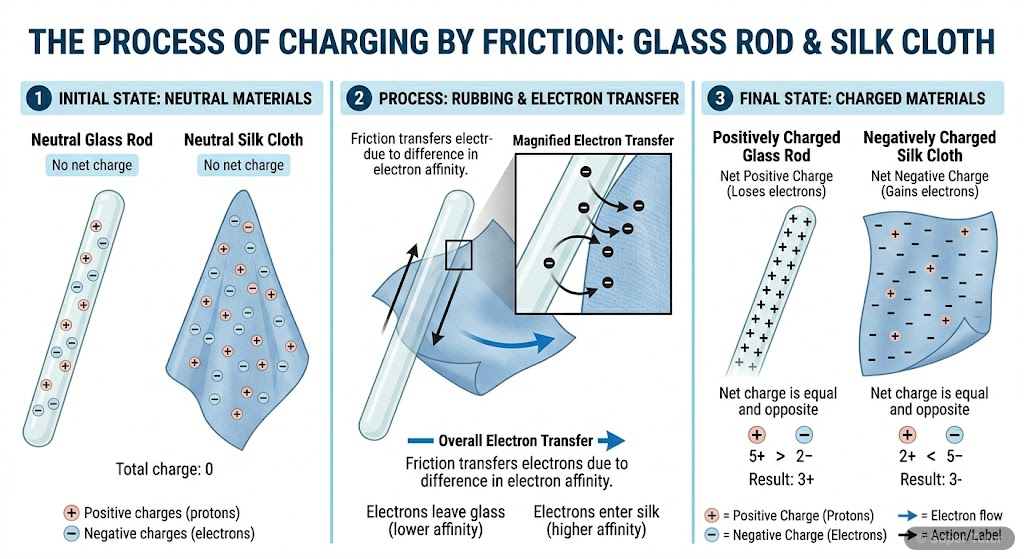
Learn better with visuals Super Tutor pairs illustrations like this with notes and quizzes for Electric Charges and Fields.
Important Questions from Electric Charges and Fields
A charge of 1 µC is placed at the centre of a spherical Gaussian surface of radius 10 cm. What is the total electric flux through the surface? (ε₀ = 8.85 × 10⁻¹² C² N⁻¹ m⁻²)
Show answer
1.13 × 10⁵ N m² C⁻¹
Step 1: Apply Gauss's law: φ = q / ε₀ Step 2: q = 1 µC = 1 × 10⁻⁶ C Step 3: φ = (1 × 10⁻⁶) / (8.85 × 10⁻¹²) Step 4: φ = 1.13 × 10⁵ N m² C⁻¹ Key point: The flux depends only on the enclosed charge, NOT on the radius of the Gaussian surface. Option B incorrectly uses the radius. The flux would be the same for any radius sphere enclosing this charge.
An infinitely long straight wire has a uniform linear charge density of 2 × 10⁻⁸ C/m. What is the magnitude of the electric field at a perpendicular distance of 1 m from the wire? (ε₀ = 8.85 × 10⁻¹² C² N⁻¹ m⁻²)
Show answer
360 N/C
Step 1: Formula for field due to infinite line charge: E = λ / (2πε₀r) Step 2: λ = 2 × 10⁻⁸ C/m, r = 1 m Step 3: 2πε₀ = 2 × 3.14 × 8.85 × 10⁻¹² = 5.56 × 10⁻¹¹ Step 4: E = (2 × 10⁻⁸) / (5.56 × 10⁻¹¹) ≈ 360 N/C Alternatively: E = 2kλ/r = 2 × 9×10⁹ × 2×10⁻⁸ / 1 = 360 N/C. Option B (180 N/C) misses the factor of 2 in the formula; Option C doubles incorrectly.
Which of the following statements about electric field lines is INCORRECT?
Show answer
Two electric field lines can cross each other at a point of zero field.
Step 1: Electric field lines NEVER cross each other, at any point including where E = 0. Step 2: If two field lines crossed, there would be two different directions of electric field at that point, which is physically impossible — the electric field at any point has a unique direction. Step 3: The other three statements are correct properties of electric field lines. This is a conceptual trick question — students often think crossing is allowed at special points, but it is NEVER allowed.
A dipole with dipole moment p = 5 × 10⁻⁸ C m is placed in a uniform electric field E = 4 × 10⁴ N/C. The angle between p and E is 30°. What is the magnitude of the torque acting on the dipole?
Show answer
1 × 10⁻³ N m
Step 1: Torque on a dipole: τ = pE sinθ Step 2: p = 5 × 10⁻⁸ C m, E = 4 × 10⁴ N/C, θ = 30° Step 3: sin 30° = 0.5 Step 4: τ = 5 × 10⁻⁸ × 4 × 10⁴ × 0.5 = 5 × 10⁻⁸ × 2 × 10⁴ = 10⁻³ N m Option B uses sin 60° instead of sin 30°; Option C uses √3/2; Option D makes a factor error. The torque aligns the dipole with the field (tends to make θ → 0).
+41 more questions on Electric Charges and Fields (Punjab Board Class 12 Physics)
Practise AllFrequently Asked Questions
What are the important topics in Electric Charges and Fields for Punjab Board Class 12 Physics?
How many important questions are there in Electric Charges and Fields?
Sources & Official References
Content is aligned to the official syllabus. Refer to the board website for the latest curriculum.
More resources for Electric Charges and Fields
For serious students
Get the full Electric Charges and Fields chapter — start free.
Quizzes, flashcards, an AI doubt solver and a study plan for Punjab Board Class 12 Physics. Free to start, no card needed.