Current Electricity — Important Questions
Punjab Board · Class 12 · Physics
45 important questions from Current Electricity for Punjab Board Class 12 Physics, with answers. Includes multiple choice questions.
Interactive on Super Tutor
Studying Current Electricity? Get the full interactive chapter.
Quizzes, flashcards, AI doubt-solver and a step-by-step study plan — built for important questions and more.
Free trial, no card needed.
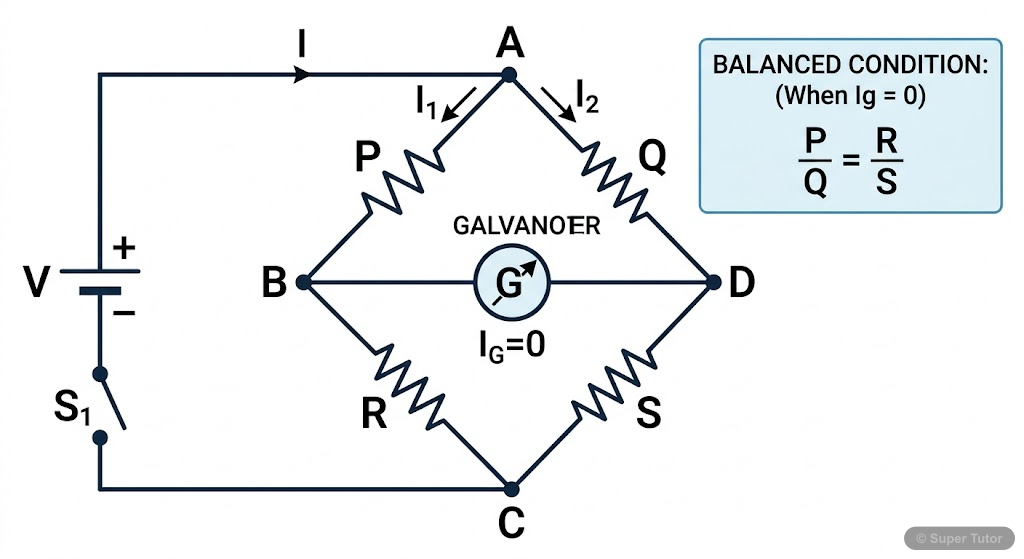
An illustration from Super Tutor's Current Electricity chapter — alongside flashcards, concept maps and practice questions.
Important Questions from Current Electricity
The resistance of a metallic wire is doubled by doubling its length (keeping area constant). If the original resistance is 10 Ω, what is the new resistance?
Show answer
20 Ω
Step 1: From R = ρl/A, resistance R is directly proportional to length l (when area A and resistivity ρ are constant). Step 2: If length is doubled (l → 2l), then R also doubles: R_new = 2 × R_original. Step 3: R_new = 2 × 10 = 20 Ω. Option A (5 Ω) would be the case if length was halved. Option B (10 Ω) assumes no change. Option D (40 Ω) would mean resistance quadrupled, which happens if length doubles AND area halves simultaneously.
The EMF of a cell is 12 V and its internal resistance is 2 Ω. What is the terminal voltage when a current of 2 A is drawn from it?
Show answer
10 V
Step 1: Recall the formula for terminal voltage: V = ε - Ir, where ε is EMF, I is current, and r is internal resistance. Step 2: Substitute values: ε = 12 V, I = 2 A, r = 2 Ω. Step 3: V = 12 - (2 × 2) = 12 - 4 = 10 V. Option A (12 V) is the EMF, which equals terminal voltage only when no current flows (open circuit). Option C (8 V) would mean Ir = 4 V but with I=4 A. Option D (14 V) would result from adding instead of subtracting — terminal voltage is always less than EMF when current flows.
Which of the following correctly states Kirchhoff's Junction Rule (KCL)?
Show answer
The sum of currents entering a junction equals the sum of currents leaving the junction
Step 1: Kirchhoff's rules consist of two rules — the Junction Rule (KCL) and the Loop Rule (KVL). Step 2: The Junction Rule states that the algebraic sum of all currents at a junction is zero, which means total current entering = total current leaving. This is based on conservation of charge — charge does not accumulate at a junction in a steady state. Step 3: Option A describes Kirchhoff's Loop Rule (KVL), not the junction rule. Option C is incorrect — currents in different branches can be different. Option D is wrong — voltage across parallel resistors is the same.
A resistor dissipates 100 W of power when connected to a 200 V supply. What is the resistance of the resistor?
Show answer
400 Ω
Step 1: Use the power formula P = V²/R, which gives R = V²/P. Step 2: Substitute values: V = 200 V, P = 100 W. Step 3: R = (200)²/100 = 40000/100 = 400 Ω. Option A (2 Ω) comes from using R = P/V = 100/200 incorrectly. Option B (20 Ω) is obtained by forgetting to square the voltage. Option D (0.5 Ω) comes from inverting the formula. Always remember: P = V²/R means R = V²/P.
+41 more questions on Current Electricity (Punjab Board Class 12 Physics)
Practise AllFrequently Asked Questions
What are the important topics in Current Electricity for Punjab Board Class 12 Physics?
How many important questions are there in Current Electricity?
Sources & Official References
Content is aligned to the official syllabus. Refer to the board website for the latest curriculum.
More resources for Current Electricity
For serious students
Get the full Current Electricity chapter — start free.
Quizzes, flashcards, an AI doubt solver and a study plan for Punjab Board Class 12 Physics. Free to start, no card needed.