Chapter 3 of 5
Revision Notes
Current Electricity — Revision Notes
Punjab Board · Class 12 · Physics
Current Electricity revision notes for Punjab Board Class 12 Physics: 4 topics in quick points. Part of the Punjab Board Class 12 Physics syllabus.
45 questions30 flashcards8 formulas & key relations5 concepts
Interactive on Super Tutor
Studying Current Electricity? Get the full interactive chapter.
Quizzes, flashcards, AI doubt-solver and a step-by-step study plan — built for revision notes and more.
Free trial, no card needed.
Super Tutor
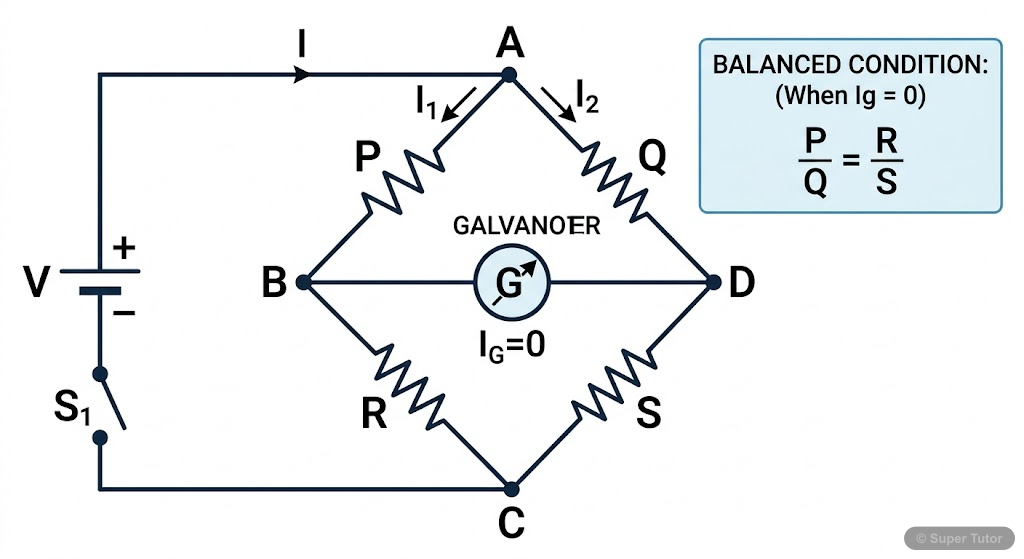
An illustration from Super Tutor's Current Electricity chapter — alongside flashcards, concept maps and practice questions.
Key Topics to Revise
1
Electric Current and Current Density
- Electric current is the net rate of flow of electric charge through a cross-section of a conductor.
- For steady current: I = q/t, where q is the net charge flowing in time t.
- For non-steady (instantaneous) current: I(t) = lim(ΔQ/Δt) as Δt → 0, which is the derivative dQ/dt.
2
Ohm's Law and Resistance
- Ohm's Law: V ∝ I, or V = IR, where R is the resistance of the conductor.
- Resistance R depends on the material and dimensions of the conductor: R = ρl/A.
- ρ (rho) is the resistivity (or specific resistance) of the material. SI unit: Ω·m.
3
Drift Velocity, Relaxation Time, and Mobility
- In the absence of an electric field, free electrons in a conductor move randomly due to thermal motion. Their average velocity is zero — no net current.
- When electric field E is applied, electrons experience a force F = eE in the direction opposite to E (since electrons are negative).
- Electrons accelerate between collisions with fixed positive ions. The average time between successive collisions is called relaxation time (τ).
4
Temperature Dependence of Resistivity
- For metals, resistivity increases with temperature: ρ_T = ρ₀[1 + α(T - T₀)]
- α is the temperature coefficient of resistivity. For metals, α is positive (resistance increases with temperature).
- Physical reason: As temperature increases, τ (relaxation time) decreases due to more frequent collisions, so ρ = m/(ne²τ) increases.
Get complete notes with diagrams and examples
Full NotesKey Concepts
Electric current (I) is defined asWhen an electric field is appliedOhm's Law states that the potentialResistance R depends on bothWhen current flows through a resistor
Frequently Asked Questions
What are the important topics in Current Electricity for Punjab Board Class 12 Physics?
Key topics in Current Electricity include Electric Current and Current Density, Ohm's Law and Resistance, Drift Velocity, Relaxation Time, and Mobility, Temperature Dependence of Resistivity. Study these first, then practise questions on each for the Punjab Board Class 12 board exam.
How should I revise Current Electricity for the Punjab Board Class 12 board exam?
Learn the core ideas first, then work through the 45 practice questions on Current Electricity. Revise definitions regularly and use flashcards for quick recall before the exam.
Sources & Official References
Content is aligned to the official syllabus. Refer to the board website for the latest curriculum.
More resources for Current Electricity
For serious students
Get the full Current Electricity chapter — start free.
Quizzes, flashcards, an AI doubt solver and a study plan for Punjab Board Class 12 Physics. Free to start, no card needed.