Magnetism and Matter — Important Questions
Punjab Board · Class 12 · Physics
45 important questions from Magnetism and Matter for Punjab Board Class 12 Physics, with answers. Includes multiple choice questions.
Interactive on Super Tutor
Studying Magnetism and Matter? Get the full interactive chapter.
Quizzes, flashcards, AI doubt-solver and a step-by-step study plan — built for important questions and more.
Free trial, no card needed.
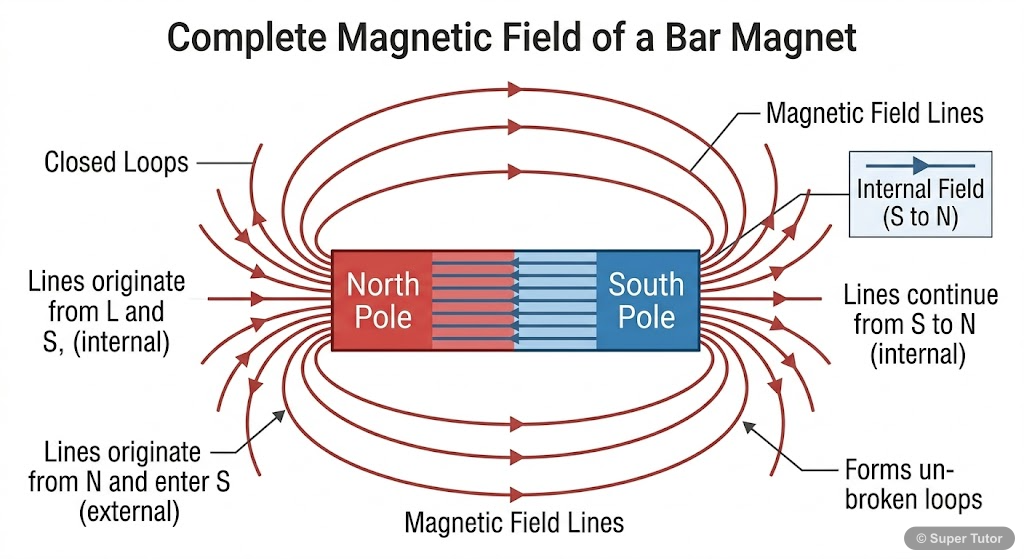
One of 9 illustrations for Magnetism and Matter in Super Tutor — alongside flashcards, concept maps and practice questions.
Important Questions from Magnetism and Matter
Which of the following correctly explains why Gauss's law for magnetism states that the net magnetic flux through any closed surface is always zero?
Show answer
Magnetic monopoles do not exist; magnetic field lines always form closed loops so equal flux enters and exits any closed surface.
Step 1: Gauss's law for magnetism: ΣB·ΔS = 0 over any closed surface. Step 2: This is a direct consequence of the non-existence of magnetic monopoles — there are no isolated sources or sinks of magnetic field. Step 3: Since magnetic field lines form continuous closed loops, every line that enters a closed surface must exit it, giving zero net flux. Step 4: Option B is wrong — the field inside can be non-zero. Option C contradicts the fact that magnetic field lines don't start or end (unlike electric field lines). Option D is a meaningless statement — flux is a scalar but not always zero for al
A solenoid with 2000 turns per metre carries a current of 1.5 A and has a core with relative permeability 600. Calculate the magnetic field B inside the solenoid. (μ₀ = 4π × 10⁻⁷ T·m/A)
Show answer
2.26 T
Step 1: First calculate H = nI = 2000 × 1.5 = 3000 A/m. Step 2: Use B = μ₀μᵣH. Step 3: B = 4π × 10⁻⁷ × 600 × 3000. Step 4: B = 4π × 10⁻⁷ × 1.8 × 10⁶ = 4π × 0.18 = 4 × 3.1416 × 0.18 ≈ 2.26 T. Step 5: Option B ignores μᵣ (uses only μ₀). Option C halves the correct answer — a common arithmetic slip. Option D incorrectly doubles. Always use B = μ₀μᵣH when a magnetic core is present.
A magnetic needle of moment m is oscillating in a uniform magnetic field B. If the time period of oscillation is T, and the moment of inertia of the needle is I, which expression correctly gives the time period?
Show answer
T = 2π√(I/mB)
Step 1: The restoring torque on a magnetic needle in a field is τ = −mB sinθ ≈ −mBθ for small θ. Step 2: This is analogous to simple harmonic motion where the restoring constant is mB. Step 3: For angular SHM: T = 2π√(I/k_restoring) = 2π√(I/mB). Step 4: Option B inverts I and mB — a common confusion with the formula. Option C misses the factor of 2. Option D omits m — the magnetic moment is crucial in determining the restoring torque. This formula is used to experimentally determine m or B.
Two short bar magnets A and B have magnetic moments 1.2 A·m² and 1.0 A·m² respectively. They are placed on the same horizontal surface with their axes along the same straight line with like poles facing each other, separated by a distance of 20 cm. At which point between them (measured from A) is th
Show answer
≈ 10.5 cm from A
Step 1: Let the neutral point be at distance x from A. Then distance from B = (0.20 − x). Step 2: On the axial line between like poles, both magnets produce fields in opposite directions. For zero net field: B_A = B_B. Step 3: (μ₀/4π)(2m_A/x³) = (μ₀/4π)(2m_B/(0.20−x)³). Step 4: m_A/x³ = m_B/(0.20−x)³ → 1.2(0.20−x)³ = 1.0·x³. Step 5: Taking cube root ratio: (0.20−x)/x = (1/1.2)^(1/3) = (0.833)^(1/3) ≈ 0.941. So 0.20 = x(1 + 0.941) = 1.941x → x ≈ 0.103 m ≈ 10.3 cm ≈ 10.5 cm. Option B assumes equal moments. Options C and D are off due to calculation errors.
+41 more questions on Magnetism and Matter (Punjab Board Class 12 Physics)
Practise AllFrequently Asked Questions
What are the important topics in Magnetism and Matter for Punjab Board Class 12 Physics?
How many important questions are there in Magnetism and Matter?
Sources & Official References
Content is aligned to the official syllabus. Refer to the board website for the latest curriculum.
More resources for Magnetism and Matter
For serious students
Get the full Magnetism and Matter chapter — start free.
Quizzes, flashcards, an AI doubt solver and a study plan for Punjab Board Class 12 Physics. Free to start, no card needed.