Current Electricity — Chapter Summary
Punjab Board · Class 12 · Physics
Summary of Current Electricity for Punjab Board Class 12 Physics. Part of the Punjab Board Class 12 Physics syllabus.
Interactive on Super Tutor
Studying Current Electricity? Get the full interactive chapter.
Quizzes, flashcards, AI doubt-solver and a step-by-step study plan — built for chapter summary and more.
Free trial, no card needed.
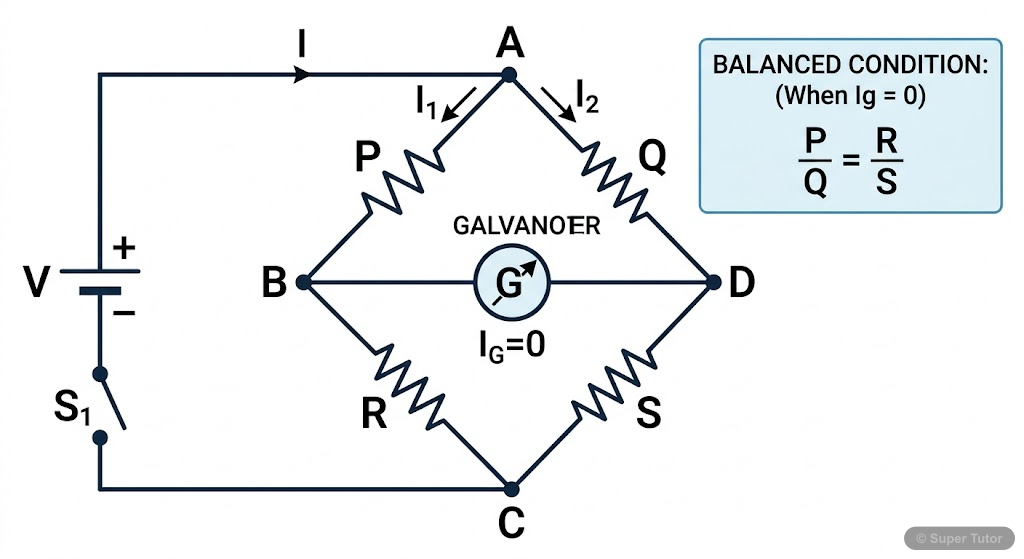
An illustration from Super Tutor's Current Electricity chapter — alongside flashcards, concept maps and practice questions.
Overview
Current Electricity deals with the flow of electric charge through conductors and the laws governing this flow. This chapter builds on electrostatics concepts to explain how charges move when an electric field is applied. Understanding current electricity is fundamental to comprehending how electric
Key Concepts
Electric current (I) is defined as
Electric current (I) is defined as the net charge flowing across a cross-section per unit time: I = ΔQ/Δt (in amperes, A). It represents the flow of c
When an electric field is applied
When an electric field is applied to a conductor, free electrons experience a force (F = -eE) and accelerate. However, they frequently collide with po
Ohm's Law states that the potential
Ohm's Law states that the potential difference V across a conductor is directly proportional to the current I flowing through it: V = IR, where R is r
Resistance R depends on both
Resistance R depends on both the material (through resistivity ρ) and geometry of the conductor: R = ρl/A, where l is length and A is cross-sectional
When current flows through a resistor
When current flows through a resistor, electrical energy is dissipated as heat. Power dissipated is P = VI = I²R = V²/R (in watts). This energy comes
Learning Objectives
- Understand the definition and measurement of electric current in various forms
- Comprehend the microscopic mechanism of electron drift and its relation to macroscopic current
- Apply Ohm's Law to analyze resistive circuits and understand resistivity
- Analyze temperature dependence of resistance and its practical implications
- Calculate electrical power dissipation and energy consumption
Frequently Asked Questions
What are the important topics in Current Electricity for Punjab Board Class 12 Physics?
How should I revise Current Electricity for the Punjab Board Class 12 board exam?
Sources & Official References
Content is aligned to the official syllabus. Refer to the board website for the latest curriculum.
More resources for Current Electricity
For serious students
Get the full Current Electricity chapter — start free.
Quizzes, flashcards, an AI doubt solver and a study plan for Punjab Board Class 12 Physics. Free to start, no card needed.