Current Electricity — Flashcards
Punjab Board · Class 12 · Physics
30 flashcards for Current Electricity (Punjab Board Class 12 Physics) to test yourself on key terms and facts.
Interactive on Super Tutor
Studying Current Electricity? Get the full interactive chapter.
Quizzes, flashcards, AI doubt-solver and a step-by-step study plan — built for flashcards and more.
Free trial, no card needed.
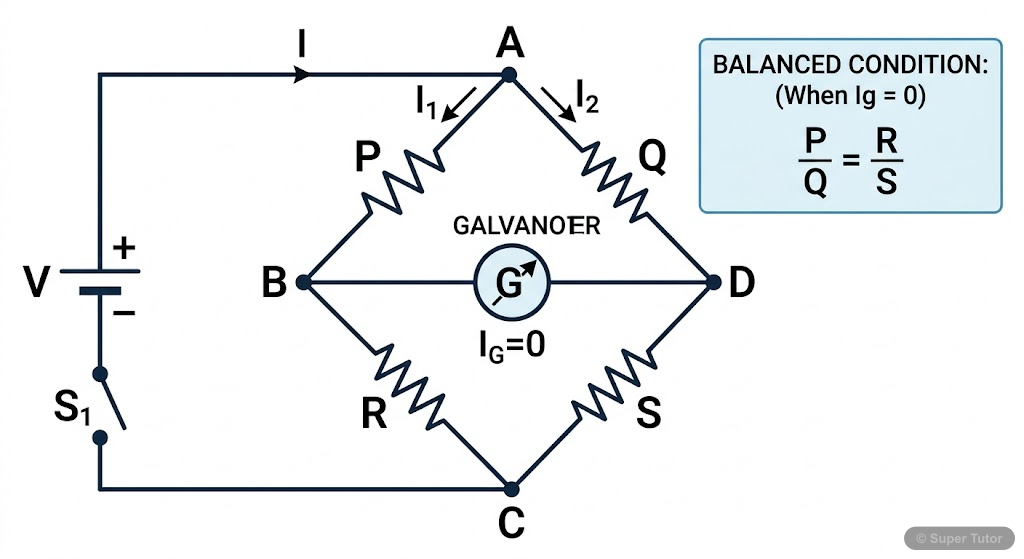
An illustration from Super Tutor's Current Electricity chapter — alongside flashcards, concept maps and practice questions.
Define electric current and state its SI unit.
Answer
Electric current (I) is defined as the amount of charge flowing through a cross-section of a conductor per unit time. Mathematically: I = Q/t, where Q is charge in coulombs and t is time in seconds. S…
A copper wire has 8.5 × 10²⁸ free electrons per m³. If a current of 2.0 A flows through a cross-sectional area of 2.0 × 10⁻⁷ m², calculate the drift velocity of electrons.
Answer
Given: n = 8.5 × 10²⁸ m⁻³, I = 2.0 A, A = 2.0 × 10⁻⁷ m², e = 1.6 × 10⁻¹⁹ C Formula: I = neAv_d, so v_d = I/(neA) Step 1: Calculate denominator = 8.5 × 10²⁸ × 1.6 × 10⁻¹⁹ × 2.0 × 10⁻⁷ = 8.5 × 1.6 × 2.0…
State Ohm's Law and explain what happens when voltage across a conductor doubles.
Answer
Ohm's Law: V = IR, where V is potential difference in volts, I is current in amperes, and R is resistance in ohms. This states that current is directly proportional to voltage if resistance remains co…
A nichrome wire has a resistance of 80 Ω at 27°C. The temperature coefficient of resistance is 0.0004 °C⁻¹. Calculate its resistance at 227°C.
Answer
Given: R₀ = 80 Ω at T₀ = 27°C, α = 0.0004 °C⁻¹, T = 227°C Formula: R_T = R₀[1 + α(T - T₀)] Step 1: Calculate temperature change: ΔT = T - T₀ = 227 - 27 = 200°C Step 2: Calculate α(ΔT) = 0.0004 × 200 =…
Derive the relationship between resistance (R), resistivity (ρ), length (l), and cross-sectional area (A).
Answer
Starting from: Resistance is proportional to length (R ∝ l) and inversely proportional to area (R ∝ 1/A). Combining: R ∝ l/A Introducing proportionality constant ρ (resistivity): R = ρl/A Where: R = r…
Why do electrons move with constant drift velocity instead of continuously accelerating under the electric field?
Answer
In a conductor, free electrons experience electric force (F = -eE) and accelerate initially. However, they constantly collide with positive ions in the lattice at random intervals. After each collisio…
Calculate the power dissipated in a 5 Ω resistor when 3 A of current flows through it.
Answer
Given: R = 5 Ω, I = 3 A Formula: P = I²R Step 1: P = (3)² × 5 = 9 × 5 = 45 W Alternative formula check: V = IR = 3 × 5 = 15 V Using P = V²/R = (15)²/5 = 225/5 = 45 W ✓ Using P = VI = 15 × 3 = 45 W ✓ A…
Two identical resistors are connected in series. If the equivalent resistance is 100 Ω, what is the resistance of each resistor?
Answer
Given: Two identical resistors in series, R_eq = 100 Ω, R₁ = R₂ = R (unknown) Formula for series: R_eq = R₁ + R₂ Step 1: Since resistors are identical: R_eq = R + R = 2R Step 2: 100 = 2R Step 3: R = 1…
+22 more flashcards
Practise AllFrequently Asked Questions
What are the important topics in Current Electricity for Punjab Board Class 12 Physics?
How many flashcards are available for Current Electricity?
How should I revise Current Electricity for the Punjab Board Class 12 board exam?
Sources & Official References
Content is aligned to the official syllabus. Refer to the board website for the latest curriculum.
More resources for Current Electricity
Practice Quiz
Test yourself with a quick quiz
Important Questions
Exam-style questions with answers
Revision Notes
Key points for last-minute revision
Formula Sheet
The chapter's formulas in one place
Chapter Summary
Understand the chapter at a glance
Concept Maps
See how topics connect
Syllabus
What topics to cover
For serious students
Get the full Current Electricity chapter — start free.
Quizzes, flashcards, an AI doubt solver and a study plan for Punjab Board Class 12 Physics. Free to start, no card needed.