Magnetism and Matter — Flashcards
Punjab Board · Class 12 · Physics
25 flashcards for Magnetism and Matter (Punjab Board Class 12 Physics) to test yourself on key terms and facts.
Interactive on Super Tutor
Studying Magnetism and Matter? Get the full interactive chapter.
Quizzes, flashcards, AI doubt-solver and a step-by-step study plan — built for flashcards and more.
Free trial, no card needed.
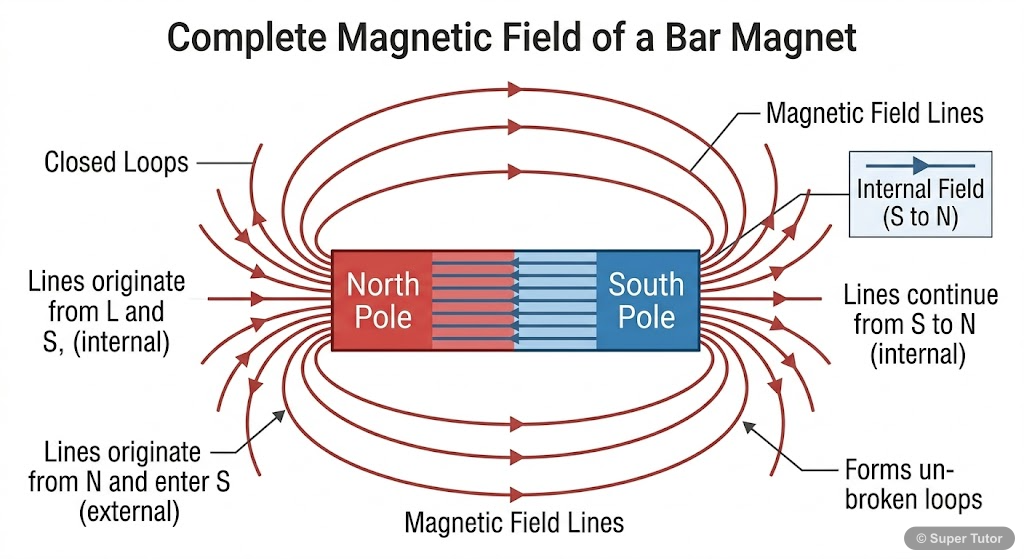
One of 9 illustrations for Magnetism and Matter in Super Tutor — alongside flashcards, concept maps and practice questions.
What is a magnetic dipole moment, and what are its units?
Answer
A magnetic dipole moment (m) is the quantitative measure of the strength and orientation of a magnet. For a current loop: m = IA, where I is current (A) and A is area (m²). Units: A·m² (ampere meter s…
A magnetic needle with moment m = 0.5 A·m² is placed in a uniform magnetic field B = 0.4 T, with the moment making an angle of 30° with the field. Calculate the torque on the needle.
Answer
Given: m = 0.5 A·m², B = 0.4 T, θ = 30° Formula: τ = mB sin θ Step 1: τ = 0.5 × 0.4 × sin(30°) Step 2: τ = 0.5 × 0.4 × 0.5 Step 3: τ = 0.1 N·m Answer: The torque is 0.1 N·m, directed to align the mome…
Why do magnetic field lines form closed loops, unlike electric field lines?
Answer
Magnetic field lines form closed loops because magnetic monopoles (isolated magnetic poles) do not exist in nature. Every magnet has both north and south poles—they cannot be separated. Therefore, fie…
State Gauss's Law for Magnetism and explain its physical significance.
Answer
Gauss's Law for Magnetism states: The net magnetic flux through any closed surface is zero. Mathematically: ∮ B·dS = 0 Physical Significance: This law confirms that isolated magnetic poles (monopoles)…
Calculate the magnetic potential energy of a magnetic needle (m = 0.8 A·m²) at an angle of 60° in a magnetic field B = 0.5 T.
Answer
Formula: U = -m·B = -mB cos θ Given: m = 0.8 A·m², B = 0.5 T, θ = 60° Step 1: U = -0.8 × 0.5 × cos(60°) Step 2: U = -0.8 × 0.5 × 0.5 Step 3: U = -0.2 J Answer: The potential energy is -0.2 J. Negative…
A bar magnet of magnetic moment m = 1.2 A·m² is placed on the axis at distance r = 0.5 m from the center. Calculate the axial magnetic field.
Answer
For a bar magnet on its axis where r >> l: Formula: B_A = (μ₀/4π) × (2m/r³) Given: m = 1.2 A·m², r = 0.5 m, μ₀/4π = 10⁻⁷ T·m/A Step 1: B_A = 10⁻⁷ × (2 × 1.2)/(0.5)³ Step 2: B_A = 10⁻⁷ × 2.4/0.125 Step…
What is the difference between diamagnetic and paramagnetic materials?
Answer
Diamagnetic materials: Have χ < 0 (negative susceptibility), are weakly repelled by magnetic fields, have μ < μ₀. Electrons' magnetic moments pair up with zero net moment. Field lines are expelled. Ex…
A solenoid with 500 turns/meter carries a current of 2 A. Calculate the magnetic field H inside.
Answer
Magnetic intensity H is independent of core material: Formula: H = nI where n = number of turns per unit length, I = current Given: n = 500 turns/m, I = 2 A Step 1: H = 500 × 2 Step 2: H = 1000 A/m An…
+17 more flashcards
Practise AllFrequently Asked Questions
What are the important topics in Magnetism and Matter for Punjab Board Class 12 Physics?
How many flashcards are available for Magnetism and Matter?
How should I revise Magnetism and Matter for the Punjab Board Class 12 board exam?
Sources & Official References
Content is aligned to the official syllabus. Refer to the board website for the latest curriculum.
More resources for Magnetism and Matter
Practice Quiz
Test yourself with a quick quiz
Important Questions
Exam-style questions with answers
Revision Notes
Key points for last-minute revision
Formula Sheet
The chapter's formulas in one place
Chapter Summary
Understand the chapter at a glance
Concept Maps
See how topics connect
Syllabus
What topics to cover
For serious students
Get the full Magnetism and Matter chapter — start free.
Quizzes, flashcards, an AI doubt solver and a study plan for Punjab Board Class 12 Physics. Free to start, no card needed.