Chapter 5 of 5
Revision Notes
Magnetism and Matter — Revision Notes
Punjab Board · Class 12 · Physics
Magnetism and Matter revision notes for Punjab Board Class 12 Physics: 4 topics in quick points. Part of the Punjab Board Class 12 Physics syllabus.
45 questions25 flashcards7 formulas & key relations5 concepts
Interactive on Super Tutor
Studying Magnetism and Matter? Get the full interactive chapter.
Quizzes, flashcards, AI doubt-solver and a step-by-step study plan — built for revision notes and more.
Free trial, no card needed.
Super Tutor
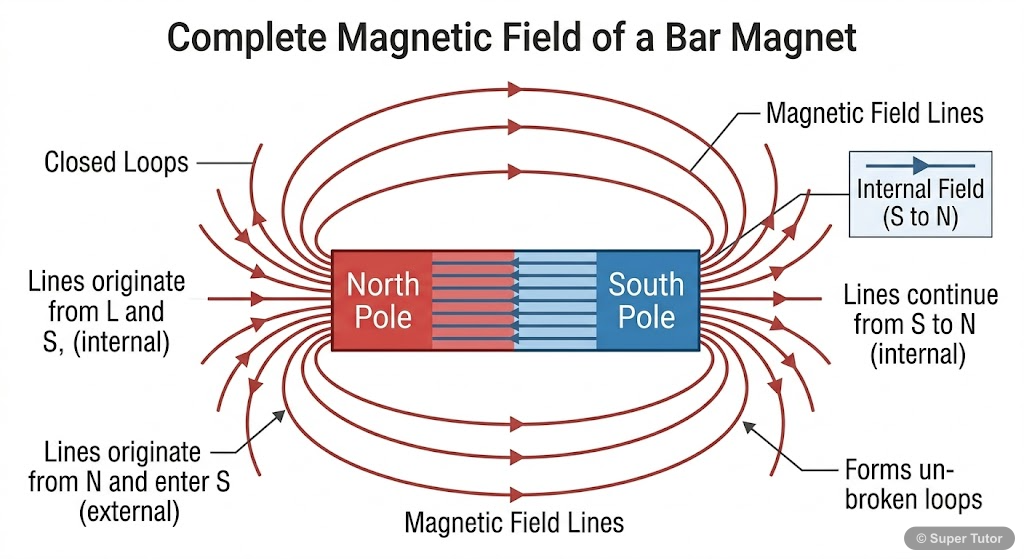
One of 9 illustrations for Magnetism and Matter in Super Tutor — alongside flashcards, concept maps and practice questions.
Key Topics to Revise
1
The Bar Magnet and Its Properties
- A bar magnet is a magnetic dipole with a North pole and a South pole — they always exist together and cannot be separated.
- When a bar magnet is freely suspended, the North pole points approximately towards geographic North.
- Like poles repel each other; unlike poles attract each other.
2
Gauss's Law for Magnetism
- Gauss's law for magnetism states: The net magnetic flux through any closed surface is always ZERO.
- Mathematically: φ_B = Σ B · ΔS = 0 for any closed surface.
- This contrasts with Gauss's law for electrostatics where flux = q/ε₀ (depends on enclosed charge).
3
Magnetisation and Magnetic Intensity
- Magnetisation M is defined as the net magnetic moment per unit volume of a material: M = m_net / V. SI unit: A/m.
- When a magnetic material is placed inside a solenoid, the net field B = B₀ + B_m where B₀ is due to solenoid current and B_m is due to material.
- The additional field due to material: B_m = μ₀M.
4
Magnetic Properties of Materials: Dia, Para, and Ferromagnetism
- Materials are classified based on magnetic susceptibility χ into three categories: Diamagnetic, Paramagnetic, and Ferromagnetic.
- DIAMAGNETIC: χ is small and NEGATIVE (-1 ≤ χ < 0), μᵣ < 1, μ < μ₀. Examples: Bismuth, Copper, Lead, Silicon, Water, NaCl, Nitrogen.
- PARAMAGNETIC: χ is small and POSITIVE (0 < χ < ε), μᵣ > 1 slightly, μ > μ₀ slightly. Examples: Aluminium, Sodium, Calcium, Oxygen, CuCl₂.
Get complete notes with diagrams and examples
Full NotesKey Concepts
A bar magnet is fundamentallyMagnetic field lines form continuous closedWhen a magnetic dipole with momentFor a bar magnet of magneticThe net magnetic flux through any
Frequently Asked Questions
What are the important topics in Magnetism and Matter for Punjab Board Class 12 Physics?
Key topics in Magnetism and Matter include The Bar Magnet and Its Properties, Gauss's Law for Magnetism, Magnetisation and Magnetic Intensity, Magnetic Properties of Materials: Dia, Para, and Ferromagnetism. Study these first, then practise questions on each for the Punjab Board Class 12 board exam.
How should I revise Magnetism and Matter for the Punjab Board Class 12 board exam?
Learn the core ideas first, then work through the 45 practice questions on Magnetism and Matter. Revise definitions regularly and use flashcards for quick recall before the exam.
Sources & Official References
Content is aligned to the official syllabus. Refer to the board website for the latest curriculum.
More resources for Magnetism and Matter
For serious students
Get the full Magnetism and Matter chapter — start free.
Quizzes, flashcards, an AI doubt solver and a study plan for Punjab Board Class 12 Physics. Free to start, no card needed.