Magnetism and Matter — Chapter Summary
Punjab Board · Class 12 · Physics
Summary of Magnetism and Matter for Punjab Board Class 12 Physics. Part of the Punjab Board Class 12 Physics syllabus.
Interactive on Super Tutor
Studying Magnetism and Matter? Get the full interactive chapter.
Quizzes, flashcards, AI doubt-solver and a step-by-step study plan — built for chapter summary and more.
Free trial, no card needed.
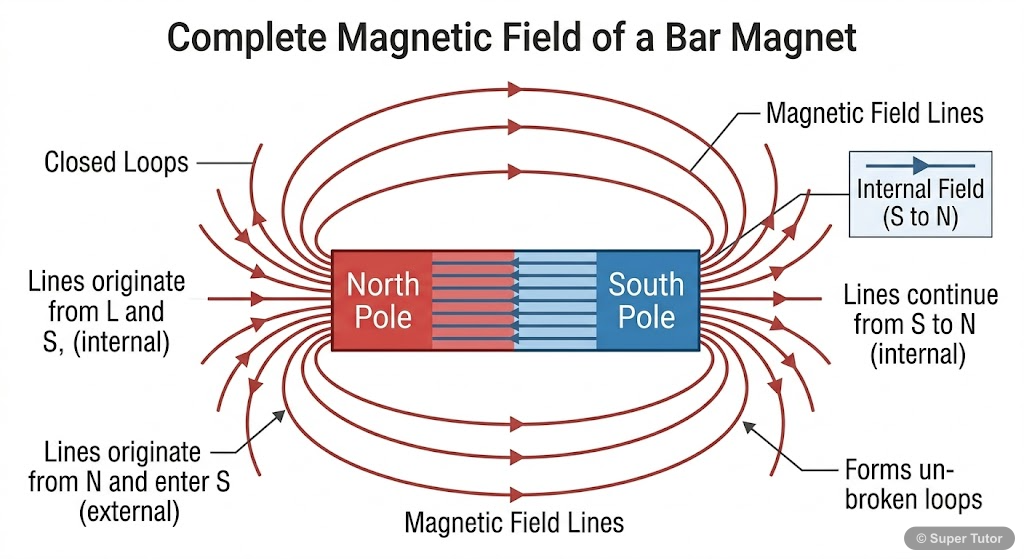
One of 9 illustrations for Magnetism and Matter in Super Tutor — alongside flashcards, concept maps and practice questions.
Overview
Magnetism is a fundamental force in nature that permeates the universe, from distant galaxies to tiny atoms. This chapter explores the science of magnetism—how magnetic fields behave, how materials respond to magnetic fields, and the properties that distinguish different classes of magnetic material
Key Concepts
A bar magnet is fundamentally
A bar magnet is fundamentally a magnetic dipole with a north pole and a south pole. Unlike electric dipoles, magnetic poles cannot be isolated—cutting
Magnetic field lines form continuous closed
Magnetic field lines form continuous closed loops, unlike electric field lines which begin on positive charges and end on negative charges. Key proper
When a magnetic dipole with moment
When a magnetic dipole with moment m is placed in an external uniform magnetic field B, it experiences a torque τ = m × B = mB sin θ, where θ is the a
For a bar magnet of magnetic
For a bar magnet of magnetic moment m, at distances r >> l (where l is the magnet's length), the magnetic field resembles that of an electric dipole:
The net magnetic flux through any
The net magnetic flux through any closed surface is always zero: ∮ B·dS = 0. This fundamental law reflects the fact that magnetic monopoles do not exi
Learning Objectives
- Understand the nature of magnetic fields and magnetic field lines, including their properties and differences from electric field lines
- Analyze the behavior of bar magnets, including their magnetic moments and dipole characteristics
- Apply Gauss's law for magnetism and understand why it differs fundamentally from Gauss's law for electrostatics
- Define and calculate magnetic intensity (H), magnetization (M), and magnetic susceptibility (χ)
- Classify magnetic materials as diamagnetic, paramagnetic, or ferromagnetic based on their properties
Frequently Asked Questions
What are the important topics in Magnetism and Matter for Punjab Board Class 12 Physics?
How should I revise Magnetism and Matter for the Punjab Board Class 12 board exam?
Sources & Official References
Content is aligned to the official syllabus. Refer to the board website for the latest curriculum.
More resources for Magnetism and Matter
For serious students
Get the full Magnetism and Matter chapter — start free.
Quizzes, flashcards, an AI doubt solver and a study plan for Punjab Board Class 12 Physics. Free to start, no card needed.