Is Matter Around us Pure? — Flashcards
Punjab Board · Class 9 · Science
25 flashcards for Is Matter Around us Pure? (Punjab Board Class 9 Science) to test yourself on key terms and facts.
Interactive on Super Tutor
Studying Is Matter Around us Pure?? Get the full interactive chapter.
Quizzes, flashcards, AI doubt-solver and a step-by-step study plan — built for flashcards and more.
Free trial, no card needed.
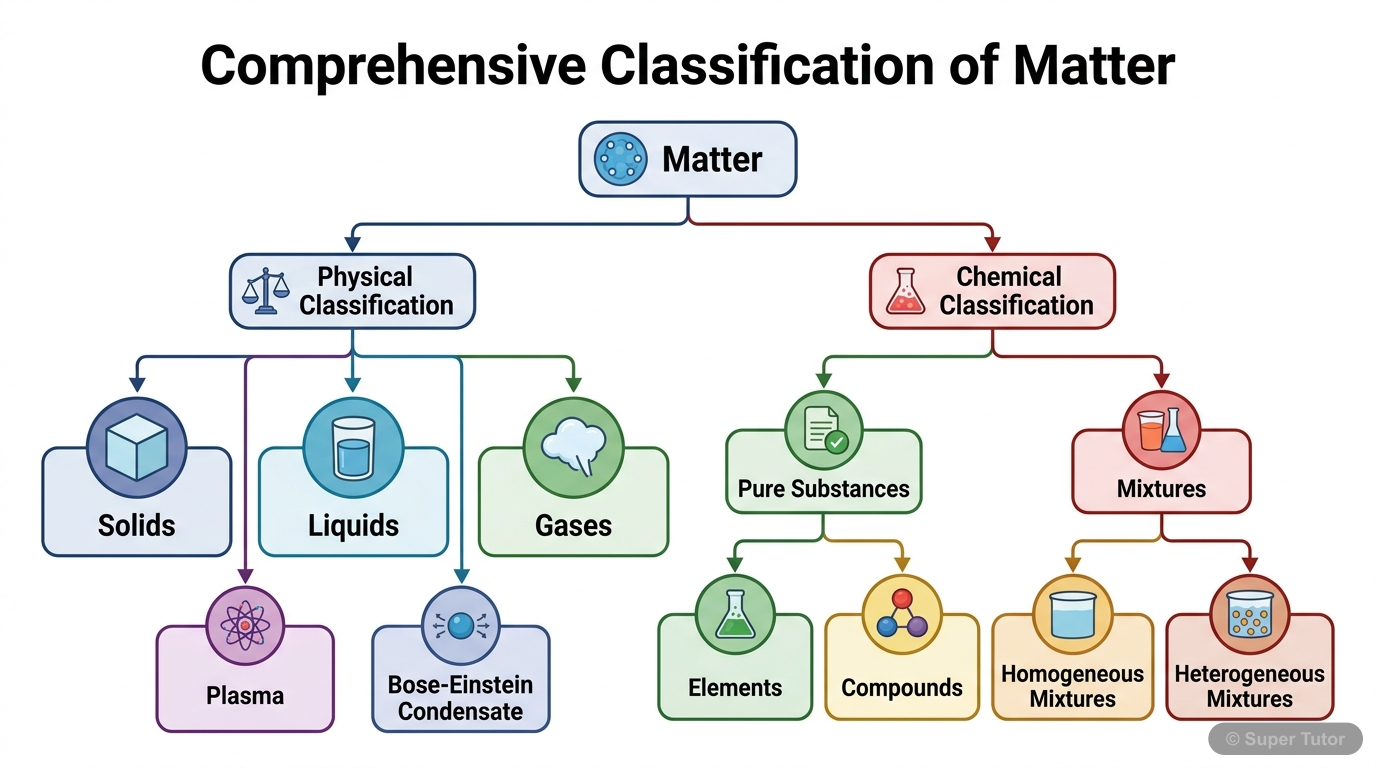
Learn better with visuals Super Tutor pairs illustrations like this with notes and quizzes for Is Matter Around us Pure?.
What is the scientific definition of a 'pure substance'?
Answer
A pure substance is matter that consists of a single type of particle where all constituent particles are identical in their chemical nature. All particles have the same chemical composition throughou…
Why is milk considered a mixture even though it appears uniform to the naked eye?
Answer
Milk appears uniform but is actually a mixture because it contains multiple substances (water, fat, proteins, lactose, minerals) that are not chemically bonded in fixed proportions. While it looks lik…
A solution of copper sulphate in water is made by dissolving 50g of copper sulphate in 500g of water. Is this solution homogeneous or heterogeneous? Why?
Answer
This solution is HOMOGENEOUS because copper sulphate completely dissolves in water, forming a uniform mixture at the molecular level. The copper sulphate particles (solute) are evenly distributed thro…
Calculate the mass by mass percentage of a solution that contains 30g of salt dissolved in 120g of water.
Answer
Step 1: Mass of solute (salt) = 30g Step 2: Mass of solvent (water) = 120g Step 3: Mass of solution = Mass of solute + Mass of solvent = 30g + 120g = 150g Step 4: Mass by mass percentage = (Mass of so…
What is a saturated solution?
Answer
A saturated solution is a solution that has dissolved the maximum amount of solute at a given temperature. At this point, no more solute can dissolve in the solvent. For example, if you add salt to wa…
Why do particles in a suspension settle down when left undisturbed, but particles in a solution do not?
Answer
Suspension particles are LARGE (visible to naked eye, typically 100 nm to 1 micrometer) and do not truly dissolve - they remain as solid particles suspended in the liquid. Gravity pulls these particle…
What is the Tyndall effect and what does it tell us about a mixture?
Answer
The Tyndall effect is the scattering of light by colloidal particles when a beam of light passes through the mixture. It appears as a visible path of light (like a spotlight beam in a movie). The Tynd…
Classify the following as homogeneous or heterogeneous mixture: (a) Vinegar (b) Sand and water (c) Air (d) Milk
Answer
(a) Vinegar = HOMOGENEOUS (it's a solution of acetic acid in water with uniform composition) (b) Sand and water = HETEROGENEOUS (you can see sand particles separately from water; non-uniform) (c) Air …
+17 more flashcards
Practise AllFrequently Asked Questions
What are the important topics in Is Matter Around us Pure? for Punjab Board Class 9 Science?
How many flashcards are available for Is Matter Around us Pure??
How should I revise Is Matter Around us Pure? for Class 9 exams?
Sources & Official References
Content is aligned to the official syllabus. Refer to the board website for the latest curriculum.
More resources for Is Matter Around us Pure?
For serious students
Get the full Is Matter Around us Pure? chapter — start free.
Quizzes, flashcards, an AI doubt solver and a study plan for Punjab Board Class 9 Science. Free to start, no card needed.