Is Matter Around us Pure? — Important Questions
Punjab Board · Class 9 · Science
44 important questions from Is Matter Around us Pure? for Punjab Board Class 9 Science, with answers. Includes multiple choice questions.
Interactive on Super Tutor
Studying Is Matter Around us Pure?? Get the full interactive chapter.
Quizzes, flashcards, AI doubt-solver and a step-by-step study plan — built for important questions and more.
Free trial, no card needed.
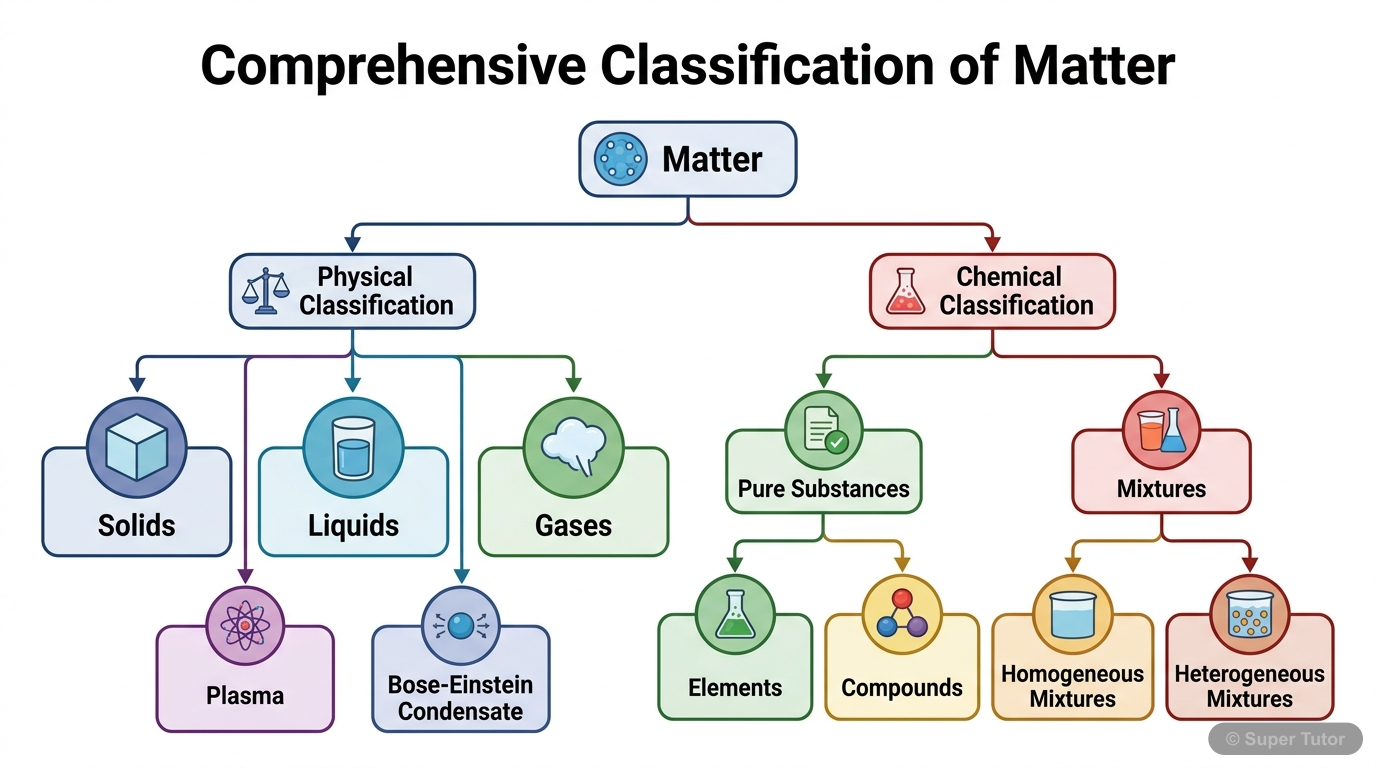
Learn better with visuals Super Tutor pairs illustrations like this with notes and quizzes for Is Matter Around us Pure?.
Important Questions from Is Matter Around us Pure?
A beam of light is passed through three different samples: (i) copper sulphate solution, (ii) milk diluted in water, and (iii) chalk powder in water left undisturbed for 10 minutes. Which observation is CORRECT?
Show answer
Only (ii) shows Tyndall effect; (i) shows no scattering; (iii) shows scattering only when freshly prepared.
Step 1: Tyndall effect occurs only when particle size is in the colloidal range (1 nm to 1000 nm). Step 2: Copper sulphate solution (i) is a true solution — particles are less than 1 nm. They are too small to scatter light, so NO Tyndall effect. Step 3: Milk diluted in water (ii) is a colloid — fat droplets are in the colloidal size range. They scatter light, showing the Tyndall effect clearly. Step 4: Chalk powder in water (iii) is a suspension. When freshly prepared, large chalk particles scatter light. But after 10 minutes, the chalk settles down, the mixture becomes clearer, and scattering
Brass is an alloy of approximately 70% copper and 30% zinc. Why is brass considered a mixture and not a compound?
Show answer
Because its composition can be varied and it shows properties of its constituent metals.
Step 1: A compound has a fixed composition and completely new properties different from its constituents. Step 2: A mixture has variable composition and retains properties of its constituents. Step 3: Brass can be made with different percentages of copper and zinc (e.g., 60:40 or 70:30) — its composition is NOT fixed, so it is a mixture. Step 4: Brass also shows metallic properties like lustre and conductivity, which are properties of its constituent metals copper and zinc. Step 5: Even though alloys cannot be separated by simple physical methods, they are still mixtures because of variable co
A solution of sodium chloride in water is prepared at 293 K. If 36 g of NaCl is dissolved in 100 g of water to make a saturated solution, what is the mass by mass percentage concentration?
Show answer
26.47%
Step 1: Mass of solute (NaCl) = 36 g. Step 2: Mass of solvent (water) = 100 g. Step 3: Mass of solution = 36 + 100 = 136 g. Step 4: Mass by mass % = (Mass of solute / Mass of solution) × 100 = (36/136) × 100. Step 5: = 0.2647 × 100 = 26.47%. Option B (36%) is wrong because that would mean dividing 36 by 100 (treating solvent mass as solution mass). Option C (26%) is close but not precise — the exact answer requires proper calculation to get 26.47%. Option D (18%) has no mathematical basis for this calculation.
Which of the following statements about a SATURATED solution is INCORRECT?
Show answer
Different substances have the same solubility in a given solvent at the same temperature.
Step 1: A saturated solution is one in which no more solute can dissolve at a given temperature. Step 2: The question asks for the INCORRECT statement — so we look for the false one. Step 3: Option C states that different substances have the SAME solubility in a given solvent — this is INCORRECT. From Activity 2.3 in the chapter, we observe that salt and sugar or barium chloride dissolve in different amounts in the same volume of water, proving that different substances have DIFFERENT solubilities. Step 4: Option A is correct — adding more solvent (not changing temperature) allows more solute
+40 more questions on Is Matter Around us Pure? (Punjab Board Class 9 Science)
Practise AllFrequently Asked Questions
What are the important topics in Is Matter Around us Pure? for Punjab Board Class 9 Science?
How many important questions are there in Is Matter Around us Pure??
Sources & Official References
Content is aligned to the official syllabus. Refer to the board website for the latest curriculum.
More resources for Is Matter Around us Pure?
For serious students
Get the full Is Matter Around us Pure? chapter — start free.
Quizzes, flashcards, an AI doubt solver and a study plan for Punjab Board Class 9 Science. Free to start, no card needed.