Chapter 2 of 5
Concept Maps
Is Matter Around us Pure? — Concept Maps
Punjab Board · Class 9 · Science
3 concept maps of Is Matter Around us Pure? for Punjab Board Class 9 Science, each also written out as a text outline.
44 questions25 flashcards5 concepts
Interactive on Super Tutor
Studying Is Matter Around us Pure?? Get the full interactive chapter.
Quizzes, flashcards, AI doubt-solver and a step-by-step study plan — built for concept maps and more.
Free trial, no card needed.
Super Tutor
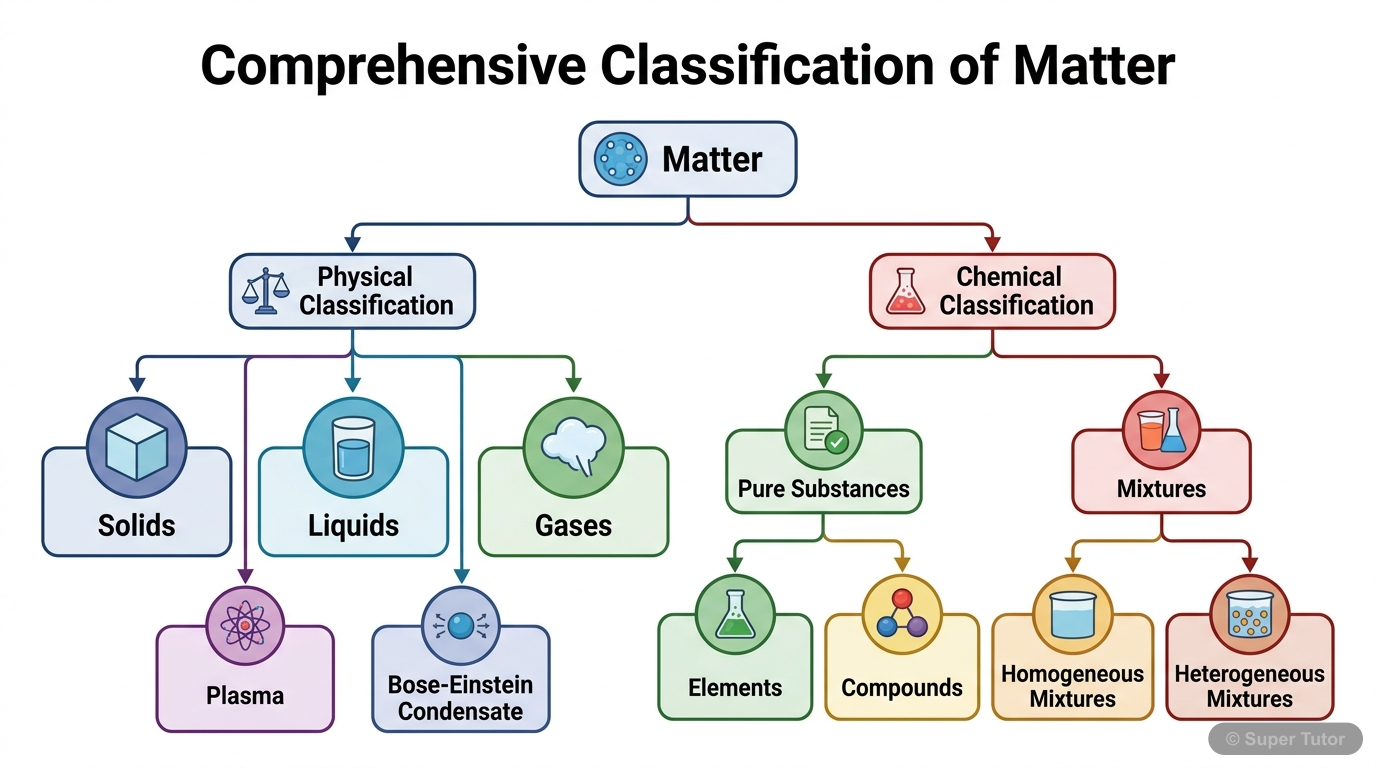
Learn better with visuals Super Tutor pairs illustrations like this with notes and quizzes for Is Matter Around us Pure?.
3 Concept Maps
Classification of Matter — Complete Overview
The map in words
- Matter
- Pure Substances
- Elements
- Metals
- Gold
- Silver
- Iron
- Non-Metals
- Oxygen
- Sulphur
- Carbon
- Metalloids
- Silicon
- Boron
- Germanium
- Metals
- Compounds
- Fixed Composition
- New Properties
- Examples
- Water H2O
- Salt NaCl
- CO2
- Elements
- Mixtures
- Homogeneous
- Solutions
- Solid in Liquid
- Gas in Liquid
- Solid Solutions Alloys
- Solutions
- Heterogeneous
- Suspensions
- Large Particles
- Settles Down
- Colloids
- Intermediate Size
- Tyndall Effect
- Suspensions
- Homogeneous
- Pure Substances
Is Matter Around Us Pure? — Complete Chapter Mind Map
The map in words
- Matter Around Us
- Pure Substance
- Element
- Metals
- Lustrous Conductor Malleable
- Example Gold Iron Copper
- Non-Metals
- Poor Conductor Not Lustrous
- Example Carbon Oxygen Sulphur
- Metalloids
- Intermediate Properties
- Boron Silicon Germanium
- Metals
- Compound
- Two or More Elements
- Fixed Composition
- Chemical Combination
- New Properties Formed
- Example Water NaCl CO2
- Element
- Mixture
- Homogeneous
- Solution
- Particle Less than 1nm
- No Tyndall Effect
- Stable No Settling
- Cannot be Filtered
- Example Salt Water Air Alloys
- Solution
- Heterogeneous
- Colloid
- Particle 1 to 1000 nm
- Tyndall Effect Present
- Stable No Settling
- Centrifugation Needed
- Example Milk Fog Smoke
- Suspension
- Particle Greater than 1000nm
- Tyndall Effect Present
- Unstable Settles Down
- Can be Filtered
- Example Muddy Water Chalk Water
- Colloid
- Homogeneous
- Changes
- Physical Change
- No New Substance
- Reversible
- Example Melting Boiling
- Chemical Change
- New Substance Formed
- Irreversible
- Example Burning Rusting
- Physical Change
- Pure Substance
Classification of Matter
The map in words
- Matter
- Pure Substances
- Elements
- Metals
- Non-metals
- Metalloids
- Compounds
- Formed by chemical bonding
- Fixed composition
- Elements
- Mixtures
- Homogeneous
- Solutions
- Solid in liquid
- Liquid in liquid
- Gas in liquid
- Gas in gas
- Solutions
- Heterogeneous
- Suspensions
- Visible particles
- Settled by standing
- Colloids
- Tyndall effect
- Intermediate size
- Suspensions
- Homogeneous
- Pure Substances
Explore these maps interactively
Explore DiagramsFrequently Asked Questions
What are the important topics in Is Matter Around us Pure? for Punjab Board Class 9 Science?
Key topics in Is Matter Around us Pure? include Pure Substances vs Mixtures — The Basics, Types of Mixtures — Homogeneous and Heterogeneous, Solutions — Properties and Concentration, Suspension — Properties and Examples. Study these first, then practise questions on each for Class 9 exams.
What do the concept maps for Is Matter Around us Pure? show?
The 3 maps show how the ideas in Is Matter Around us Pure? connect: Classification of Matter — Complete Overview; Is Matter Around Us Pure? — Complete Chapter Mind Map. Each map is also written out as an outline on this page.
How should I revise Is Matter Around us Pure? for Class 9 exams?
Learn the core ideas first, then work through the 44 practice questions on Is Matter Around us Pure?. Revise definitions regularly and use flashcards for quick recall before the exam.
Sources & Official References
Content is aligned to the official syllabus. Refer to the board website for the latest curriculum.
More resources for Is Matter Around us Pure?
For serious students
Get the full Is Matter Around us Pure? chapter — start free.
Quizzes, flashcards, an AI doubt solver and a study plan for Punjab Board Class 9 Science. Free to start, no card needed.