Chapter 2 of 5
Revision Notes
Is Matter Around us Pure? — Revision Notes
Punjab Board · Class 9 · Science
Is Matter Around us Pure? revision notes for Punjab Board Class 9 Science: 4 topics in quick points. Part of the Punjab Board Class 9 Science syllabus.
44 questions25 flashcards5 concepts
Interactive on Super Tutor
Studying Is Matter Around us Pure?? Get the full interactive chapter.
Quizzes, flashcards, AI doubt-solver and a step-by-step study plan — built for revision notes and more.
Free trial, no card needed.
Super Tutor
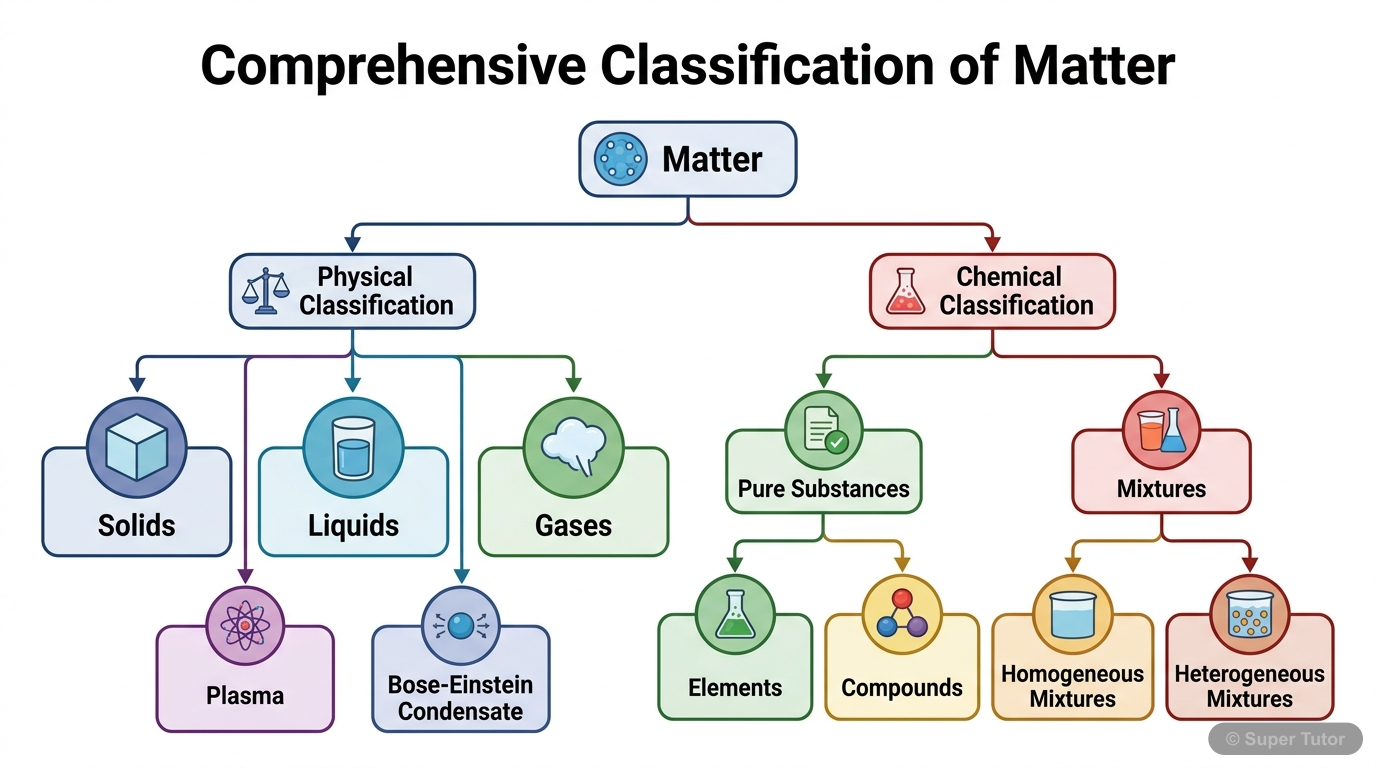
Learn better with visuals Super Tutor pairs illustrations like this with notes and quizzes for Is Matter Around us Pure?.
Key Topics to Revise
1
1. Pure Substances vs Mixtures — The Basics
- A PURE SUBSTANCE contains only one kind of particle and has a definite, fixed composition throughout. Examples: distilled water, pure gold, common salt (NaCl), oxygen gas.
- A MIXTURE contains two or more pure substances mixed together in any proportion. Examples: sea water, soil, air, lemonade, milk.
- The components of a mixture retain their individual properties.
2
2. Types of Mixtures — Homogeneous and Heterogeneous
- HOMOGENEOUS MIXTURES have a uniform composition throughout — you cannot see the individual components. Example: salt solution, sugar solution, air, alloys.
- HETEROGENEOUS MIXTURES have a non-uniform composition — you can often see the distinct parts. Example: sand and salt mixture, oil and water, soil.
- In a homogeneous mixture, the components are uniformly distributed at the particle level.
3
3. Solutions — Properties and Concentration
- A SOLUTION is a homogeneous mixture of two or more substances.
- SOLVENT is the component present in larger quantity that dissolves the other substance. Example: water in salt water.
- SOLUTE is the component present in smaller quantity that gets dissolved. Example: salt in salt water.
4
4. Suspension — Properties and Examples
- A SUSPENSION is a heterogeneous mixture in which the solute particles do NOT dissolve but remain suspended in the medium.
- Particle size in a suspension is LARGER than 1000 nm (greater than 1 micrometer) — particles are VISIBLE to the naked eye.
- Suspension particles SCATTER light — the path of light beam IS visible (shows Tyndall effect).
Get complete notes with diagrams and examples
Full NotesKey Concepts
A pure substance contains only oneHomogeneous mixtures have uniform compositionSuspensions are heterogeneous mixtures where solidColloids are intermediate between solutionsThe Tyndall effect is the scattering
Frequently Asked Questions
What are the important topics in Is Matter Around us Pure? for Punjab Board Class 9 Science?
Key topics in Is Matter Around us Pure? include Pure Substances vs Mixtures — The Basics, Types of Mixtures — Homogeneous and Heterogeneous, Solutions — Properties and Concentration, Suspension — Properties and Examples. Study these first, then practise questions on each for Class 9 exams.
How should I revise Is Matter Around us Pure? for Class 9 exams?
Learn the core ideas first, then work through the 44 practice questions on Is Matter Around us Pure?. Revise definitions regularly and use flashcards for quick recall before the exam.
Sources & Official References
Content is aligned to the official syllabus. Refer to the board website for the latest curriculum.
More resources for Is Matter Around us Pure?
For serious students
Get the full Is Matter Around us Pure? chapter — start free.
Quizzes, flashcards, an AI doubt solver and a study plan for Punjab Board Class 9 Science. Free to start, no card needed.