The Fundamental Unit of Life — Syllabus
Punjab Board · Class 9 · Science
What The Fundamental Unit of Life covers in Punjab Board Class 9 Science: 4 topics, for the 2026-27 session. Topics include Discovery of the Cell and Cell.
Interactive on Super Tutor
Studying The Fundamental Unit of Life? Get the full interactive chapter.
Quizzes, flashcards, AI doubt-solver and a step-by-step study plan — built for syllabus and more.
Free trial, no card needed.
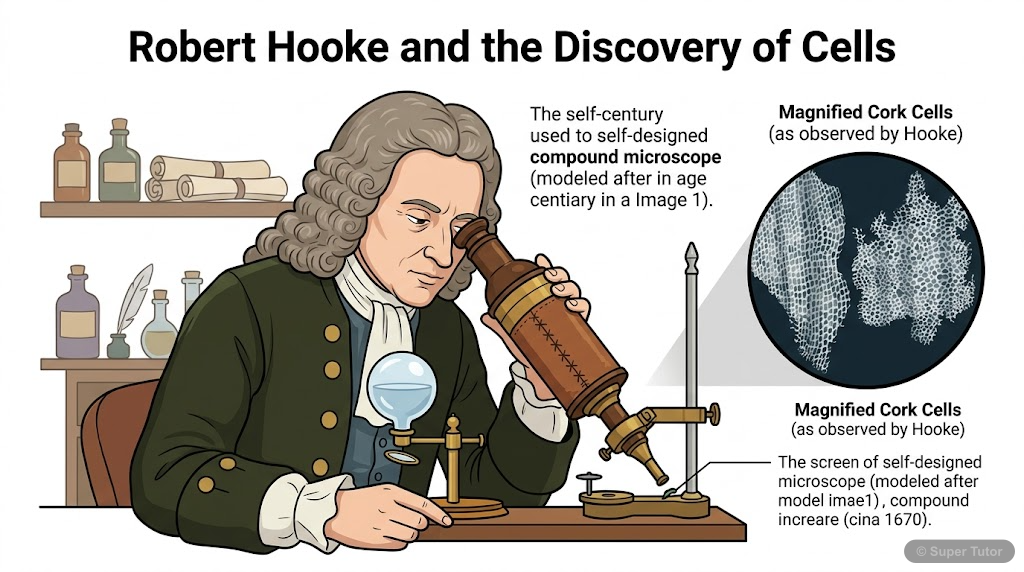
Learn better with visuals Super Tutor pairs illustrations like this with notes and quizzes for The Fundamental Unit of Life.
Topics in The Fundamental Unit of Life
Discovery of the Cell and Cell Theory
- Robert Hooke (1665) first observed cells in a thin slice of cork using a self-designed microscope. He called the tiny compartments 'cells' (Latin for 'a little room').
- Leeuwenhoek (1674) discovered free-living cells (microorganisms) in pond water using an improved microscope.
- Robert Brown (1831) discovered the nucleus inside the cell.
Plasma Membrane (Cell Membrane)
- The plasma membrane is the outermost covering of the cell (in animal cells) that separates the cell contents from its external environment.
- It is called a selectively permeable membrane because it allows only certain substances to pass in and out.
- It is made of organic molecules — lipids and proteins.
Cell Wall
- Cell wall is present only in plant cells, fungi, and bacteria — NOT in animal cells.
- In plants, the cell wall is mainly composed of cellulose, which provides structural strength.
- The cell wall lies outside the plasma membrane.
Nucleus
- The nucleus is a double-layered structure covered by the nuclear membrane (also called nuclear envelope).
- The nuclear membrane has pores (nuclear pores) that allow transfer of material between the nucleus and the cytoplasm.
- The nucleus contains chromosomes — rod-shaped structures visible only when the cell is about to divide.
Key Concepts
Work through every topic in The Fundamental Unit of Life with notes and quizzes
Start This ChapterFrequently Asked Questions
What are the important topics in The Fundamental Unit of Life for Punjab Board Class 9 Science?
How should I revise The Fundamental Unit of Life for Class 9 exams?
Sources & Official References
Content is aligned to the official syllabus. Refer to the board website for the latest curriculum.
More resources for The Fundamental Unit of Life
For serious students
Get the full The Fundamental Unit of Life chapter — start free.
Quizzes, flashcards, an AI doubt solver and a study plan for Punjab Board Class 9 Science. Free to start, no card needed.