Laws of Motion — Chapter Summary
Tamil Nadu Board · Class 10 · Science
Summary of Laws of Motion for Tamil Nadu Board Class 10 Science. Part of the Tamil Nadu Board Class 10 Science syllabus.
Interactive on Super Tutor
Studying Laws of Motion? Get the full interactive chapter.
Quizzes, flashcards, AI doubt-solver and a step-by-step study plan — built for chapter summary and more.
Free trial, no card needed.
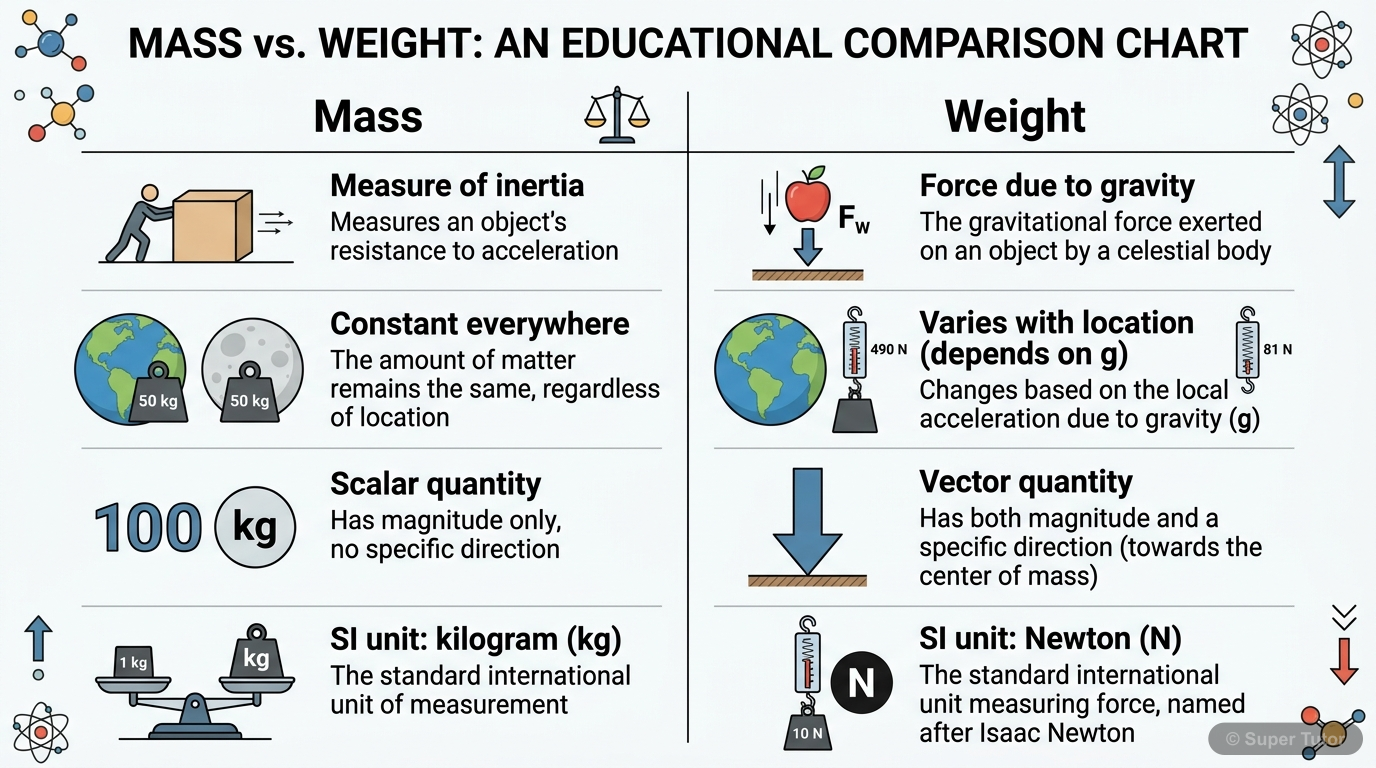
Learn better with visuals Super Tutor pairs illustrations like this with notes and quizzes for Laws of Motion.
Overview
The Laws of Motion form the foundation of classical mechanics, explaining how objects move and interact with forces. These principles, developed by Sir Isaac Newton, help us understand everything from falling objects to planetary motion. This chapter explores force, motion, inertia, momentum, and gr
Key Concepts
Force is an external effort
Force is an external effort in the form of push or pull that produces or tries to produce motion in a static body, stops or tries to stop a moving bod
Inertia is the inherent property
Inertia is the inherent property of a body to resist any change in its state of rest or uniform motion. It depends on the mass of the object—greater m
Linear momentum (p) is the product
Linear momentum (p) is the product of mass and velocity of a moving body: p = mv. It measures the impact of force on a body and is a vector quantity a
This law states that every body
This law states that every body continues to be in its state of rest or uniform motion along a straight line unless acted upon by an external unbalanc
This law states that force acting
This law states that force acting on a body is directly proportional to the rate of change of linear momentum, and this change occurs in the direction
Learning Objectives
- Understand the concepts of force and motion and distinguish between different types of motion
- Explain inertia and identify its three types with practical examples
- State and apply Newton's three laws of motion to various situations
- Define and calculate linear momentum, impulse, and their relationships
- Distinguish between mass and weight and understand their differences
Frequently Asked Questions
What are the important topics in Laws of Motion for Tamil Nadu Board Class 10 Science?
How should I revise Laws of Motion for the Tamil Nadu Board Class 10 board exam?
Sources & Official References
Content is aligned to the official syllabus. Refer to the board website for the latest curriculum.
More resources for Laws of Motion
For serious students
Get the full Laws of Motion chapter — start free.
Quizzes, flashcards, an AI doubt solver and a study plan for Tamil Nadu Board Class 10 Science. Free to start, no card needed.