Laws of Motion — Flashcards
Tamil Nadu Board · Class 10 · Science
28 flashcards for Laws of Motion (Tamil Nadu Board Class 10 Science) to test yourself on key terms and facts. Sample: "What is force? Define it.
Interactive on Super Tutor
Studying Laws of Motion? Get the full interactive chapter.
Quizzes, flashcards, AI doubt-solver and a step-by-step study plan — built for flashcards and more.
Free trial, no card needed.
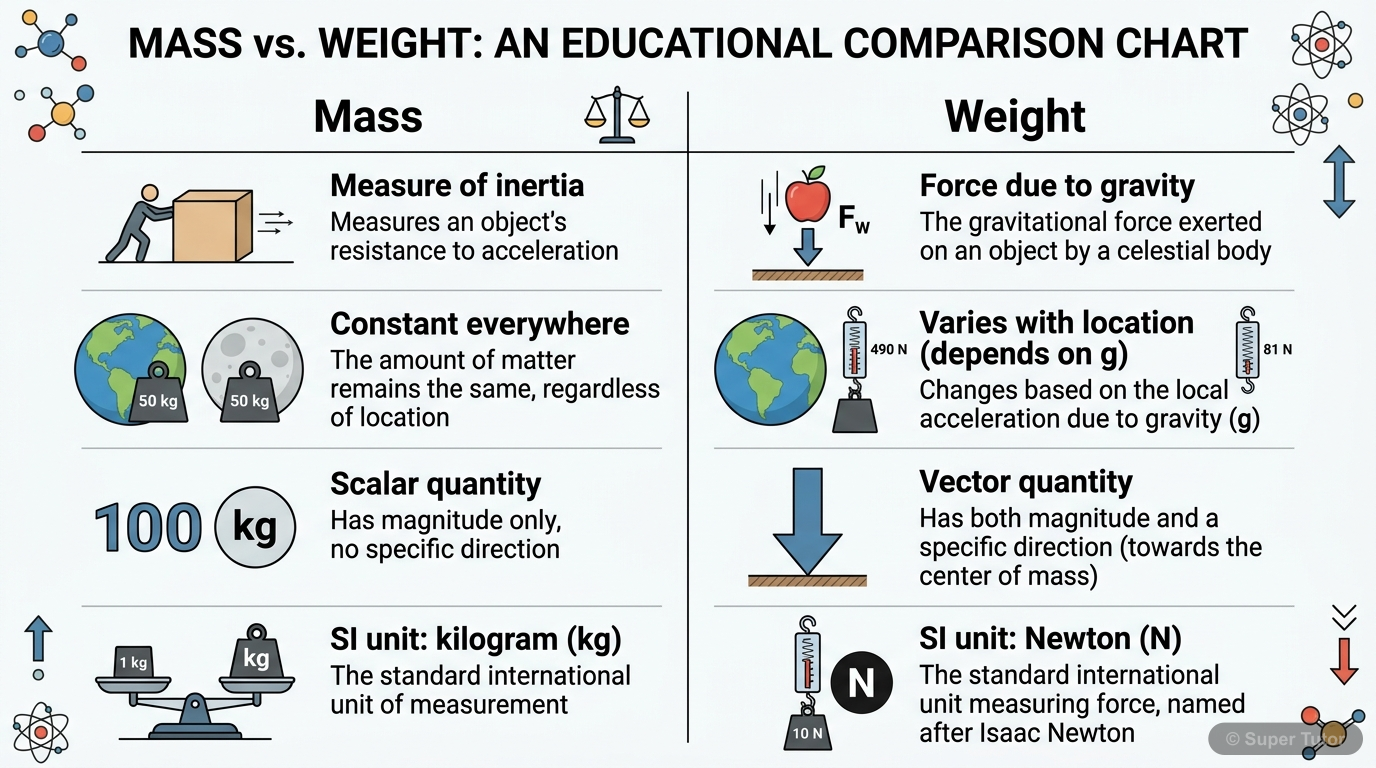
Learn better with visuals Super Tutor pairs illustrations like this with notes and quizzes for Laws of Motion.
What is force? Define it in scientific terms.
Answer
Force is an external effort in the form of a push or pull that can: (1) produce or try to produce motion of a static body, (2) stop or try to stop a moving body, or (3) change or try to change the dir…
Explain inertia with an everyday example.
Answer
Inertia is the property of a body to resist any change in its state of rest or motion. Example: When a bus suddenly stops, passengers lean forward because their body tends to continue moving forward (…
What are the three types of inertia? Give one example for each.
Answer
1. Inertia of rest: Resistance to change from rest to motion. Example: Shaking a tree makes leaves fall because leaves resist the change. 2. Inertia of motion: Resistance to change from motion to rest…
Calculate linear momentum: A body of mass 5 kg moves with velocity 8 m/s. Find its momentum.
Answer
Formula: p = m × v Given: m = 5 kg, v = 8 m/s p = 5 × 8 = 40 kg·m/s Linear momentum is 40 kg·m/s in the direction of motion. This represents the impact force of the moving body.
State Newton's First Law of Motion.
Answer
Newton's First Law states: Every body continues to be in its state of rest or uniform motion along a straight line unless acted upon by an external unbalanced force. This law defines both force and in…
State Newton's Second Law of Motion and write its mathematical form.
Answer
Newton's Second Law states: The force acting on a body is directly proportional to the rate of change of linear momentum. Mathematical form: F = ma or F = m(v-u)/t Where: F = force (N), m = mass (kg),…
Calculate force: A 10 kg object accelerates at 5 m/s². What force is applied?
Answer
Formula: F = m × a Given: m = 10 kg, a = 5 m/s² F = 10 × 5 = 50 N A force of 50 Newtons is applied to produce the acceleration. This shows the direct proportionality between force and both mass and ac…
State Newton's Third Law of Motion with an example.
Answer
Newton's Third Law states: For every action, there is an equal and opposite reaction. They always act on two different bodies. Example: When you walk, you push the ground backward (action), and the gr…
+20 more flashcards
Practise AllFrequently Asked Questions
What are the important topics in Laws of Motion for Tamil Nadu Board Class 10 Science?
How many flashcards are available for Laws of Motion?
How should I revise Laws of Motion for the Tamil Nadu Board Class 10 board exam?
Sources & Official References
Content is aligned to the official syllabus. Refer to the board website for the latest curriculum.
More resources for Laws of Motion
For serious students
Get the full Laws of Motion chapter — start free.
Quizzes, flashcards, an AI doubt solver and a study plan for Tamil Nadu Board Class 10 Science. Free to start, no card needed.