Laws of Motion — Important Questions
Tamil Nadu Board · Class 10 · Science
45 important questions from Laws of Motion for Tamil Nadu Board Class 10 Science, with answers. Includes multiple choice questions.
Interactive on Super Tutor
Studying Laws of Motion? Get the full interactive chapter.
Quizzes, flashcards, AI doubt-solver and a step-by-step study plan — built for important questions and more.
Free trial, no card needed.
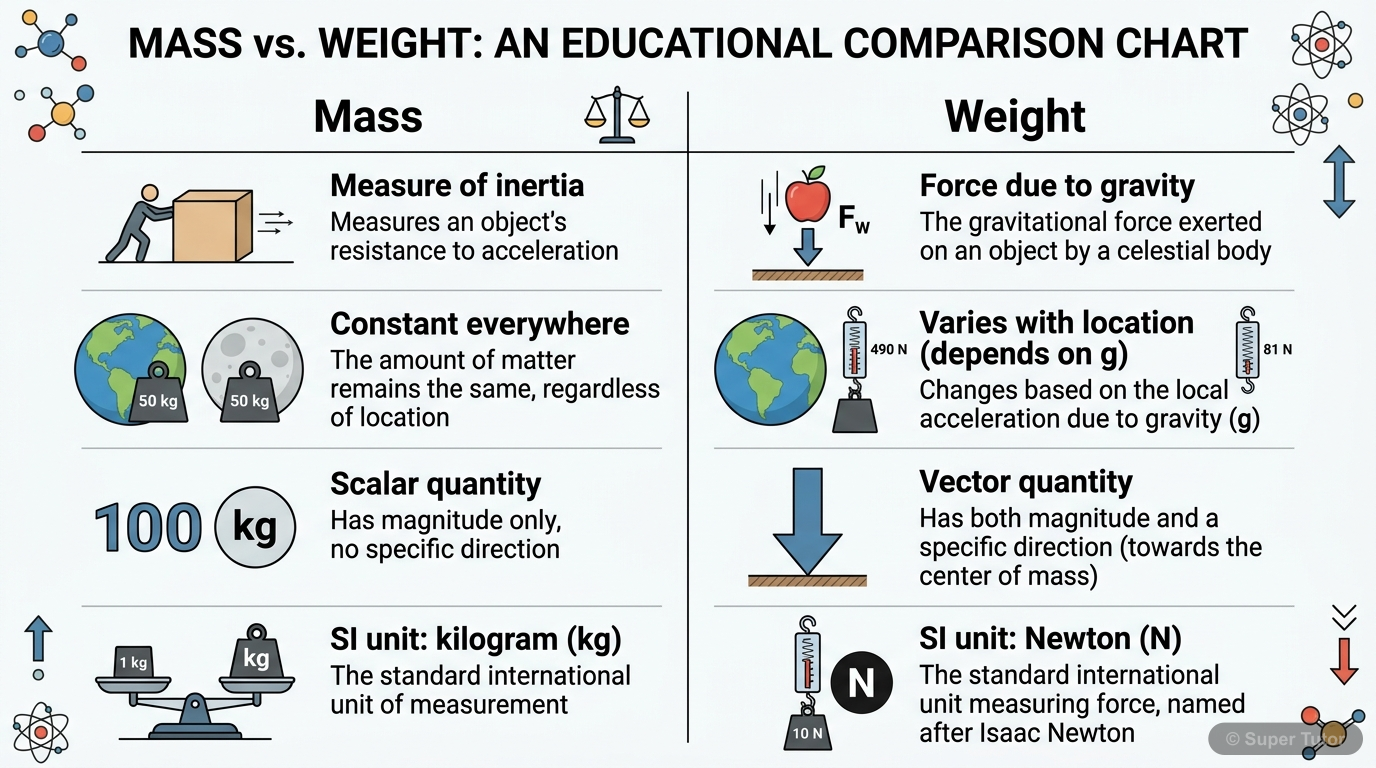
Learn better with visuals Super Tutor pairs illustrations like this with notes and quizzes for Laws of Motion.
Important Questions from Laws of Motion
A fielder in cricket pulls his hands back while catching a ball. The scientific reason behind this action is best explained by which of the following?
Show answer
It increases the time of action of force, reducing the force experienced
Step 1: The concept of impulse states J = F × t = change in momentum (Δp). Step 2: The momentum change (Δp) of the ball is fixed — it must be brought to rest from its initial velocity. Step 3: By pulling hands back, the cricketer increases the time 't' over which the force acts. Step 4: Since Δp = F × t is constant, if t increases, then F decreases. This means less force acts on the hands, reducing injury. Step 5: The impulse received (= Δp) stays the same — it is the force that decreases, not the impulse. Option C is wrong as the fielder doesn't add momentum to the ball.
A rocket of total mass 1000 kg (including 200 kg of fuel) is fired. The fuel burns and ejects gas at a rate that produces a thrust of 12000 N. What is the initial acceleration of the rocket? (g = 10 m/s²)
Show answer
2 m/s²
Step 1: Total mass of rocket = 1000 kg; Thrust (upward force) = 12000 N. Step 2: Weight of rocket (downward) = mg = 1000 × 10 = 10000 N. Step 3: Net upward force = Thrust - Weight = 12000 - 10000 = 2000 N. Step 4: Using F = ma: a = F/m = 2000/1000 = 2 m/s². Step 5: 12 m/s² ignores gravity; 10 m/s² is just g; 22 m/s² incorrectly adds instead of subtracting gravity. The key concept is that the net force drives acceleration, not just the thrust.
At what distance from the centre of the Earth will the acceleration due to gravity be 1/9th of its value on the Earth's surface? (R = radius of Earth)
Show answer
3R from the centre
Step 1: Use the relation g = GM/r² where r is the distance from the centre. Step 2: Let the required distance be r. Then g'/g = R²/r². Step 3: Given g'/g = 1/9, so R²/r² = 1/9. Step 4: Therefore r² = 9R², which gives r = 3R. This means the object must be at 3 times the Earth's radius from the centre. Step 5: R/3 would make g nine times larger (not smaller); 9R would make g 1/81 of surface value; 2R would give g = g/4. Only 3R satisfies the 1/9 condition.
Which of the following correctly explains why astronauts feel weightless in an orbiting space station?
Show answer
The space station and astronauts are both in free fall with the same acceleration around Earth
Step 1: Weightlessness occurs when apparent weight R = 0. This happens in free fall when a = g. Step 2: An orbiting space station is constantly falling towards Earth due to gravity, but its high tangential velocity keeps it in orbit — this is free fall around Earth. Step 3: Since both the space station and astronauts fall with the same acceleration (a = g), the normal reaction force R = m(g - g) = 0. Step 4: Gravity does act at the space station's altitude — it's what keeps it in orbit! So option A is completely wrong. Step 5: Speed doesn't cancel gravity; mass is unaffected by air pressure —
+41 more questions on Laws of Motion (Tamil Nadu Board Class 10 Science)
Practise AllFrequently Asked Questions
What are the important topics in Laws of Motion for Tamil Nadu Board Class 10 Science?
How many important questions are there in Laws of Motion?
Sources & Official References
Content is aligned to the official syllabus. Refer to the board website for the latest curriculum.
More resources for Laws of Motion
For serious students
Get the full Laws of Motion chapter — start free.
Quizzes, flashcards, an AI doubt solver and a study plan for Tamil Nadu Board Class 10 Science. Free to start, no card needed.