Electricity — Important Questions
Tamil Nadu Board · Class 10 · Science
45 important questions from Electricity for Tamil Nadu Board Class 10 Science, with answers. Includes multiple choice questions.
Interactive on Super Tutor
Studying Electricity? Get the full interactive chapter.
Quizzes, flashcards, AI doubt-solver and a step-by-step study plan — built for important questions and more.
Free trial, no card needed.
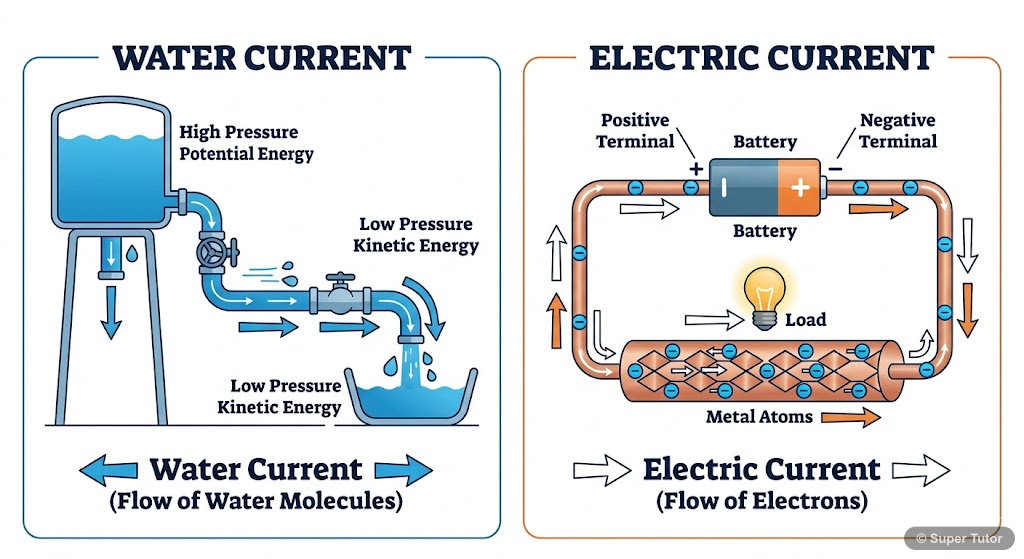
One of 13 illustrations for Electricity in Super Tutor — alongside flashcards, concept maps and practice questions.
Important Questions from Electricity
When resistors are connected in series, which of the following statements is TRUE?
Show answer
The same current flows through each resistor
Step 1: In a series circuit, there is only one path for current to flow. Step 2: Since all components are in a single loop, the same current passes through each resistor. Step 3: The total voltage is divided across the resistors (not the same across each). Step 4: The equivalent resistance is greater than the highest individual resistance. In a series circuit, if one component fails, the entire circuit breaks — unlike parallel circuits.
Three resistors of 6 Ω, 6 Ω, and 6 Ω are connected in series. What is their equivalent resistance?
Show answer
18 Ω
Step 1: For resistors in series, the equivalent resistance is Rs = R1 + R2 + R3. Step 2: Substitute the values: Rs = 6 + 6 + 6. Step 3: Rs = 18 Ω. Option 2 Ω is the answer if they were in parallel (R/n = 6/3 = 2). Option 6 Ω is just one resistor's value. Option 36 Ω results from multiplying (6 × 6 = 36, which is wrong).
In a parallel circuit, what remains the SAME across all the resistors connected in parallel?
Show answer
Potential difference across each resistor
Step 1: In a parallel circuit, all resistors are connected between the same two points (A and B). Step 2: Since they share the same two end points, the voltage (potential difference) across each resistor is equal. Step 3: However, the current through each resistor is different (I = V/R), with smaller resistors carrying more current. This is why all appliances in a house get 220 V — they are all connected in parallel.
The phenomenon where heat is produced when electric current flows through a conductor is called:
Show answer
Heating effect of current
Step 1: When current flows through a conductor, the moving electrons collide with atoms of the conductor. Step 2: These collisions transfer energy to the atoms, causing them to vibrate faster, which produces heat. Step 3: This is called the heating effect of current and is described by Joule's Law (H = I²Rt). This effect is used in electric irons, heaters, and toasters. The other options — magnetic effect, chemical effect, and photoelectric effect — are different phenomena.
+41 more questions on Electricity (Tamil Nadu Board Class 10 Science)
Practise AllFrequently Asked Questions
What are the important topics in Electricity for Tamil Nadu Board Class 10 Science?
How many important questions are there in Electricity?
Sources & Official References
Content is aligned to the official syllabus. Refer to the board website for the latest curriculum.
More resources for Electricity
For serious students
Get the full Electricity chapter — start free.
Quizzes, flashcards, an AI doubt solver and a study plan for Tamil Nadu Board Class 10 Science. Free to start, no card needed.